Table of Contents
- What Is CBD Oil and Why Dosage Matters for Beginners
- Factors That Influence Your CBD Oil Dosage for Beginners
- How to Calculate CBD Dosage: A Step-by-Step Method
- The CBD Oil Titration Method: Starting Low and Going Slow
- Starting Dose of CBD for Anxiety and Other Common Symptoms
- Safety, Side Effects, and Drug Interactions to Know First
- How Long Does CBD Stay in Your System?
- Conclusion
Last Updated: June 5, 2026
Getting cbd oil dosage for beginners right is the single factor that separates a positive first experience from one that puts people off entirely. CBD Health Collection has helped thousands of first-time users navigate this challenge, and the most common mistake is always the same: starting too high, too fast. Cannabidiol affects everyone differently based on body chemistry, metabolism, and the condition being addressed. Below, we’ll show you exactly how to find your personal baseline, avoid the most common pitfalls, and build a dosing routine that actually works.
Here’s what most guides get wrong: they hand you a number and call it a day. CBD dosage is not a fixed target, it’s a moving variable that depends on your product’s potency, delivery method, body weight, and goal. The five frameworks we cover here give you a repeatable process, not just a starting point.
What Is CBD Oil and Why Dosage Matters for Beginners
CBD oil is a hemp-derived product containing cannabidiol, a non-psychoactive cannabinoid that interacts with the body’s endocannabinoid system to support homeostasis. Unlike THC, it does not produce intoxication, and hemp-derived products with THC below 0.3% are federally legal under the Farm Bill 2018.
Dosage matters more for beginners because the endocannabinoid system responds differently when it first encounters cannabinoids. Too much too soon causes drowsiness, nausea, or lightheadedness. Too little produces no effect, leading many first-timers to quit before finding their therapeutic window.
According to FDA’s guidance on cannabidiol products, no universal dosage standard exists outside the prescription drug Epidiolex, which is exactly why a structured personal approach matters.
Full-Spectrum, Broad-Spectrum, and Isolate: Which Affects Your Dose?
The type of CBD product you choose directly affects how much you need.
Full-spectrum CBD contains cannabidiol plus all other cannabinoids, terpenes, and trace THC (under 0.3%). The entourage effect means full-spectrum products typically require a lower milligram dose than isolate.
Broad-spectrum CBD contains multiple cannabinoids and terpenes with THC removed. It’s the format CBD Health Collection uses in its gummies and soft gels, offering entourage benefits without THC exposure.
CBD isolate is pure cannabidiol with no other plant compounds, the most predictable format, but it typically requires a higher mg dose to match full-spectrum or broad-spectrum results.
The practical implication: don’t assume 25mg of isolate equals 25mg of full-spectrum. It doesn’t. Switching product types will likely require dose adjustment.
Factors That Influence Your CBD Oil Dosage for Beginners
No two people respond to CBD the same way. Understanding the variables that shape your response is the foundation of smart dosing.
Body Weight, Metabolism, and Potency
Body weight is a commonly cited starting point. A rough framework used by many practitioners is 1-6mg of CBD per 10 pounds of body weight, with beginners starting at the low end. Larger body mass generally requires a higher dose.
Metabolism plays an equally important role. Faster metabolizers process cannabinoids more quickly, shortening the duration of effect and potentially requiring more frequent dosing rather than a higher single dose.
Potency, the concentration of cannabidiol in your product, determines actual milligrams per serving. A 30ml tincture containing 1500mg of CBD delivers 50mg per ml; a 300mg tincture delivers only 10mg per ml. Checking the certificate of analysis (COA) from third-party lab testing is the only reliable way to confirm potency, which is why CBD Health Collection publishes independently verified COA results for every product.
Delivery Systems and Bioavailability
Bioavailability is the percentage of a substance that actually reaches your bloodstream, and delivery method makes a dramatic difference.
| Delivery Method | Onset Time | Bioavailability | Best For |
|---|---|---|---|
| Sublingual tincture | 15-45 minutes | 20-35% | Precise dosing, faster onset |
| Oral capsules/gummies | 45-90 minutes | 6-20% | Convenience, consistent dosing |
| Topical application | 30-60 minutes (local) | Minimal systemic | Localized pain, inflammation |
| Water-based CBD | 15-30 minutes | Higher than oil-based | Optimized absorption |
Sublingual administration, placing oil under the tongue for 60-90 seconds before swallowing, bypasses first-pass liver metabolism and delivers cannabinoids directly into the bloodstream. This is why tinctures are the recommended starting format for beginners: faster feedback means faster dose adjustment.
Water-based CBD formulations achieve higher bioavailability than standard oil-based tinctures because the cannabidiol is already in a water-soluble form the body absorbs more readily. If you’re not getting results from oil-based products, try this before increasing your dose.
How to Calculate CBD Dosage: A Step-by-Step Method
Calculating your starting CBD dose is straightforward when broken into concrete steps. The goal is to establish a personal baseline before making any adjustments.
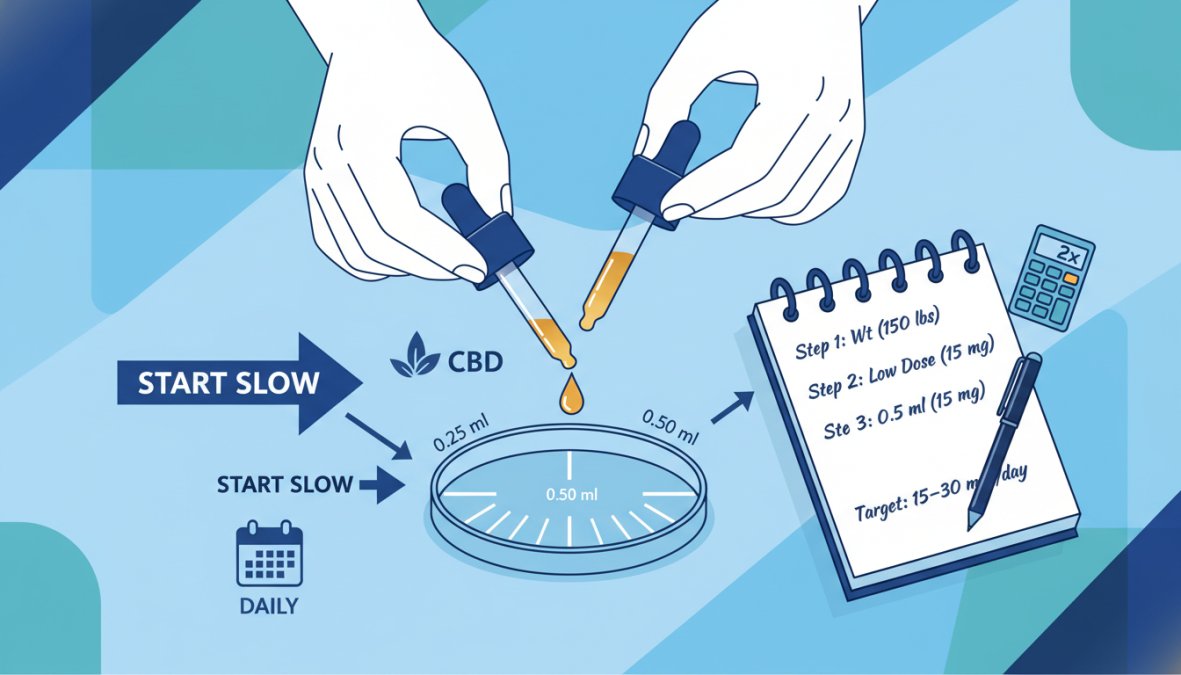
Step 1: Determine your body weight in pounds.
Multiply your weight by 0.1 to get a conservative starting dose in milligrams. A 150-pound person starts at 15mg.
Step 2: Identify your product’s concentration.
Divide total mg of CBD by total volume in ml to get mg per ml.
Step 3: Calculate your serving size in ml.
Divide your target dose by the mg-per-ml concentration. If you need 15mg and your tincture contains 30mg/ml, you need 0.5ml.
Step 4: Choose your delivery method.
Adjust upward for oral capsules or gummies to account for lower bioavailability. A 15mg sublingual dose may require 25-30mg orally for a comparable effect.
Step 5: Set a consistent time and document your response.
Same time of day, same conditions. This controls variables and makes your dosage journal useful.
The calculation is only useful if you stick to it long enough to generate real data. One dose tells you almost nothing. Seven consistent days tells you a great deal.
The CBD Oil Titration Method: Starting Low and Going Slow
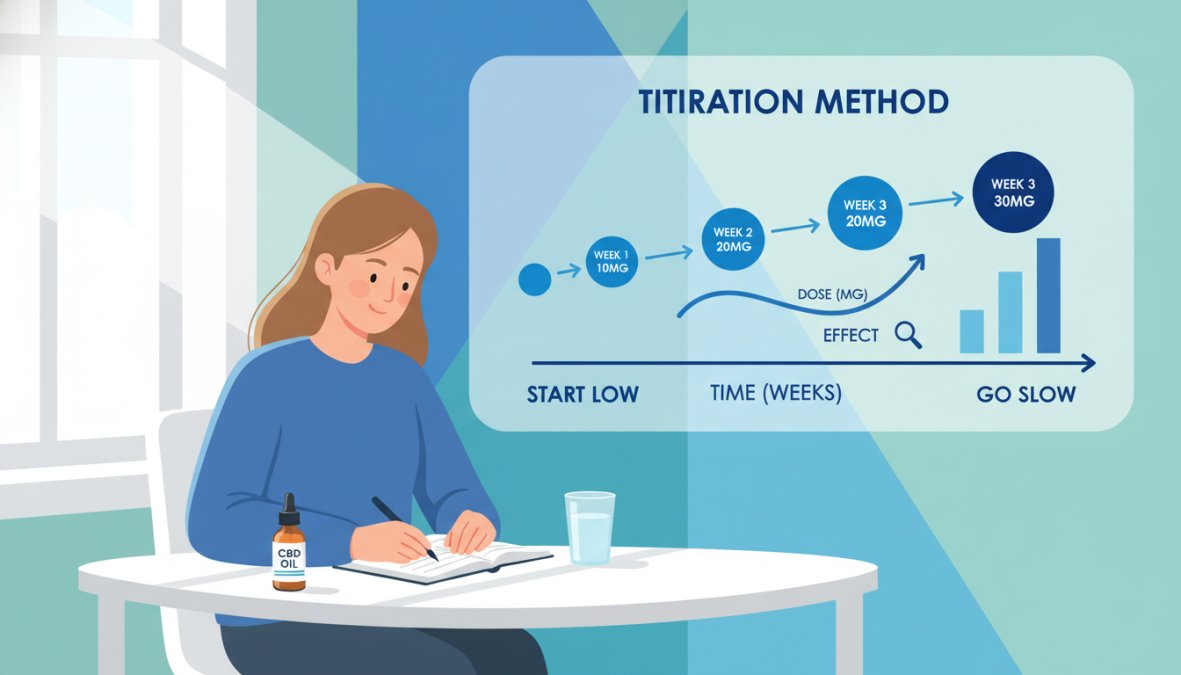
The CBD oil titration method means beginning with the lowest effective dose and increasing incrementally until the desired therapeutic effect is achieved. It’s the most reliable way to find your minimum effective dose without overshooting.
Here’s the protocol:
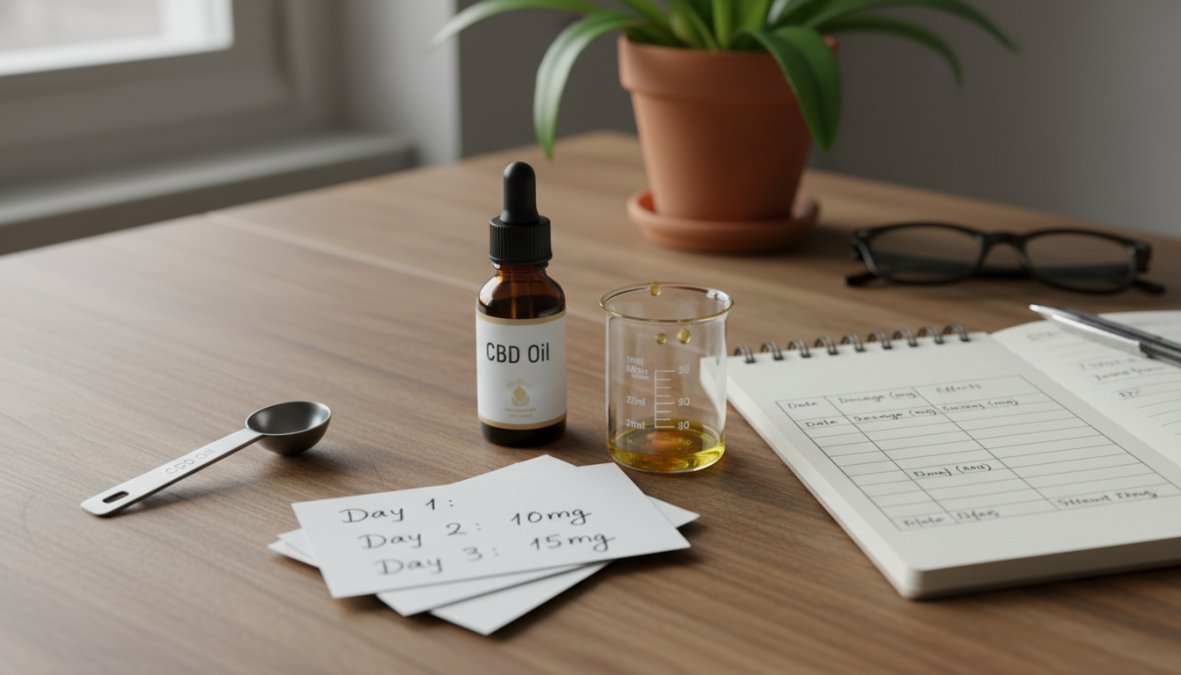
- Start with 5-10mg per day for the first three to five days
- If no effect is observed, increase by 5mg and hold for another three to five days
- Continue increasing in 5mg increments until you notice a therapeutic response
- Once you find the effective dose, hold it for two weeks before reassessing
- If side effects appear at any point, reduce by 5mg immediately
The titration process typically takes two to four weeks. That timeline feels slow, but it’s the difference between finding your actual baseline and guessing.
Skipping the titration process and starting at a high dose is the most common beginner mistake. It increases the likelihood of side effects like drowsiness or digestive discomfort, and makes it impossible to know what dose is actually doing the work.
How to Keep a Dosage Journal to Track Your Baseline
A dosage journal creates a consistent record that reveals patterns over time. Track these five variables daily:
- Date and time of each dose
- Dose in milligrams and product used
- Delivery method (sublingual, oral, topical)
- Symptom rating before and after (scale of 1-10)
- Notes on sleep quality, mood, energy, or side effects
After two weeks, you’ll have enough data to identify your effective dose range, optimal timing, and whether your current product is the right fit.
Starting Dose of CBD for Anxiety and Other Common Symptoms
The starting dose of CBD for anxiety and other common conditions varies by symptom severity and individual sensitivity. The general principle holds: start low, increase slowly, and track your response.
Dosage by Symptom: A Practical Reference Guide
The following framework is based on commonly reported patterns from practitioners and wellness communities. It is not medical advice, and individual responses will vary.
| Condition | Starting Dose | Common Effective Range | Notes |
|---|---|---|---|
| General wellness | 5-10mg | 10-25mg daily | Once daily, morning or evening |
| Anxiety/stress | 10-15mg | 15-40mg daily | Sublingual for faster onset |
| Sleep support | 15-25mg | 25-50mg | 30-60 min before bed |
| Mild pain/inflammation | 15-20mg | 20-50mg | Combine with topical for localized areas |
| Chronic pain | 20-30mg | 30-75mg | Split into morning/evening doses |
Anxiety responds well to moderate sublingual doses, where faster onset helps during acute stress. Sleep formulations work best at the higher end of the beginner range, taken 30-60 minutes before bed. For localized pain, combining an oral dose with a topical application addresses both systemic and local inflammation simultaneously.
According to Project CBD’s clinical research overview, dosage research remains in early stages for most applications outside of epilepsy, reinforcing the case for personal titration over fixed-dose recommendations.
There is no universal “correct” CBD dose. Your effective dose is personal, and finding it requires consistent tracking over at least two weeks. The symptom framework above gives you a starting point, not a finish line.
Safety, Side Effects, and Drug Interactions to Know First
CBD is generally well-tolerated, but it’s not without risk, particularly for people taking prescription medications.
Common Side Effects and How to Avoid Them
The most frequently reported side effects are dose-dependent and typically mild:
- Drowsiness or fatigue: Most common at higher doses; often resolves as the body adjusts
- Dry mouth: Cannabinoids reduce saliva production; staying hydrated minimizes this
- Digestive discomfort: More common with oil-based products; switching to water-based CBD or taking with food helps
- Changes in appetite: Usually temporary; more common with higher doses
- Lightheadedness: Typically associated with taking CBD on an empty stomach
Most side effects can be avoided by following the titration method, taking CBD with food, and staying well hydrated. If side effects persist after reducing your dose, discontinue use and consult a healthcare provider.
Checking for Drug Interactions Before You Start
CBD inhibits a group of liver enzymes called CYP450, which metabolize a significant portion of pharmaceutical drugs. When CBD inhibits these enzymes, certain medications metabolize more slowly, leading to higher blood concentrations and increased side effect risk.
Drug classes that commonly interact with CBD include:
- Blood thinners (warfarin)
- Anti-seizure medications
- Certain antidepressants and antipsychotics
- Immunosuppressants
- Some cholesterol medications (statins)
- Sedatives and sleep aids
Before starting any CBD regimen, check your medications against the NIH drug interaction checker. The "grapefruit warning" is a useful shortcut: if your medication warns against grapefruit, it likely uses the same CYP450 pathway as CBD and warrants a conversation with your doctor.
How Long Does CBD Stay in Your System?
CBD stays in the body two to five days on average for occasional users, and up to two weeks for daily users. The variation depends on dose frequency, potency, body fat percentage, and individual metabolism. Because cannabidiol is fat-soluble, it accumulates in fatty tissue and releases gradually, which is why daily users maintain a higher baseline level that can improve consistency of effect over time.
For drug testing purposes, most standard tests screen for THC metabolites, not CBD. However, full-spectrum products containing trace THC could theoretically accumulate enough THC metabolites to trigger a positive result with very high, frequent dosing. Broad-spectrum or isolate products eliminate this risk. As noted by the Substance Abuse and Mental Health Services Administration, standard workplace drug panels test for THC-COOH, not cannabidiol itself.
Managing Tolerance Buildup Over Time
Unlike THC, CBD does not appear to produce traditional tolerance buildup. Some users even report a "reverse tolerance" effect, where the endocannabinoid system becomes more sensitive over time, requiring less product for the same result.
That said, some long-term users do report reduced effectiveness at their established dose. The most effective strategy is a CBD tolerance break: a structured pause of five to seven days every two to three months. Most users find they can return to a lower dose after the break and achieve the same or better results.
A few practical strategies for long-term dose management:
- Cycle between delivery methods (sublingual for two weeks, then oral for two weeks)
- Reduce your dose by 20-30% every three months and assess effectiveness
- Take a full five-day break every quarter
- Reassess your symptom scores before and after the break to measure baseline shift
The goal of long-term CBD use is to find the lowest effective dose that maintains your desired outcome. Consistent, tracked use of a quality product at the right dose is what produces lasting results.
Finding the right CBD dose takes patience, but the process doesn’t have to be complicated. CBD Health Collection was built by pharmaceutical industry veteran Rick Bauer specifically to bring a science-based approach to this challenge, and every product in the range, from CO2-extracted tinctures to broad-spectrum soft gels, is independently third-party lab tested and produced in a GMP- and FDA-registered facility. Get started with CBD Health Collection and take the guesswork out of your first CBD experience, backed by a 30-day satisfaction guarantee and free shipping on every order.
Frequently Asked Questions
How many drops of CBD oil should a beginner take?
Most beginners should start with 1-2 drops (roughly 5-10 mg of CBD) once or twice daily. The exact number depends on your tincture's potency, check the mg per mL listed on the label. Divide the total mg per bottle by the number of mL to find mg per drop. Start at this low serving size for at least one week before adjusting. This low-and-slow titration approach is the safest way to find your personal CBD oil dosage for beginners without overshooting.
How do I calculate my CBD dosage based on body weight?
A commonly used starting point is 1-6 mg of CBD per 10 pounds of body weight, depending on the severity of your symptoms. For example, a 150-pound person might begin at 15-25 mg per day for mild concerns. To calculate your dose, multiply your weight in pounds by your chosen mg factor, then divide by 10. Use this as your baseline and adjust gradually using the titration method. Always consult a healthcare provider if you're unsure how to calculate CBD dosage for your specific situation.
How long does CBD stay in your system?
CBD's pharmacokinetics vary by individual, but it generally stays in the system for 2-5 days for occasional users and up to 2 weeks for those using it daily. Factors like metabolism, body weight, potency, and delivery method all influence clearance time. Sublingual tinctures are processed faster than oral capsules or edibles. If you're subject to drug testing, be aware that full-spectrum products contain trace THC (up to the legal 0.3% limit), which could accumulate with regular use.
What is the starting dose of CBD for anxiety?
For anxiety, many beginners find relief starting at 15-25 mg of CBD per day, taken sublingually for faster bioavailability. This is not a medical recommendation, individual responses vary widely. Begin at the lower end, hold the oil under your tongue for 60-90 seconds, and give it 1-2 weeks before increasing. Keep a dosage journal to track mood, stress levels, and sleep. If symptoms don't improve after 4 weeks of consistent use, speak with a healthcare professional about adjusting your approach.
Can you take too much CBD oil?
CBD is generally considered well-tolerated, but taking too much can cause side effects such as drowsiness, dry mouth, nausea, or changes in appetite. There is no established lethal dose for cannabidiol, but higher doses are not necessarily more effective. More is not always better, your endocannabinoid system responds best to a consistent, calibrated serving size. If you experience discomfort, reduce your dose and titrate back up more slowly. Always check for potential drug interactions if you take other medications.
Is it better to take CBD oil with food?
Yes, taking CBD oil with a meal, especially one containing healthy fats, can significantly improve absorption. CBD is fat-soluble, meaning a fatty carrier oil or food helps it pass through the digestive system more efficiently, increasing bioavailability. This is particularly relevant for oral formats like softgels or gummies. For sublingual tinctures, food is less critical since the cannabidiol absorbs directly through mucous membranes, bypassing first-pass digestion entirely. Either way, consistency in timing helps your body establish a reliable baseline response.
This article was written using GrandRanker