Table of Contents
- Step 1: Understand What You’re Buying, CBD Oil Basics
- Step 2: Verify Third-Party Lab Testing and COA Documentation
- Step 3: Identify Reputable CBD Brands and Retailers
- Step 4: Read and Understand CBD Labels Correctly
- Step 5: Check Legal Status and Regulatory Compliance
- Step 6: Assess Financial Safety and Payment Security
- Step 7: Evaluate Shipping, Storage, and Product Shelf Stability
- Common Mistakes to Avoid When Buying CBD Oil Online
Last Updated: July 31, 2026
How to safely buy CBD oil online requires more than just picking the first product you find. The CBD market has exploded in recent years, and with it comes an overwhelming number of options, many of which don’t deliver on their promises. At CBD Health Collection, we’ve helped thousands of customers navigate this landscape by breaking down exactly what separates legitimate, high-quality CBD products from those that fall short on safety, purity, and transparency. According to research from the FDA’s analysis of CBD products, many retailers make unsubstantiated claims about their products, and third-party testing reveals that potency labels often don’t match what’s actually in the bottle. This guide gives you the tools to cut through the noise and make an informed purchase.
Step 1: Understand What You’re Buying, CBD Oil Basics
Before you safely buy CBD oil online, you need to understand what you’re actually purchasing. Cannabidiol (CBD) is a non-psychoactive compound derived from hemp plants. Unlike THC, it won’t make you feel intoxicated. When CBD is extracted from the plant and suspended in a carrier oil, you get CBD oil, a liquid that’s typically taken sublingually (under the tongue) for faster absorption into the bloodstream.
Full-Spectrum vs. Broad-Spectrum vs. Isolate
Full-spectrum CBD oil contains all the cannabinoids, terpenes, and other compounds present in the hemp plant, including trace amounts of THC (less than 0.3% by federal law). This combination creates what researchers call the "entourage effect", the theory that these compounds work synergistically to enhance therapeutic benefits.
Broad-spectrum CBD oil has had THC removed while retaining most other cannabinoids and terpenes. It’s ideal for people who want the entourage effect without any THC in their system, useful if you’re subject to drug testing or simply prefer to avoid THC entirely.
CBD isolate is pure CBD with all other plant compounds removed. It’s the most refined form and contains zero THC, appealing to users who want precise dosing and predictable effects.
::tip
If you’re new to CBD, broad-spectrum is the sweet spot. You get therapeutic benefits without THC concerns.
:::
Extraction Methods: CO2 vs. Solvent-Based
Supercritical CO2 extraction uses pressurized carbon dioxide to pull cannabinoids and terpenes from the plant material. This method is considered the gold standard because it’s clean, efficient, and doesn’t leave behind chemical residues. When you’re evaluating how to safely buy CBD oil online, CO2-extracted products are your safest bet.
Solvent-based extraction uses chemicals like ethanol or butane to strip cannabinoids from the plant. While effective and less expensive, this method carries risks if solvents aren’t completely purged from the final product.
CBD Health Collection uses clean CO2 extraction across its entire product line, ensuring zero chemical processing and maximum purity.
Step 2: Verify Third-Party Lab Testing and COA Documentation
This is non-negotiable when you safely buy CBD oil online. When a product undergoes third-party testing, an independent laboratory tests the product for potency, purity, and contaminants, then issues a Certificate of Analysis (COA), a detailed report showing exactly what’s in the product. Legitimate CBD brands make their COAs easily accessible, usually by posting them on their website or providing a QR code on the product label. If a brand doesn’t readily provide COAs, that’s a major red flag.
How to Read a Certificate of Analysis
A COA contains the product name, batch number, and testing date, allowing you to verify you’re looking at the correct product and that the test is recent (ideally within 6 months of purchase). The cannabinoid profile section lists the exact amounts of CBD, THC, and other cannabinoids in milligrams per milliliter (mg/mL). If the label says 1000 mg CBD per 30 mL bottle, the COA should confirm approximately 33 mg/mL. Discrepancies here indicate either labeling fraud or quality control problems.
The contaminant testing section is equally critical. Labs test for pesticide residue, heavy metals (lead, cadmium, mercury), microbial contamination, and mold. Any positive result for pesticides or heavy metals should disqualify that product immediately.
What to Check For: Potency, Purity, and Contaminants
Potency refers to the concentration of CBD in the product. Check the mg/mL listed on both the label and the COA. A 1000 mg bottle with 30 mL of oil contains roughly 33 mg/mL, a common starting strength for daily users.
Purity means the product contains what the label claims and nothing harmful. The COA should show your desired cannabinoid profile with no unexpected compounds. According to research published in JAMA, many CBD products fail purity standards, making COA verification essential.
Contaminant testing is where many products fail. Look for these specific test results:
- Pesticide screening: should show "Not Detected" or values below regulatory limits
- Heavy metals (lead, cadmium, mercury, arsenic): should be non-detectable or below EPA thresholds
- Microbial testing (E. coli, salmonella, mold): should be negative
- Solvent residue (if applicable): should be non-detectable
If a product’s COA shows ANY detected pesticides or heavy metals, avoid it entirely. These compounds accumulate in your body and pose serious long-term health risks.
Step 3: Identify Reputable CBD Brands and Retailers
When you safely buy CBD oil online, start by researching the brand’s background. How long have they been in business? Do they have transparent ownership? What’s their quality philosophy? Brands that have been operating for several years with consistent quality standards are generally more trustworthy than newcomers making aggressive claims.
Hemp Sourcing and USDA Organic Certification
The quality of CBD starts with the quality of the hemp plant. Look for brands that source hemp from the United States, as domestic hemp is subject to USDA regulations and state oversight, making it more traceable and safer than hemp imported from countries with weaker agricultural standards.
USDA organic certification is a significant quality indicator. Organic hemp is grown without synthetic pesticides, herbicides, or fertilizers. Achieving organic certification requires annual audits and documentation, so brands that display this certification have invested in verified quality standards.
CBD Health Collection sources all hemp from organic farms in the United States, ensuring full traceability and compliance with USDA organic standards.
GMP Certification and FDA-Registered Facilities
Good Manufacturing Practice (GMP) certification indicates that a facility follows strict quality control protocols during production. FDA-registered facilities have registered their manufacturing location with the FDA, which means the facility is subject to FDA inspection and oversight. Brands that manufacture in GMP-certified, FDA-registered facilities demonstrate a serious commitment to product safety and consistency.
Step 4: Read and Understand CBD Labels Correctly
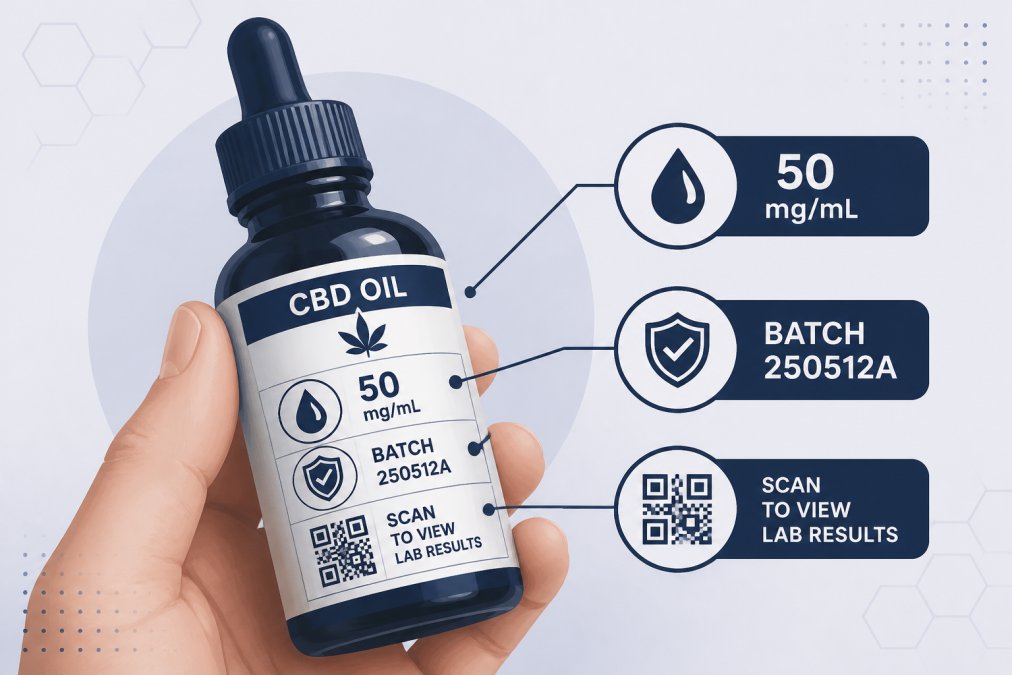
A quality label tells you everything you need to know about the product. When you safely buy CBD oil online, examine the label carefully before purchase. A transparent label should clearly display:
- Total CBD amount in the bottle (e.g., 1000 mg)
- Volume of the product (e.g., 30 mL)
- CBD concentration in mg/mL
- Full ingredient list, including the carrier oil
- Suggested serving size
- Batch number and expiration date
- QR code linking to the COA
Milligrams Per Milliliter, Batch Numbers, and QR Codes
Milligrams per milliliter (mg/mL) is the metric that matters most. This tells you the strength of each dose. A 1000 mg bottle in 30 mL contains 33 mg/mL. If you take 1 mL (typically one dropper), you’re consuming 33 mg of CBD.
Batch numbers allow you to match your product to its specific COA. Every batch of product should have a unique batch number printed on the label. When you receive your order, record the batch number and look it up on the brand’s website to verify the corresponding COA.
QR codes on labels should link directly to the product’s COA. If you scan the QR code and it doesn’t work or doesn’t display a valid COA, that’s a red flag.
Label Accuracy and Transparency Red Flags
Watch for these warning signs:
- Claims that CBD "cures" or "treats" specific diseases (the FDA prohibits disease claims for CBD)
- Missing batch numbers or expiration dates
- No QR code linking to a COA
- Inconsistencies between the label claim and the COA
- Carrier oil listed as "proprietary blend" instead of a specific oil
The best CBD labels are boring. They state facts clearly: total CBD, mg/mL, ingredients, batch number, expiration date. Flashy marketing language is often a sign the product’s quality isn’t strong enough to speak for itself.
Step 5: Check Legal Status and Regulatory Compliance
Hemp-derived CBD with less than 0.3% THC is federally legal under the 2018 Farm Bill. However, state laws vary significantly. Before you safely buy CBD oil online, verify that CBD is legal in your state by checking your state’s agriculture or health department website.
When purchasing from online retailers, confirm they ship to your state. Reputable brands will prevent shipping to states where CBD is prohibited. Federal compliance also matters: the product must contain less than 0.3% THC (verified by the COA), must be derived from hemp, and cannot make disease claims.
Step 6: Assess Financial Safety and Payment Security
When you safely buy CBD oil online, use retailers with secure checkout processes. Look for:
- HTTPS encryption (the "s" in https and a padlock icon in your browser)
- Recognized payment methods (credit cards, PayPal, Apple Pay)
- Clear privacy policies explaining how your data is protected
Avoid retailers that only accept wire transfers, cryptocurrency, or untraceable payment methods, or that don’t display a privacy policy.
A solid return policy is equally important. If a product doesn’t work for you or arrives damaged, you should be able to return it for a refund or replacement. CBD Health Collection offers a 30-day satisfaction guarantee on all purchases, allowing you to try products risk-free.
Save your order confirmation and COA when you purchase. If you ever need to return a product or file a complaint, these documents prove what you purchased and when.
Step 7: Evaluate Shipping, Storage, and Product Shelf Stability
How CBD is shipped and stored affects its quality. CBD is sensitive to heat, light, and oxygen, which degrade cannabinoids over time. Quality brands use discreet packaging, dark glass bottles, and proper sealing to prevent oxidation.
Once your product arrives, store it in a cool, dark place, a pantry or cabinet away from direct sunlight works well. Some users prefer refrigeration, which extends shelf life. Avoid storing CBD in bathrooms (humidity) or near windows (light exposure).
Check the expiration date on your product. Most quality CBD oils remain stable for 12-24 months when stored properly. Factor shipping costs into your total price when comparing brands. CBD Health Collection includes free shipping on all orders.
Common Mistakes to Avoid When Buying CBD Oil Online
Ignoring Drug Interaction Warnings
CBD interacts with certain medications by competing for the same metabolic pathways in your liver. If you take medications that carry a "grapefruit warning", CBD may interact similarly. Before purchasing CBD, consult with your healthcare provider, especially if you take prescription medications.
Skipping Third-Party Verification
Buying CBD without verifying a COA means you’re gambling with your health and money. You might purchase a product that’s under-potent, over-potent, or contaminated. Always verify the COA before purchasing.
Choosing Based on Price Alone
The cheapest CBD oil online is often the cheapest for a reason. Quality CBD costs more because quality costs more. Compare price per mg of CBD across brands to find genuine value.
| Factor | Why It Matters | What to Look For |
|---|---|---|
| Third-party COA | Verifies potency and purity | Recent test date, no contaminants detected |
| Extraction method | Affects safety and quality | CO2 extraction preferred, solvent-free |
| Hemp sourcing | Determines starting material quality | USA-grown, USDA organic certified |
| Manufacturing facility | Ensures product consistency | GMP certified, FDA-registered |
| Label accuracy | Confirms you know what you’re buying | Batch number, mg/mL, expiration date |
| Return policy | Protects your purchase | 30+ days, full refund option |
| Shipping method | Preserves product quality | Temperature controlled, dark packaging |
Learning how to safely buy CBD oil online protects your health and your wallet. The process requires attention to third-party testing, label transparency, brand reputation, and legal compliance, but these steps take less than 30 minutes per purchase and eliminate nearly all risk. CBD Health Collection simplifies this process by providing organically grown, USA-sourced hemp extracted using clean CO2 methods, independently third-party lab tested for purity and potency, and manufactured in GMP-certified, FDA-registered facilities. Start your search with brands that prioritize transparency, and you’ll find CBD oil that actually delivers the quality and results you’re paying for.
Frequently Asked Questions
Is it legal to buy CBD oil online in the US?
Yes, CBD derived from hemp is legal to buy online in the US under federal law, provided it contains no more than 0.3% THC. However, state laws vary, some states have additional restrictions or bans. Always verify your state's current regulations before purchasing. Check your state's official health department website for the most up-to-date legal status.
How can I verify third-party lab test results for CBD oil?
Request the Certificate of Analysis (COA) from the retailer or look for a QR code on the product label linking to the report. Verify the testing lab is independent and accredited. Check that the COA includes potency (cannabinoid levels), contaminant screening (pesticides, heavy metals, microbial), and matches the batch number on your product. Reputable brands display COAs transparently on their websites.
What's the difference between full-spectrum, broad-spectrum, and CBD isolate?
Full-spectrum contains all cannabinoids, terpenes, and plant compounds (including trace THC up to 0.3%), potentially offering greater bioavailability. Broad-spectrum removes THC but retains other cannabinoids and terpenes. Isolate is pure CBD only. Full-spectrum and broad-spectrum may provide enhanced effects through the entourage effect, while isolate is THC-free and flavorless. Your choice depends on preference, drug testing concerns, and desired effects.
What are the red flags when buying CBD oil online?
Avoid retailers lacking accessible COAs, making unproven health claims, offering suspiciously low prices, or using vague sourcing language. Red flags include missing batch numbers, no third-party testing, poor website security (no HTTPS), unclear return policies, and retailers unwilling to answer questions about extraction methods or hemp origin. Reputable brands prioritize transparency and consumer safety above all else.
Should I consult a doctor before using CBD oil if I take medications?
Yes, CBD can interact with certain medications, particularly those metabolized by the cytochrome P450 enzyme system (like blood thinners, heart medications, and seizure drugs). Consult your healthcare provider before starting CBD to ensure it won't interfere with your current prescriptions or medical conditions. Your doctor can advise on safe dosing and timing.
How do I know if a CBD brand is reputable?
Look for brands that provide transparent COAs, source hemp from US farms, use clean CO2 extraction, maintain GMP and FDA-registered facilities, and offer USDA organic certification. Check customer reviews, verify their business address and contact information, and assess their customer service responsiveness. Established brands with clear company histories, founder credentials, and satisfaction guarantees demonstrate higher trustworthiness than new or anonymous retailers.
This article was written using GrandRanker