Table of Contents
- What Is a Certificate of Analysis and Why It Matters
- How to Read CBD Lab Reports: Finding and Accessing Your COA
- Understanding CBD Potency Testing and Cannabinoid Profiles
- Identifying Contaminants in CBD Lab Reports
- Red Flags in Lab Reports: What Signals a Problem
- Verifying Lab Accreditation and Third-Party Testing Legitimacy
- Terpene Profiles and What They Tell You About Your CBD Product
- Practical Steps to Evaluate CBD Product Safety Using Lab Reports
Last Updated: July 30, 2026
What Is a Certificate of Analysis and Why It Matters
A Certificate of Analysis (COA) is an official laboratory document that details the chemical composition, potency, and purity of a CBD product. It’s your proof that what’s in the bottle matches what’s on the label. Understanding how to read CBD lab reports starts with recognizing that a COA is not optional marketing material, it’s the foundation of product safety and transparency.
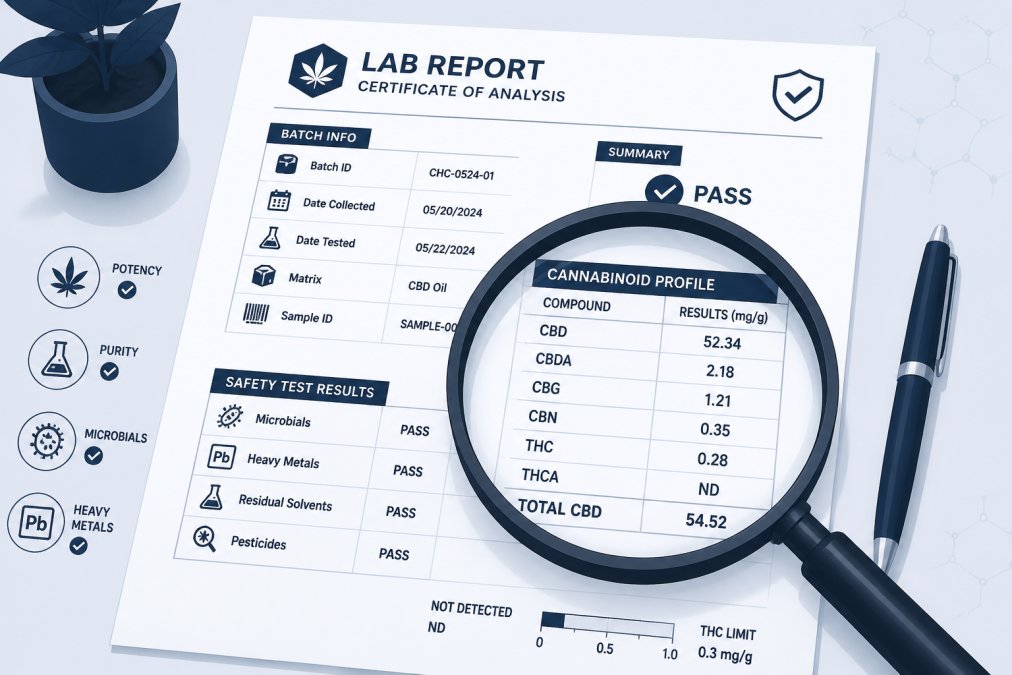
When you’re evaluating a CBD product, the COA tells you exactly what you’re getting. It shows cannabinoid potency (how much CBD and THC are actually present), identifies contaminants like heavy metals and pesticides, documents microbial testing results, and confirms that the product was tested by an independent third-party laboratory. At CBD Health Collection, we believe transparency isn’t just good business, it’s essential for consumer safety and trust.
Most consumers never ask for a lab report. That’s a mistake. A product without a COA could contain anything. It might have less CBD than advertised, or worse, it could contain harmful contaminants. The companies that hide their testing results usually have something to hide.
The anatomy of a lab report follows a standard format across legitimate testing facilities. Every reputable COA includes the same core sections: product identification, cannabinoid profile, contaminant testing results, and lab accreditation details. Knowing what to look for in each section transforms a confusing document into actionable information about product quality.
The Anatomy of a Lab Report: What You’re Actually Looking At
Reading a COA requires understanding its basic structure. Think of a lab report like a medical test result, each section answers a specific question about your product’s safety and composition. Rather than memorizing every detail, learn to scan for the critical data points in each zone.
Product Identification Zone (Top of Report)
At the top of every COA, you’ll find product identification information. This section is your anchor point for verification:
- Product name and description, Should match exactly what’s on your bottle label
- Batch number or lot number, The most critical piece of data; this ties the report to your specific product. If your bottle has batch #2406-1847 and the COA shows batch #2406-1823, they don’t match, that’s a red flag that signals either a mislabeled product or a fraudulent report
- Sample date, When the product was collected for testing
- Analysis date, When the lab performed the tests
- Report issue date, When the lab finalized and released the report
The time gap between sample date and analysis date should be minimal (typically within 1-2 weeks). A large gap suggests the product sat in storage before testing, which can affect accuracy for volatile compounds like terpenes. Reports older than 12 months should trigger skepticism, if a product is still being sold with a year-old COA, the company should have conducted fresh testing.
Cannabinoid Profile Section (Middle-Upper Area)
This section displays the actual CBD concentration and other cannabinoids, usually measured in milligrams per gram (mg/g) or as a percentage of total weight. You’ll see:
- Total CBD, The primary number; compare this to the label claim within ±10% tolerance
- Total THC, Must be below 0.3% by federal law for hemp-derived products
- Minor cannabinoids, CBG, CBC, CBN, CBDA (the acidic precursor to CBD), and others, if present
- Specification of product type, The report should explicitly state whether the product is full-spectrum, broad-spectrum, or isolate
Full-spectrum products contain all cannabinoids including trace THC (below 0.3% by federal law). Broad-spectrum products have THC removed but retain other cannabinoids. Isolate products contain only CBD. The cannabinoid profile is where you verify the product type matches the label claim. If a label says "full-spectrum" but the COA shows zero minor cannabinoids, something is wrong.
Contaminant Testing Zone (Middle-Lower Area)
This is the safety section. It covers multiple categories of tests, each with pass/fail results:
- Heavy metals, Lead, cadmium, arsenic, mercury (each with individual limits)
- Pesticide residues, A list of pesticides screened for, with results for each
- Microbial analysis, Bacteria (E. coli, salmonella, listeria), mold, yeast
- Residual solvents, Traces of extraction solvents (ethanol, butane, hexane, etc.)
- Mycotoxins, Aflatoxin and ochratoxin A, produced by mold contamination
Each test result shows either "pass" (below safety limit), "fail" (above safety limit), or "not detected" (below the lab’s limit of quantitation). A single "fail" result is grounds for rejection. Most labs use a standardized format with a results column and a limits column side-by-side, making it easy to spot violations at a glance.
Terpene Profile Section (If Included)
Not all COAs include terpene profiles, but comprehensive ones do. This section lists aromatic compounds like myrcene, limonene, pinene, linalool, and caryophyllene with their concentrations. A detailed terpene profile indicates the product contains naturally occurring plant compounds rather than artificial flavoring. If a full-spectrum product shows no terpenes detected, that’s unusual and suggests either improper processing or mislabeling.
Lab Accreditation and Signature Block (Bottom of Report)
At the bottom, you’ll find:
- Lab name and contact information
- ISO 17025 accreditation number, The gold standard for lab credibility
- Analyst signature or digital signature, Indicates the report has been formally issued
- Report number, A unique identifier for tracking
- QA/QC statement, A note confirming the lab’s quality assurance procedures
The accreditation block is where you verify the lab is legitimate and independent. You can cross-reference the ISO 17025 number on the lab’s website or contact the lab directly to confirm it’s current.
When you first open a COA, scan from top to bottom in this order: (1) batch number match, (2) cannabinoid potency, (3) contaminant pass/fail results, (4) lab accreditation. This 30-second scan tells you 90% of what you need to know. Only dive into the detailed numbers if something looks off.
How to Read CBD Lab Reports: Finding and Accessing Your COA
Most legitimate CBD brands make their lab reports easy to access. The first step is knowing where to look. Some companies print a QR code directly on the product packaging. Others provide batch numbers on the label that you can use to search their website.
Using QR Codes and Batch Numbers
If your CBD product has a QR code on the label, scan it with your smartphone camera. This should direct you to the corresponding COA for that specific batch. This method is fast and convenient, no searching required. However, always verify that the batch number on your product matches the batch number in the report you’re viewing. Scammers sometimes use generic QR codes that link to outdated or unrelated lab reports.
If there’s no QR code, locate the batch number on your product label. It’s usually printed on the back or bottom of the bottle, often formatted like "Batch #2406-1847" or "LOT 06-24-001." Visit the brand’s website and look for a "Lab Results," "Testing," or "Certificates" page. Enter your batch number into their search tool. The correct COA should appear within seconds.
Legitimate brands make finding lab reports effortless. If you have to email customer service and wait days to get a COA, or if the company claims they “don’t have reports available yet,” that’s a warning sign. Transparency should be immediate and frictionless.
What to Do If You Can’t Find a Lab Report
If a company won’t provide a lab report, don’t buy from them. Period. A missing COA means either the product was never tested (unsafe), or the company is hiding poor test results (also unsafe). This isn’t paranoia, it’s basic consumer protection.
If you’re having trouble locating a report you believe should exist, contact the company’s customer service with your batch number. Reputable brands respond within 24 hours with the correct documentation. If they’re evasive, defensive, or claim they "don’t release lab reports to customers," that company has failed the transparency test.
Understanding CBD Potency Testing and Cannabinoid Profiles
Potency testing measures the actual concentration of CBD and other cannabinoids in your product. This is where the rubber meets the road, does the product contain what the label claims?
Reading Cannabinoid Profile Explained: THC, CBD, and Full-Spectrum vs. Isolate
The cannabinoid profile section of a COA lists every cannabinoid detected in the product, measured in milligrams per gram (mg/g) or as a percentage. CBD concentration is the primary figure, if the label says 1000mg of CBD and the COA shows 950mg, that’s acceptable variance (typically ±10% is considered normal). If the COA shows 600mg when the label claims 1000mg, the product is significantly underpotent and you should request a refund.
THC content is equally important. Federal law allows up to 0.3% THC in hemp-derived CBD products. Some people want zero THC (broad-spectrum or isolate), while others prefer the full-spectrum benefit. The COA tells you exactly what you’re getting. If you need THC-free products for employment drug testing, verify the report shows non-detectable or <0.03% THC.
Full-spectrum products contain all cannabinoids present in the plant, including trace amounts of THC, other minor cannabinoids, and terpenes. Many users report better results with full-spectrum because of the "entourage effect", the theory that cannabinoids work synergistically. Broad-spectrum products have THC removed through additional processing but retain other cannabinoids and terpenes. Isolate products contain only pure CBD, making them the most predictable option for precise dosing.
The most important number on a COA is the total CBD concentration. Everything else, terpenes, minor cannabinoids, THC content, matters, but CBD potency is what you’re paying for. Verify it matches the label within ±10%.
Interpreting Potency Numbers and Milligrams per Gram
CBD concentration is typically expressed in two ways: total milligrams in the product (e.g., "1000mg CBD") or as milligrams per gram (e.g., "10mg/g"). Understanding the math helps you spot inconsistencies.
If a 100ml bottle contains 1000mg of CBD, that’s 10mg per milliliter. If you take a 1ml dropper dose, you’re consuming 10mg of CBD. The COA should show the total concentration and often breaks this down per serving or per milliliter for oils and tinctures.
For topicals and other products, mg/g is more common. A freeze gel with 500mg CBD in a 50g container equals 10mg/g. When comparing products, always calculate the cost per milligram of CBD to ensure you’re getting fair pricing across different formats and brands.
Decarboxylation is sometimes mentioned in lab reports. This is the process of heating CBD to activate it for maximum bioavailability. Some labs measure both raw CBDA (the acidic form) and decarboxylated CBD. The total cannabinoid content should account for both forms. CBD Health Collection uses water-based extraction and processing methods specifically designed to optimize bioavailability, which means more of the CBD your body can actually use.
Identifying Contaminants in CBD Lab Reports
Contaminant testing is where many consumers get lost, but it’s straightforward once you understand what each test measures and why it matters.
Heavy Metals, Pesticides, and Microbial Analysis
Heavy metals (lead, cadmium, arsenic, and mercury) accumulate in plants from soil and water. Hemp is a bioaccumulator, it pulls metals from the environment more readily than many crops. The COA should show that all heavy metals tested below the established safety limits. According to FDA guidance on heavy metals in dietary supplements, lead should not exceed 5 micrograms per serving, cadmium should be below 4.7 micrograms per serving, and arsenic should remain below 15 micrograms per serving.
Pesticide residues are tested because many CBD producers use conventional farming methods that involve chemical pesticides. The COA lists which pesticides were screened for and shows results for each. Look for "pass" results across all pesticides tested. If any pesticide is detected above the legal limit, that’s grounds for rejection.
Microbial analysis tests for bacteria (E. coli, salmonella, listeria), mold, and yeast. These organisms can cause serious illness if present in significant quantities. The COA should show that all microbial tests passed, meaning pathogenic bacteria and harmful molds were either absent or below acceptable levels. Most labs use a limit of quantitation (LOQ), the lowest amount they can reliably detect. If a pathogen is below LOQ, it’s reported as "not detected," which is what you want to see.
Residual Solvents and Safety Limits
CBD is extracted from hemp using various methods. Some extraction processes use solvents like ethanol, hexane, or butane. Residual solvents are the traces of these chemicals left behind after extraction. The COA documents which solvents were tested for and whether they’re below safe limits.
CBD Health Collection uses clean CO2 extraction, which produces no residual solvents. However, if you’re evaluating other brands, check that residual solvent testing shows all solvents below their established safety limits. Ethanol, for example, has a limit of 5000 ppm (parts per million). Butane is limited to 2 ppm. These limits exist because chronic exposure to residual solvents can cause health problems.
If a COA shows residual solvents detected above their safety limits, or if no residual solvent testing was performed at all, avoid that product. This is a serious safety issue that indicates either poor extraction practices or inadequate quality control.
Mycotoxins and Pass/Fail Criteria
Mycotoxins are toxic compounds produced by mold and fungi. The most common concern is aflatoxin, which can develop in improperly stored hemp. The COA tests for mycotoxins and should show "pass" results for all toxins tested. The pass/fail criteria typically follows FDA guidelines, where aflatoxin must be below 20 ppb (parts per billion) and ochratoxin A must be below 20 ppb.
A "fail" result for any contaminant, heavy metals, pesticides, microbial organisms, residual solvents, or mycotoxins, means the product should not be consumed. Reputable companies pull contaminated batches from shelves immediately. If you ever see a COA with a "fail" result still being sold, report that company to the FDA’s MedWatch program immediately.
Red Flags in Lab Reports: What Signals a Problem
Not all lab reports are created equal. Some are fabricated, manipulated, or incomplete. Learning to spot red flags protects you from unsafe or ineffective products. More importantly, understanding why each flag matters helps you decide whether to reject a product outright or contact the company for clarification.
Missing or Incomplete Test Results
A complete COA includes product identification, cannabinoid potency, heavy metals testing, pesticide screening, microbial analysis, residual solvent testing, and lab accreditation. If any of these sections are missing, that’s a red flag, but the severity depends on which section is absent.
Critical absences (reject immediately):
- No contaminant testing at all (heavy metals, pesticides, microbial)
- No lab accreditation information or ISO 17025 number
- No batch number or product identification
These omissions suggest either the product was never properly tested or the company is hiding poor results. A company that skips contaminant testing either has something to hide or doesn’t care about product safety.
Moderate concerns (contact the company):
- Missing terpene profile (acceptable if the product is isolate or broad-spectrum)
- No residual solvent testing (concerning if the product uses solvent-based extraction; acceptable for CO2-extracted products)
- Incomplete microbial testing (e.g., tested for bacteria but not mold)
If a company uses CO2 extraction, residual solvent testing is less critical. If they use ethanol or butane extraction, residual solvent testing is mandatory. Ask the company which extraction method they use and why certain tests are absent.
Red flag: Vague or incomplete sample information. The COA should clearly state what product was tested, when it was sampled, and when the analysis was performed. If the report just says "CBD Oil" without specifying the batch, strength, or date, you can’t verify it corresponds to your product. This is often a sign of a generic or reused report.
Limit of Quantitation (LOQ) Mismatches
Limit of Quantitation is the lowest concentration a lab can reliably detect. Some labs have high LOQs, meaning they can only detect contaminants at relatively high levels. A lab with a 0.01 ppm LOQ for pesticides is more thorough than one with a 1 ppm LOQ.
Why this matters: A pesticide might be present at 0.5 ppm, but if the lab’s LOQ is 1 ppm, the report will show "not detected." The pesticide is still there, the lab just can’t measure it reliably. When comparing products from different labs, check the LOQ values. Higher sensitivity (lower LOQ) is better.
What to do: If a COA shows high LOQs (e.g., 1 ppm for pesticides when industry standard is 0.01 ppm), contact the company and ask why they chose a less sensitive lab. Reputable brands use labs with lower LOQs because they’re more protective of consumer safety.
Batch-to-Batch Inconsistency
If you’ve been using a CBD product for months and suddenly the potency drops dramatically, compare the COA from your current batch to previous batches. CBD concentration should be relatively consistent from batch to batch. Significant variations (more than ±15%) suggest quality control issues or undisclosed formula changes.
Expected variance: ±10% is normal and acceptable. This reflects natural variation in plant material and testing precision. ±15% is borderline; anything beyond that warrants investigation.
What to do: Save copies of COAs from products you use regularly. If you notice batch-to-batch inconsistencies in potency or contaminant levels, contact the company. Reputable brands investigate and explain variations. Companies that dismiss your concerns or claim "all batches are different" aren’t maintaining proper quality standards.
Red flag: Contaminant levels that spike. If one batch shows no detectable pesticides but the next batch shows pesticides near the safety limit, that indicates inconsistent farming or processing practices. This is more concerning than potency variance because it suggests the company isn’t controlling environmental factors (soil quality, water source, storage conditions).
Suspiciously High Potency Claims
If a product claims 5000mg of CBD in a 30ml bottle (167mg/ml), that’s unusually high. Most full-spectrum products max out around 50mg/ml because the plant material can only hold so much CBD. Isolate products can reach higher concentrations, but even then, claims above 100mg/ml should be verified against the COA.
What to do: Check the COA. If the lab confirms the potency, it’s legitimate (though expensive). If the COA shows significantly lower potency than the label claims, the product is mislabeled. If the company won’t provide a COA for a high-potency product, assume the claim is false.
Red flag: Potency claims with no supporting COA. If a company advertises "ultra-potent" or "maximum strength" CBD without providing lab verification, they’re making unsubstantiated claims. The FDA prohibits health claims on CBD products, and potency claims without lab backing are misleading.
Lab Accreditation Red Flags
Not all labs are independent. Some are owned by or financially tied to CBD companies, creating a conflict of interest. A lab owned by the brand has incentive to produce favorable results.
Red flags:
- Lab name is the same as or very similar to the brand name (e.g., "XYZ CBD Labs" testing "XYZ CBD Products")
- No ISO 17025 accreditation number on the report
- Lab accreditation number doesn’t match when you verify it on the lab’s website
- Lab is located in the same building or facility as the brand’s headquarters
- No way to contact the lab independently; all communication goes through the brand
What to do: Visit the lab’s website independently and verify their ISO 17025 accreditation. Call the lab directly and confirm they tested the product. Legitimate third-party labs have no ownership stake in the companies they test and are happy to discuss their independence.
Outdated or Undated Reports
Lab results are typically valid for one year. If the COA is older than that and the product is still being sold, the company should have conducted new testing. Older reports may no longer reflect the product’s current composition, especially if the formula, supplier, or processing method has changed.
Red flag: No report date at all. Some fraudulent or low-quality COAs omit the analysis date or issue date entirely. This makes it impossible to verify when the testing occurred or whether the results are current. Always demand a report with clear dates.
What to do: Check the report issue date. If it’s more than 12 months old, ask the company when they plan to conduct fresh testing. Reputable brands test at least annually and often more frequently (quarterly or per batch).
Contaminant Results at or Near Safety Limits
A contaminant that "passes" because it’s just barely below the safety limit is technically acceptable but worth scrutinizing. For example, if lead is detected at 4.9 micrograms per serving and the FDA limit is 5 micrograms, the product passes, but it’s at the edge of safety.
What to do: Compare results across batches. If contaminants consistently hover near the limit, the company may have quality control issues. If a contaminant is near the limit in one batch but much lower in others, it could be a one-time anomaly. Reputable brands maintain results well below safety limits as a safety margin.
Red flag: Contaminants detected in some batches but not others. This inconsistency suggests the company isn’t controlling the source of contamination (soil, water, storage conditions). A truly quality-controlled product should show consistent, low contaminant levels across all batches.
Decision Tree: When to Reject vs. When to Ask Questions
Reject immediately (do not buy):
- Any contaminant shows "fail" or exceeds safety limits
- No lab accreditation or unverifiable accreditation
- Batch number doesn’t match your product
- No COA available at all
- Lab is owned by or financially tied to the brand
Contact the company for clarification:
- Potency is ±10-15% below label claim (within normal variance, but worth confirming)
- Terpene profile is missing (acceptable depending on product type)
- Residual solvent testing is missing (acceptable for CO2 extraction, concerning for solvent-based)
- Report is 6-12 months old (ask about their testing schedule)
- Minor inconsistencies between batches (±15% variance)
Proceed with confidence:
- All contaminants show "pass" or "not detected"
- Potency matches label within ±10%
- Lab is independently accredited with verifiable ISO 17025 number
- Report is current (less than 12 months old)
- Batch number matches your product
- Contaminant levels are well below safety limits (not at the edge)
If a company refuses to provide a COA, claims they “don’t have reports available yet,” or becomes defensive when you ask questions, that’s your signal to shop elsewhere. Transparency should be immediate and frictionless. A company that hides its lab reports is hiding something.
Verifying Lab Accreditation and Third-Party Testing Legitimacy
Not all labs are equal. A COA is only as credible as the lab that issued it. Verifying lab accreditation ensures you’re looking at results from a legitimate, independent testing facility.
ISO Accreditation and Independent Lab Verification
The gold standard for lab credibility is ISO 17025 accreditation. This international standard certifies that a laboratory meets rigorous requirements for testing accuracy, reliability, and impartiality. Every COA should display the lab’s ISO 17025 accreditation number. You can verify this accreditation by visiting the lab’s website or contacting them directly.
Look for labs that are truly independent. A lab owned by or financially tied to a CBD company has a conflict of interest, they’re incentivized to produce favorable results. Legitimate third-party labs have no financial relationship with the brands they test. They’re paid per test, not per favorable result.
Some companies claim their products are "third-party tested" but then use an in-house lab or a lab owned by the parent company. This is misleading. True third-party testing means the lab has no ownership stake in the company selling the product.
Research from the Association of Commercial Labs (ACL) shows that accredited labs produce significantly more reliable and consistent results than unaccredited facilities. When evaluating a CBD product, always verify the testing lab’s accreditation status before trusting the results.
Legal vs. Safety Limits: Understanding the Difference
Federal law allows up to 0.3% THC in hemp-derived CBD products. This is the legal limit. However, some states have stricter regulations. If you’re in a state with more stringent THC limits, check that your product complies with state law, not just federal law.
Safety limits for contaminants are often more conservative than legal limits. The FDA has established acceptable limits for heavy metals and microbial contamination in dietary supplements. However, some labs use even stricter limits to ensure maximum safety. A COA might show a pesticide result of 0.05 ppm when the legal limit is 0.1 ppm, that’s actually better for you.
Understanding this distinction helps you evaluate whether a product truly meets safety standards or just barely scrapes by on legal minimums. CBD Health Collection tests to safety standards that often exceed legal requirements because we prioritize your health over regulatory minimums.
Terpene Profiles and What They Tell You About Your CBD Product
Terpenes are aromatic compounds found in plants. In CBD products, they contribute to flavor, aroma, and potentially therapeutic effects. A terpene profile on a COA lists which terpenes are present and their concentrations.
Common terpenes in CBD products include myrcene (earthy, herbal), limonene (citrus), pinene (pine), linalool (floral), and caryophyllene (spicy, peppery). Each terpene has different characteristics. Myrcene is believed to enhance relaxation, while limonene may support mood. However, the scientific evidence for terpene-specific effects is still emerging.
A full terpene profile indicates the product contains naturally occurring compounds from the plant rather than artificial flavoring. If a COA shows no terpenes detected in a full-spectrum product, that’s unusual and suggests the terpenes were removed or the product isn’t actually full-spectrum.
Terpene profiles matter most if you’re sensitive to specific flavors or aromas, or if you’re seeking the entourage effect. For basic CBD effectiveness, the cannabinoid profile is more important than the terpene profile. However, a detailed terpene profile is another sign of a company that invests in thorough testing and transparency.
Practical Steps to Evaluate CBD Product Safety Using Lab Reports
You now understand the components of a lab report. Here’s how to apply that knowledge when evaluating a real product.
Start by requesting the COA before you buy. A reputable company provides it immediately. If you have to search their website, use a batch number, or wait for customer service, that’s less convenient but acceptable. If the company refuses or claims they don’t have reports available, don’t purchase from them.
Compare the batch number on the product you’re holding to the batch number on the COA. They must match. If they don’t, the report doesn’t correspond to your product.
Review the cannabinoid profile. Does the CBD concentration match the label? Is it within ±10%? If the label says 1000mg and the COA shows 850mg, that’s acceptable. If it shows 600mg, contact the company for a refund.
Check the contaminant section. Look for "pass" results across all tests. If any heavy metals, pesticides, microbial organisms, residual solvents, or mycotoxins show "fail" or are above safety limits, reject the product.
Verify the lab’s accreditation. Visit the lab’s website and confirm they have ISO 17025 certification. If you can’t find accreditation information, email the lab directly and ask.
Review the report date. Lab results are typically valid for one year. If the COA is older than that and the product is still being sold, the company should have conducted new testing.
A Checklist for Reading Lab Reports Like a Pro
| Step | What to Check | What You’re Looking For |
|---|---|---|
| Batch verification | Product batch number vs. COA batch number | Exact match |
| Cannabinoid potency | CBD concentration on COA vs. label | Within ±10% of label claim |
| THC content | THC percentage on COA | Below 0.3% federal limit |
| Heavy metals | Lead, cadmium, arsenic, mercury results | All below safety limits |
| Pesticides | Pesticide screening results | All show "pass" or "not detected" |
| Microbial analysis | Bacteria, mold, yeast results | All show "pass" or "not detected" |
| Residual solvents | Solvent screening results | All below safety limits or "not detected" |
| Lab accreditation | ISO 17025 certification on report | Lab is independently accredited |
| Report date | Analysis date and issue date | Current (less than 1 year old) |
| Terpene profile | Terpene list (if included) | Natural compounds listed, not artificial additives |
Using this checklist takes five minutes. It’s the difference between buying a product blindly and making an informed decision about what goes into your body.
When you understand how to read CBD lab reports, you take control of your health decisions. A Certificate of Analysis is your proof of product integrity, use it. At CBD Health Collection, every product comes with a detailed, independently verified COA because we believe transparency builds trust. Our organically grown, USA-sourced hemp is extracted using clean CO2 processing in a GMP- and FDA-registered facility, and every batch is tested by accredited third-party laboratories for purity and potency. Start evaluating your CBD products with confidence by requesting and reviewing their lab reports today.
Frequently Asked Questions
What is a Certificate of Analysis (COA) for CBD?
A Certificate of Analysis is an official lab report documenting the test results for a specific CBD product batch. It shows cannabinoid potency (THC and CBD levels), contaminant screening (pesticides, heavy metals, microbial analysis), residual solvents, and terpene profiles. Third-party labs generate COAs to verify product safety, purity, and potency. Reputable CBD brands provide COAs for transparency and consumer trust.
How do I verify a CBD lab report is legitimate and from an accredited lab?
Check if the lab has ISO accreditation or third-party testing credentials listed on the report. Verify the lab's name and contact information, then search for their accreditation status independently. Legitimate labs display their credentials clearly and allow customers to contact them directly. Be cautious of reports with missing lab contact details, vague testing methods, or claims that seem too good to be true. Reputable brands like CBD Health Collection use independently verified testing.
What do terms like 'ND' and 'LOQ' mean on a CBD lab report?
ND stands for 'Not Detected,' meaning the substance tested for (like THC or contaminants) was not found above the lab's detection threshold. LOQ is 'Limit of Quantitation', the lowest concentration a lab can accurately measure and report. If a result shows 'ND' with an LOQ value, it means the substance is either absent or present below detectable levels, which is generally a good sign for safety and purity.
How do I check for contaminants like pesticides and heavy metals in a CBD lab report?
Look for the 'Contaminant Analysis' or 'Safety Testing' section of the lab report. This section lists results for pesticides, heavy metals (cadmium, lead, arsenic), microbial analysis (bacteria, mold), and mycotoxins. Results should show 'Pass' or 'ND' (Not Detected). If any contaminant shows levels above legal or safety limits, or if results are missing entirely, that's a red flag. Always verify the lab tested for all major contaminant categories.
This article was written using GrandRanker