

Table of Contents
- What Is the Entourage Effect in CBD?
- How the Entourage Effect Works: Molecular Synergy Explained
- Cannabinoids and Endocannabinoid System: The Foundation
- Benefits of CBD Terpenes and Flavonoids
- Full Spectrum vs. Broad-Spectrum CBD: Which Maximizes the Entourage Effect?
- Is the Entourage Effect Scientifically Proven?
- Practical Dosing and Product Selection for Entourage Benefits
- Conclusion: Making Informed Choices About the Entourage Effect
Last Updated: July 7, 2026
What Is the Entourage Effect in CBD?
The entourage effect describes how multiple compounds in cannabis work together synergistically, producing effects greater than the sum of their individual parts. This phenomenon challenges the assumption that isolated cannabinoids deliver superior results and fundamentally shapes how consumers should approach product selection.
According to the National Institutes of Health’s cannabinoid research database, the entourage effect involves the interaction of cannabinoids, terpenes, flavonoids, and other phytochemicals present in full-spectrum cannabis extracts. Rather than CBD or THC acting alone, these compounds modulate each other’s effects through receptor binding, enzyme inhibition, and metabolic pathways.
The Core Concept
Cannabis contains 100+ compounds that interact within your body’s endocannabinoid system in ways that isolated CBD alone cannot replicate. When CBD sits alongside limonene (a citrus terpene), pinene (a pine-scented terpene), and myrcene (an earthy terpene), the pharmacological profile shifts. These terpenes modulate how cannabinoids cross the blood-brain barrier, how long they persist in your system, and which receptors they preferentially bind to.
When evaluating CBD products, look for the [cannabinoid and terpene profile on the lab report](/understanding-cbd-lab-results/). If the report shows only CBD percentage with no terpene breakdown, you’re likely looking at an isolate or heavily processed extract that won’t deliver entourage benefits.
Historical Origins of the Entourage Hypothesis
Early cannabis researchers noticed that whole-plant extracts consistently outperformed purified cannabinoids in animal studies, even when cannabinoid concentrations were identical. The term "entourage effect" was formally introduced in a 1998 paper examining how non-cannabinoid plant compounds modulate cannabinoid pharmacology. Over two decades, researchers mapped which terpenes and flavonoids most significantly influenced cannabinoid activity, revealing that the entourage effect was reproducible pharmacology, not speculation.
How the Entourage Effect Works: Molecular Synergy Explained
The entourage effect operates through multiple biochemical mechanisms occurring simultaneously within your endocannabinoid system. When cannabinoids like CBD and THC enter your bloodstream, terpenes and flavonoids alter how quickly these cannabinoids reach your brain, how efficiently they bind to cannabinoid receptors, and how long they remain active.
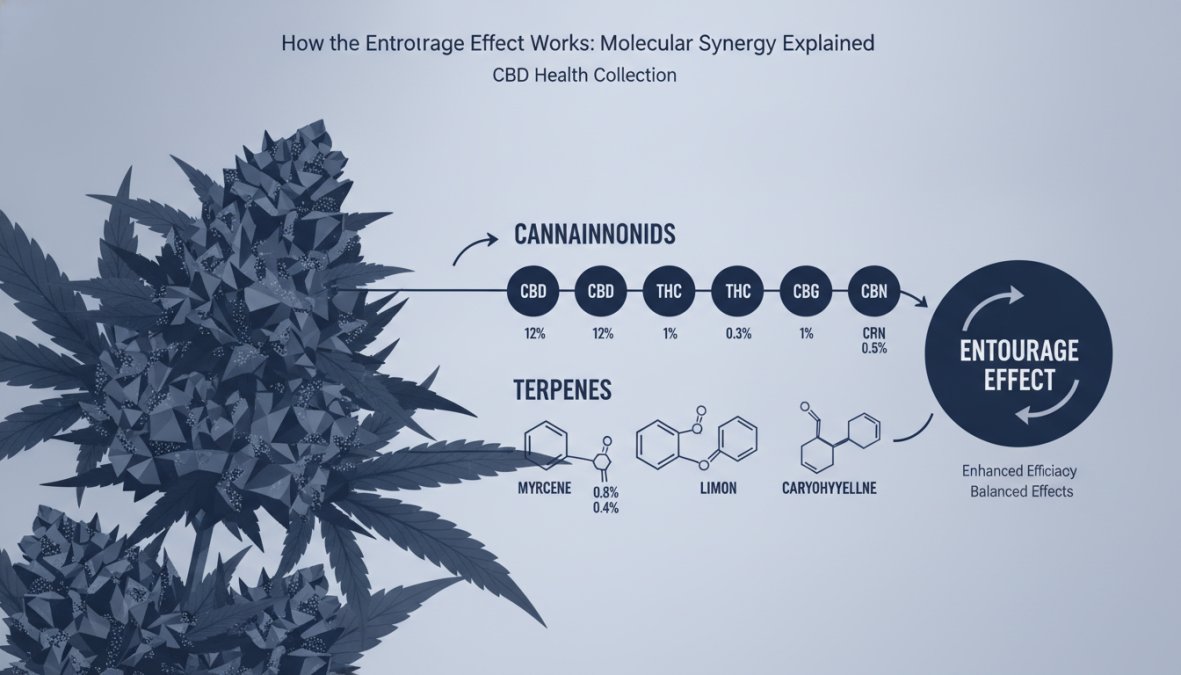
A 2025 pharmacology review found that certain terpenes increase cannabinoid bioavailability by up to 20%, meaning your body extracts more therapeutic value from the same dose. Without these terpenes, you’re essentially wasting a portion of your CBD or THC.
Additive vs. Antagonistic Effects
Not all compound interactions produce synergy. Additive effects occur when two compounds work together to amplify a desired outcome; limonene enhances CBD’s anti-inflammatory properties, for example. Antagonistic effects happen when one compound dampens another’s action, which isn’t necessarily negative. Sometimes antagonistic interactions prevent unwanted side effects or broaden the therapeutic window of a cannabinoid.
Antagonistic effects can also mean unwanted interactions. If you’re sensitive to THC’s psychoactive effects, consuming a full-spectrum product with high THC alongside certain terpenes that increase THC bioavailability could intensify that effect. This is why product selection and dosing transparency matter.
Bioavailability and Absorption
A 50mg CBD isolate might deliver only 6-8mg of active compound to your system, while the same 50mg dose in a full-spectrum extract with specific terpenes could deliver 10-12mg or more. Myrcene increases cell membrane permeability, allowing cannabinoids to cross barriers more efficiently. Pinene inhibits certain metabolic enzymes, slowing cannabinoid breakdown and extending duration. Limonene enhances absorption in the gastrointestinal tract.
If you’re comparing products by CBD milligrams alone, you’re missing the critical variable of bioavailability. A 500mg full-spectrum product might deliver more active cannabinoid benefit than a 1000mg isolate, depending on terpene composition and extraction method.
Cannabinoids and Endocannabinoid System: The Foundation
The entourage effect only makes sense when you understand the endocannabinoid system (ECS), the biological network that cannabinoids interact with. Your ECS maintains homeostasis, regulating sleep, mood, pain perception, immune function, and inflammation.
CB1 and CB2 Receptors
CB1 receptors concentrate primarily in your brain and central nervous system, governing neurological functions like mood, memory, and pain perception. CB2 receptors populate immune cells, the gastrointestinal tract, and peripheral tissues, managing inflammation and immune response.
Cannabinoids alone have moderate receptor affinity, but terpenes and flavonoids modulate receptor sensitivity and expression. Beta-caryophyllene actually binds directly to CB2 receptors, amplifying immune-modulating effects. Limonene increases the permeability of the blood-brain barrier, allowing more CBD to reach CB1 receptors in the brain. Research from the Journal of Cannabis Research has documented how specific terpene-cannabinoid combinations produce measurable changes in receptor binding patterns and downstream cellular signaling.
THC and CBD in the Entourage Context
THC binds directly and potently to CB1 receptors, producing psychoactive effects. CBD has weak direct CB1 binding but instead modulates CB1 receptor function indirectly, often dampening THC’s psychoactive intensity while preserving therapeutic benefits. A 1:1 ratio of THC to CBD produces a notably different experience than THC alone, even at identical THC doses.
The entourage effect isn’t about getting more cannabinoids, it’s about those cannabinoids working more efficiently within your body’s endocannabinoid system. Full-spectrum products achieve this through molecular diversity; isolates cannot.
Benefits of CBD Terpenes and Flavonoids
Terpenes are organic compounds responsible for cannabis’s distinctive aromas and flavors, but they’re far more than sensory elements. Each terpene carries its own pharmacological profile: myrcene is sedating, limonene is uplifting, pinene is clarifying. When combined with cannabinoids, these terpenes fundamentally alter the therapeutic profile of the product.
Common Terpenes and Their Roles
Myrcene dominates the terpene profiles of most cannabis strains, comprising 20-65% of the terpene content in some cultivars. This earthy, clove-like terpene is profoundly sedating and increases cell membrane permeability, enhancing cannabinoid absorption and allowing them to cross the blood-brain barrier more efficiently. For consumers seeking sleep support or deep relaxation, myrcene-rich full-spectrum products amplify CBD’s calming effects far beyond what CBD isolate alone could achieve.
Limonene, with its bright citrus aroma, produces uplifting and mood-supportive effects. Research indicates limonene enhances serotonin signaling and increases gastrointestinal absorption of cannabinoids. Pinene (found in pine needles and rosemary) acts as a bronchodilator and enhances focus, while beta-caryophyllene (peppery, spicy) directly activates CB2 receptors, amplifying anti-inflammatory and immune-supporting effects.
Flavonoids as Synergistic Compounds
Cannabis contains over 20 identified flavonoids, many of which are also found in tea, berries, and dark chocolate. These compounds possess antioxidant and anti-inflammatory properties independent of cannabinoids, but when combined with CBD and THC, they enhance receptor signaling and reduce inflammatory cytokines more effectively than cannabinoids alone.
Cannflavin A, a flavonoid unique to cannabis, showed in preliminary research to be 30 times more potent than aspirin at reducing inflammatory markers. Full-spectrum extracts retain these flavonoids; broad-spectrum and isolate products typically lose them during processing.
Full Spectrum vs. Broad-Spectrum CBD: Which Maximizes the Entourage Effect?
The product category you choose determines whether you access the entourage effect at all. Full-spectrum, broad-spectrum, and isolate represent three distinct approaches to CBD extraction and processing.
Full-Spectrum Products
Full-spectrum extracts retain the entire plant matrix: all cannabinoids (CBD, THC, CBN, CBG, and 100+ others), all terpenes, all flavonoids, and all other phytochemicals present in the source material. This is the entourage effect in its complete form.
The trade-off: full-spectrum products contain trace to moderate amounts of THC (typically 0.3% or less in hemp-derived products, compliant with federal regulations). For consumers concerned about THC’s psychoactive effects or those subject to drug testing, this presents a barrier. For pain relief, sleep support, and stress management, full-spectrum remains the most comprehensive approach to using the entourage effect.
Broad-Spectrum and Isolate Comparison
Broad-spectrum extracts remove THC through post-extraction processing while retaining most cannabinoids and terpenes. This creates a middle ground: you access much of the entourage effect without THC’s psychoactive properties. Isolates represent the opposite extreme, removing all compounds except CBD, eliminating the entourage effect entirely.
| Product Type | Cannabinoid Profile | Terpenes Present | THC Content | Entourage Effect |
|---|---|---|---|---|
| Full-Spectrum | 100+ cannabinoids | Yes, complete | 0.3% or less | Maximum |
| Broad-Spectrum | 10-20 cannabinoids | Yes, partial | None/trace | Moderate |
| Isolate | CBD only | None | None | None |
For most consumers seeking wellness benefits, broad-spectrum represents a practical balance: strong entourage effect without THC concerns.
Check the Certificate of Analysis (COA) from your CBD product’s third-party lab test. A detailed COA will show the full cannabinoid and terpene profile. If the COA lists only CBD percentage, you’re likely looking at an isolate or heavily processed extract.
Is the Entourage Effect Scientifically Proven?
The entourage effect is supported by compelling preliminary research, yet the scientific community remains cautious about making definitive claims. Most research has occurred in cell cultures or animal models, where researchers can precisely control variables and measure molecular outcomes. These studies consistently demonstrate that full-spectrum extracts outperform isolated cannabinoids at equivalent doses.
A 2021 review published in Frontiers in Plant Science examined available evidence on cannabis synergy and concluded that the entourage effect is "pharmacologically plausible" with "emerging clinical support," but that rigorous human trials remain scarce. Cannabis’s legal status in many jurisdictions has historically restricted research funding and clinical trial approval, creating an evidence gap that persists today.
Definitive proof requires large, controlled clinical trials comparing full-spectrum, broad-spectrum, and isolate products at equivalent cannabinoid doses while measuring specific biomarkers. Researchers also need to map which specific terpene-cannabinoid combinations produce which effects and optimal ratios in human populations. The honest assessment: the entourage effect is well-supported by preliminary evidence and mechanistic plausibility, but not yet proven with the rigor that regulatory agencies typically demand.
Practical Dosing and Product Selection for Entourage Benefits
Understanding the entourage effect theoretically matters far less than knowing how to apply it practically. If you want to maximize entourage benefits, product selection and dosing strategy are critical.
How to Choose Products That Use the Entourage Effect
Start by identifying your primary wellness goal. Are you seeking sleep support, pain relief, stress management, or general wellness? Your goal should drive your terpene selection because different terpene profiles support different outcomes.
For sleep support, prioritize full-spectrum or broad-spectrum products high in myrcene. Check the lab report’s terpene profile; if myrcene comprises 20% or more of the terpene content, that product will amplify CBD’s sedative effects. For pain relief and inflammation, seek products containing myrcene, beta-caryophyllene, and limonene in balanced ratios. For stress and mood support, limonene-dominant products work best.
Consumer Safety and Potential Interactions
Full-spectrum products containing trace THC carry minimal psychoactive risk at standard doses, but they warrant caution if you’re drug-tested for employment or sports competition. Terpenes themselves are generally safe at the concentrations found in CBD products, but they can interact with certain medications. Limonene may interact with blood pressure medications; myrcene could potentiate sedative effects if you’re already taking sleep aids. If you’re on prescription medications, consult your healthcare provider before adding full-spectrum CBD products to your routine.
Full-spectrum products may produce stronger effects than isolates, potentially requiring dose adjustment. Start with lower doses when switching product types and adjust upward based on your response.
If you’re pregnant, breastfeeding, or have liver conditions, consult a healthcare provider before using any CBD product. The entourage effect amplifies cannabinoid bioavailability, which could increase risks in these populations.
Conclusion: Making Informed Choices About the Entourage Effect
Choosing the right CBD product means understanding what the entourage effect is and recognizing that not all CBD products are created equal. Full-spectrum extracts deliver the complete plant synergy, while broad-spectrum and isolate products sacrifice some therapeutic potential for simplicity and THC elimination.
The entourage effect represents the future of cannabinoid medicine, moving away from single-compound approaches toward whole-plant synergy. If you’re seeking maximum therapeutic benefit from your CBD investment, prioritize full-spectrum or broad-spectrum products with transparent, third-party-verified lab reports showing complete cannabinoid and terpene profiles.
Finding quality full-spectrum CBD that actually delivers on the entourage effect requires choosing a brand that prioritizes transparency and extraction integrity. CBD Health Collection’s full-spectrum and broad-spectrum products are extracted using clean CO2 processing, independently lab-tested for purity and potency, and formulated with specific terpene profiles targeting sleep support, pain relief, stress management, and everyday wellness. Every product includes a detailed Certificate of Analysis, so you know exactly what compounds you’re consuming and why.
Frequently Asked Questions
What is the entourage effect in CBD, and why does it matter?
The entourage effect in CBD refers to the theory that cannabinoids, terpenes, and flavonoids work together synergistically to produce greater therapeutic effects than any single compound alone. This matters because it suggests full-spectrum CBD products may offer more comprehensive wellness benefits than CBD isolates. While the entourage effect is supported by anecdotal evidence and preliminary research, ongoing clinical trials continue to explore the precise mechanisms of how these plant-based compounds interact within the endocannabinoid system.
How do terpenes contribute to the entourage effect in CBD products?
Terpenes are aromatic compounds in cannabis that influence how cannabinoids interact with CB1 and CB2 receptors. Common terpenes like myrcene, limonene, and pinene may modulate the effects of CBD and THC, potentially enhancing bioavailability and therapeutic potential. For example, myrcene may increase cell membrane permeability, allowing cannabinoids to be absorbed more efficiently. The benefits of CBD terpenes extend beyond synergy, they contribute their own pharmacological properties, creating a more complete wellness profile in full-spectrum formulations.
What is the difference between full-spectrum and broad-spectrum CBD regarding the entourage effect?
Full-spectrum CBD contains all cannabinoids, terpenes, and flavonoids from the cannabis plant, including trace amounts of THC (below 0.3% in legal products). This complete profile maximizes potential synergistic interactions. Broad-spectrum CBD removes most THC while retaining other compounds, offering a middle ground. CBD isolate contains only pure cannabidiol. For consumers seeking maximum entourage effect benefits, full-spectrum products theoretically provide the most comprehensive molecular interaction, though individual responses vary based on the endocannabinoid system's unique characteristics.
Is the entourage effect scientifically proven?
The entourage effect remains partially proven. While preliminary research and anecdotal evidence support the concept of synergistic cannabinoid and terpene interactions, large-scale clinical trials are still limited. Some studies demonstrate that whole-plant extracts produce different effects than isolated cannabinoids, suggesting synergy exists. However, researchers need more rigorous clinical trials to fully understand the mechanisms and confirm therapeutic benefits. The entourage hypothesis represents a compelling area of ongoing pharmacology research, but consumers should base decisions on both emerging science and personal wellness goals.
This article was written using GrandRanker