Table of Contents
- Can CBD Fail a Drug Test? Understanding the Risk
- CBD Isolate vs Full Spectrum Drug Test Results
- THC Contamination in CBD Products: What You Need to Know
- How Long Does CBD Stay in Your System?
- How to Pass a Drug Test While Using CBD
- False Positives: Can CBD Cause a Failed Drug Test?
- What Not to Do: Common Mistakes When Using CBD Before Drug Tests
- Conclusion: Making Informed CBD Choices
Can CBD Fail a Drug Test? A Complete Guide
Last Updated: July 2, 2026
The question of whether can cbd fail drug test is one that affects millions of people in safety-sensitive jobs, athletes subject to testing, and anyone concerned about their employment. At CBD Health Collection, we understand this concern deeply, it’s one of the most frequently asked questions we receive from customers considering CBD products. The short answer is yes, it’s possible, but the risk depends heavily on what type of CBD product you’re using and whether it contains trace amounts of THC. Below, we’ll show you exactly how to evaluate that risk and choose products that won’t jeopardize your livelihood.
According to the U.S. Drug Enforcement Administration (DEA), hemp-derived CBD products are legal at the federal level only if they contain no more than 0.3% THC by dry weight. However, this threshold creates a real problem: even products within that legal limit can accumulate enough THC metabolites in your system to trigger a positive result on a standard drug test. The distinction between legal and detectable is what most guides skip over, and it’s where the actual risk lives.
How Drug Tests Work and What They Detect
Drug tests use a two-stage screening process designed to catch THC use, not CBD use. The initial screening relies on immunoassay technology, which detects THC metabolites, the breakdown products your body creates after processing THC. This screening is sensitive but not specific, meaning it can flag compounds that resemble THC metabolites without actually being THC itself.
If the immunoassay screening comes back positive, the sample moves to a confirmation test using gas chromatography-mass spectrometry (GC-MS). This is the gold standard. GC-MS can distinguish between actual THC and other cannabinoids or metabolites that might have triggered the initial screen. The critical threshold for a confirmed positive is typically 50 nanograms per milliliter (ng/mL) of THC metabolites in urine, though some employers and testing facilities use 15 ng/mL for safety-sensitive positions.
The immunoassay screening is where false positives can occur. Broad-spectrum CBD products, which contain many cannabinoids but have THC removed, sometimes trigger these initial screens because some of their remaining cannabinoids structurally resemble THC metabolites. However, the GC-MS confirmation typically clears these cases, assuming the product actually contains no THC. The real danger isn’t false positives from CBD itself; it’s real THC accumulation from contaminated or mislabeled products.
If you fail an immunoassay screening and the GC-MS confirmation also comes back positive, you’ve likely consumed enough THC to trigger a genuine positive result. This is not a false positive, it’s evidence that the product you used contained more THC than advertised or you consumed enough full-spectrum CBD to accumulate detectable metabolites.
CBD Isolate vs Full Spectrum Drug Test Results
The difference between CBD isolate and full-spectrum products is the single biggest factor determining whether can cbd fail drug test becomes your problem. This distinction matters more than any other product choice you’ll make.
CBD isolate is pure cannabidiol with all other plant compounds removed during extraction and processing. Because it contains zero THC, zero other cannabinoids, and zero plant terpenes, it cannot accumulate THC metabolites in your system. If you use a verified CBD isolate product and still fail a drug test, the failure is due to something else, contamination in the testing process, a medication you’re taking, or a different substance entirely. For people in safety-sensitive positions, CBD isolate is the only CBD format that eliminates THC risk entirely.
Full-spectrum CBD contains the complete range of cannabinoids from the hemp plant, including trace amounts of THC (up to 0.3% by federal law). The problem is cumulative exposure. A single dose of full-spectrum CBD might contain 1-3 mg of THC. Over several days or weeks of consistent use, those small amounts add up. Your body stores THC metabolites in fat tissue, and they accumulate over time. After 7-14 days of regular full-spectrum CBD use, many users develop detectable THC metabolite levels, even though each individual dose was legally compliant.
Broad-spectrum CBD occupies the middle ground. It contains multiple cannabinoids and terpenes like full-spectrum but has THC removed through additional processing. In theory, broad-spectrum products should pose zero risk. In practice, the effectiveness of THC removal varies significantly between manufacturers. Some broad-spectrum products test at genuinely 0% THC. Others contain trace amounts that weren’t fully removed, or they become recontaminated during packaging. This is where third-party testing becomes essential.
If you’re facing a drug test within the next two weeks and currently use full-spectrum CBD, switching to CBD isolate won’t help, your body still contains accumulated THC metabolites. Plan ahead: if you know a test is coming, stop full-spectrum CBD use at least 21-28 days in advance to allow metabolite clearance. This is far more reliable than hoping the test uses a higher detection threshold.
THC Contamination in CBD Products: What You Need to Know
Not all CBD products are created equal, and unregulated products pose a genuine risk. Research from the FDA’s CBD enforcement actions has documented cases where CBD products labeled as containing 0% THC actually contained 5-10% THC by weight. These aren’t rare exceptions, they’re systematic problems in the unregulated market.
The CBD industry operates in a legal gray zone. The FDA doesn’t regulate CBD as a dietary supplement or pharmaceutical, which means manufacturers can make claims without third-party verification. Some companies deliberately add THC to increase the product’s effects and market appeal. Others simply have poor quality control and don’t verify their final product composition. Either way, the consumer bears the risk.
Why does this happen? Full-spectrum extraction is cheaper and faster than isolate production. Some manufacturers extract full-spectrum material, make vague claims about "THC removal," and sell it as broad-spectrum or even isolate without actually removing the THC. The product looks and tastes the same, costs less to produce, and consumers have no way to know the difference without lab testing.
The federal 0.3% THC limit exists because that’s the threshold below which most people won’t experience psychoactive effects. It has nothing to do with drug test detection. A product at the legal 0.3% THC limit, taken consistently for two weeks, will almost certainly cause a positive drug test result. The law doesn’t protect you from testing positive, it only protects manufacturers from federal prosecution.
Certificate of Analysis and Third-Party Testing
The only reliable defense against THC contamination is a Certificate of Analysis (COA) from an independent third-party lab. A legitimate COA includes:
- The exact THC percentage by weight
- The exact CBD percentage by weight
- A complete cannabinoid profile (all detected cannabinoids listed)
- Detection limits for the testing method used
- The lab’s accreditation or certification status
- The batch number and testing date
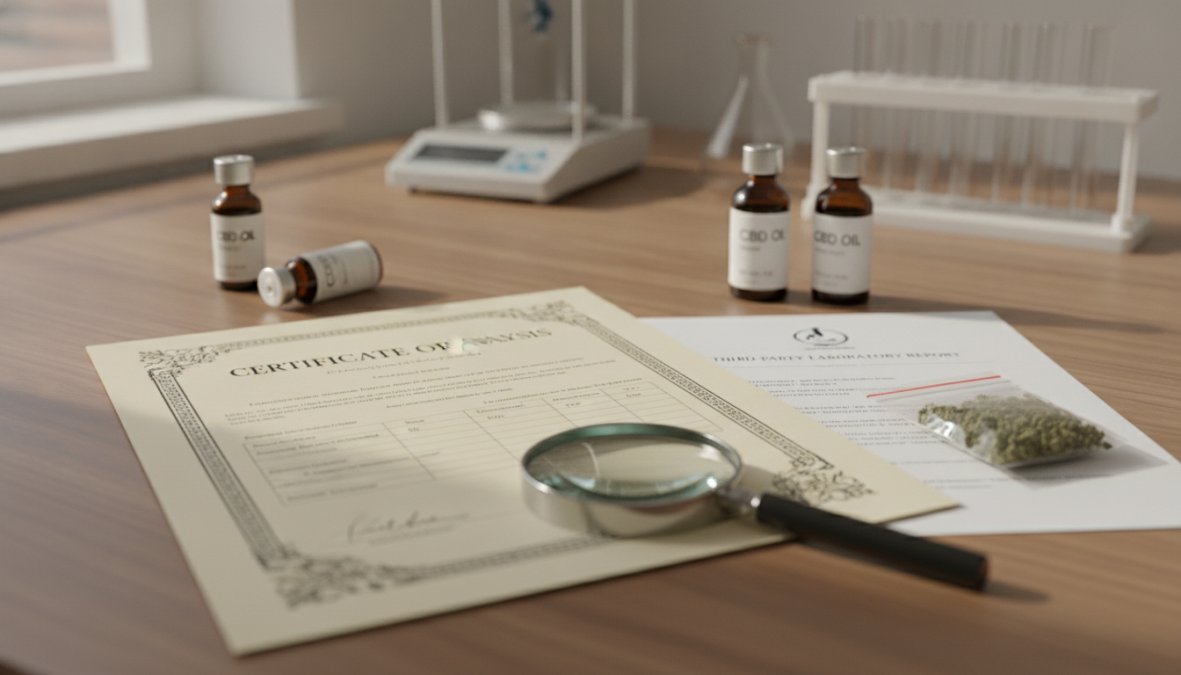
When you see a COA that lists "THC: <0.01%" or "THC: Not Detected," that’s meaningful. It means the lab tested for THC and found it below their detection limit, typically 0.01% or lower. A COA that lists "0% THC" without a detection limit is less reliable; it might mean the lab didn’t actually test for THC or used a crude testing method.
CBD Health Collection tests every batch of every product through independent third-party labs and makes the COA publicly available on our website. This isn’t a marketing advantage, it’s a basic transparency requirement that protects customers. If a company won’t provide a COA, or if their COA is from their own in-house lab, assume the product’s THC content is unknown and potentially problematic.
Different labs use different testing methods with different accuracy levels. High-performance liquid chromatography (HPLC) and gas chromatography-mass spectrometry (GC-MS) are the gold standards. If a COA doesn’t specify the testing method, ask the company directly. Some budget labs use less precise methods that might miss low-level THC contamination.
How Long Does CBD Stay in Your System?
The detection window for THC metabolites depends on several factors: how much THC you consumed, how frequently you consumed it, your body composition, your metabolism, and the detection threshold of the test being used. But understanding how drug tests detect THC is equally important, because the same amount of THC metabolites in your system can produce a positive result on one test and a negative result on another, depending on the testing methodology and threshold used.
THC Metabolite Accumulation and Clearance Timelines
A single dose of full-spectrum CBD typically produces detectable THC metabolites within 2-4 hours. Those metabolites remain detectable for 3-5 days in most cases. However, if you use full-spectrum CBD daily, THC metabolites accumulate in your fatty tissue and can remain detectable for 21-30 days or longer, even after you stop using the product.
This is why can cbd fail drug test becomes a serious concern for regular users. You might use full-spectrum CBD for two weeks, stop completely, and still test positive a week later. The metabolites are still in your system, slowly clearing.
The timeline varies significantly based on individual factors:
-
Body fat percentage: THC metabolites are fat-soluble, meaning they accumulate in fatty tissue. A person with 30% body fat will retain metabolites longer than a person with 15% body fat, even if both consumed the same amount of THC. This is one of the most significant variables and is often overlooked in generic "how long does THC stay in your system" guides.
-
Frequency of use: A single dose clears in 3-5 days. Daily use for two weeks can result in 21-30 days of detectability. The difference is cumulative exposure, each dose adds THC that hasn’t fully cleared from the previous dose.
-
Metabolism rate: People with faster metabolisms (influenced by age, genetics, liver function, and activity level) clear THC metabolites more quickly. A 25-year-old athlete might clear metabolites in 15 days; a 55-year-old with sedentary habits might take 35 days. This is why "standard" timelines are misleading.
-
Liver function: Medications that inhibit cytochrome P450 enzymes (common antidepressants, anticonvulsants, and some blood pressure medications) slow THC metabolism. If you’re on these medications, THC clearance can be 50% slower than average.
-
Dosage: A 10 mg dose of THC clears faster than a 50 mg dose. Full-spectrum CBD products vary widely in THC content (0.05% to 0.3%), so the actual THC dose varies by product and serving size.
How Drug Tests Actually Work: The Two-Stage Process
Understanding the two-stage testing process is critical because it explains why someone might fail one test and pass another, and why the threshold matters more than most people realize.
Stage 1: Immunoassay Screening
The initial screening uses immunoassay technology, which works like a lock-and-key system. The test uses antibodies (proteins) that are designed to bind to THC metabolites. If THC metabolites are present in the sample, they bind to the antibodies, triggering a color change or fluorescent signal that indicates a positive result.
The critical limitation of immunoassay is that it’s not perfectly specific. The antibodies are designed to recognize THC metabolites, but they can also bind to other compounds with similar chemical structures. This is why broad-spectrum CBD products, which contain cannabinoids like CBN (cannabinol) and CBG (cannabigerol), can sometimes trigger false positives on immunoassay screening. The antibodies recognize these cannabinoids as "THC-like" even though they’re not THC.
Immunoassay screening uses a cutoff threshold, typically 50 ng/mL (nanograms per milliliter) for standard employment testing, though some employers and safety-sensitive positions use 15 ng/mL or even 5 ng/mL. This threshold is crucial: a sample with 45 ng/mL of THC metabolites will pass a 50 ng/mL test but fail a 15 ng/mL test. The same person, the same sample, different results depending on the threshold.
If the immunoassay screening comes back positive (above the cutoff), the sample moves to confirmation testing. If it comes back negative (below the cutoff), the test is reported as negative, and no further testing occurs.
Stage 2: GC-MS Confirmation Testing
If the immunoassay screening is positive, the sample moves to gas chromatography-mass spectrometry (GC-MS) confirmation. This is the gold standard and is far more specific than immunoassay.
GC-MS works by ionizing the sample (breaking molecules into charged fragments) and measuring the mass-to-charge ratio of each fragment. Each compound produces a unique fragmentation pattern, like a molecular fingerprint. THC has a specific fingerprint that’s distinct from CBN, CBG, and other cannabinoids. This is why GC-MS can definitively distinguish THC from other compounds that might have triggered the immunoassay screen.
GC-MS also uses a cutoff threshold, typically 50 ng/mL for standard testing, though some labs use 15 ng/mL for confirmation as well. If the GC-MS result is above the cutoff, the test is confirmed positive. If it’s below the cutoff, the immunoassay screening is reported as a false positive, and the final result is negative.
This is where the distinction between false positives and true positives becomes clear:
-
False positive: Immunoassay screening is positive (above 50 ng/mL), but GC-MS confirmation is negative (below 50 ng/mL). This can happen if the person used broad-spectrum CBD with cannabinoids that triggered the immunoassay antibodies, but the actual THC content is below the threshold. The screening was wrong; the confirmation is correct.
-
True positive: Both immunoassay screening and GC-MS confirmation are positive (above the cutoff). This means THC metabolites are genuinely present in the sample at detectable levels. The source could be intentional THC use, or it could be THC from a contaminated or mislabeled CBD product, but the result is genuine.
If you fail an immunoassay screening and the GC-MS confirmation also comes back positive, you’ve accumulated enough THC to trigger a genuine positive result. This is not a false positive, it’s evidence that the product you used contained more THC than advertised, or you consumed enough full-spectrum CBD to accumulate detectable metabolites over time.
Why Thresholds Matter More Than You Think
The cutoff threshold is the single most important factor in determining whether you pass or fail a drug test. A sample with 60 ng/mL of THC metabolites will:
- Pass a test using a 100 ng/mL threshold
- Fail a test using a 50 ng/mL threshold
- Fail a test using a 15 ng/mL threshold
The same person, the same sample, three different outcomes. This is why knowing your employer’s or testing facility’s threshold is critical. Standard employment testing uses 50 ng/mL, but safety-sensitive positions (DOT, healthcare, law enforcement) often use 15 ng/mL or even 5 ng/mL.
Full-spectrum CBD users often accumulate THC metabolites in the 30-80 ng/mL range after 2-3 weeks of daily use, depending on the factors listed above. This range is:
- Below the 100 ng/mL threshold (would pass)
- Around or above the 50 ng/mL threshold (likely to fail)
- Well above the 15 ng/mL threshold (will definitely fail)
This is why a full-spectrum CBD user might pass a test at one facility and fail at another, even if they used the same product and the same amount.
Detection Windows and Bioavailability Factors
The absorption rate of CBD varies dramatically based on how you consume it, and this affects how quickly THC accumulates in your system.
Oral CBD (oils, gummies, capsules) takes 30-90 minutes to reach peak blood concentration and has lower bioavailability, meaning less of the CBD actually enters your bloodstream. Bioavailability for standard oral CBD is typically 6-15%, depending on whether you take it with food (which increases absorption). This slower absorption means THC from oral CBD accumulates more gradually, but it still accumulates with daily use.
Sublingual administration (placing CBD oil under your tongue) absorbs faster and more efficiently, with bioavailability around 13-19%. The sublingual route bypasses some of the digestive system, allowing faster absorption into the bloodstream. This means THC reaches your system faster and accumulates more quickly with daily use.
Topical CBD doesn’t enter the bloodstream in meaningful amounts, so it poses minimal THC risk. Topical products are absorbed through the skin and act locally; they don’t accumulate in your system the way oral or sublingual CBD does.
Inhalation (vaping CBD) has the highest bioavailability, around 34-46%, and the fastest onset, with peak levels in 3-10 minutes. If you’re vaping full-spectrum CBD, THC accumulates very quickly. This is the highest-risk consumption method for drug-test failure.
Bioavailability matters because it affects how much THC accumulates. A full-spectrum CBD oil with 10% bioavailability delivers less THC to your system than the same product with 40% bioavailability. Water-based CBD formulations, like those produced by CBD Health Collection using our proprietary extraction process, offer improved bioavailability compared to traditional oil-based products. This means better CBD effects, but it also means faster THC accumulation if you’re using full-spectrum.
The timing of your test relative to your last CBD dose matters too. If you use full-spectrum CBD in the morning and take a drug test that afternoon, THC levels will be higher than if you’d waited three days. This is why some people can use full-spectrum CBD sporadically and pass tests, while daily users almost always fail.
Metabolism Variables Affecting THC Detection
Your individual metabolism significantly impacts THC clearance rates. People with faster metabolisms clear THC metabolites more quickly; people with slower metabolisms retain them longer. Age, body fat percentage, liver function, and genetics all influence how rapidly your body breaks down and eliminates THC.
People with higher body fat percentages store THC metabolites longer because THC is fat-soluble. A lean person and an overweight person using the same full-spectrum CBD product will have different clearance timelines. The overweight person will likely test positive longer. Research suggests that for every 10% increase in body fat percentage, THC clearance can be delayed by 5-7 days.
Medications that interact with liver enzymes (especially cytochrome P450 inhibitors like fluoxetine, sertraline, and certain anticonvulsants) can slow THC metabolism significantly. If you’re taking these medications, THC might clear from your system 30-50% more slowly than average.
Hydration and exercise also play minor roles. Increased water intake doesn’t significantly flush THC metabolites, despite common myths, THC is stored in fat, not dissolved in blood, so drinking more water won’t accelerate clearance. Exercise can mobilize THC stored in fat tissue, sometimes causing metabolite levels to spike temporarily. For someone facing a drug test, moderate activity is fine, but intense exercise immediately before testing isn’t advisable because it can temporarily increase THC levels in urine.
If you’re facing a drug test within the next two weeks and currently use full-spectrum CBD, switching to CBD isolate won’t help, your body still contains accumulated THC metabolites. Plan ahead: if you know a test is coming, stop full-spectrum CBD use at least 21-28 days in advance to allow metabolite clearance. This is far more reliable than hoping the test uses a higher detection threshold.
How to Pass a Drug Test While Using CBD
The most reliable strategy is straightforward: use CBD isolate instead of full-spectrum, verify the product with a COA, and you eliminate the THC risk entirely. This approach works because CBD isolate contains zero THC and therefore cannot contribute THC metabolites to your system.
If you’re already using full-spectrum CBD and a test is coming, your options are limited. The metabolites are in your system and will clear on their own timeline, typically 21-30 days. You cannot accelerate this process with detox drinks, cranberry juice, or other remedies. Those products don’t work. What does work is time and stopping use of the THC-containing product.
Choosing High-Quality, Verified CBD Products
Start by requesting a COA before you buy. Legitimate companies provide these freely on their websites or via email within 24 hours. If a company is evasive about providing testing results, that’s a red flag. The product’s THC content is unknown, and the risk is unacceptable.
Look for COAs from accredited labs. Check whether the lab is listed on the Association of Commercial Labs (ACL) or similar accreditation bodies. Labs that specialize in cannabis and hemp testing are more reliable than general-purpose labs.
For isolate products, confirm the COA explicitly states "CBD Isolate" or lists the product as containing only CBD with no other cannabinoids. Broad-spectrum products should list multiple cannabinoids (CBG, CBN, CBC, etc.) but explicitly show THC as "Not Detected" or "<0.01%."
CBD Health Collection uses a clean CO2 extraction process and tests every batch independently. Our products are produced in a GMP- and FDA-registered facility, which means we follow pharmaceutical-grade manufacturing standards. We publish our COAs publicly, and we offer a 30-day satisfaction guarantee. If you use our isolate products and still fail a drug test, the failure isn’t due to THC from our product.
The single most important factor in passing a drug test while using CBD is choosing an isolate product from a company that publishes third-party test results. This eliminates THC exposure entirely and removes the uncertainty from the equation.
Documenting Your CBD Use for Employers
If you test positive and you’ve been using CBD, documentation can help. Keep receipts for your CBD purchases and the COA for the specific batch you used. If your product’s COA shows 0% THC or <0.01% THC, and you can prove you were using that product, you have evidence that the positive result wasn’t due to intentional THC use.
Some employers accept this explanation; others don’t. It depends on the company’s policy and the testing threshold they use. A result at 50 ng/mL is easier to explain as CBD-related accumulation than a result at 500 ng/mL, which suggests either heavy THC use or a product with significant THC content.
The stronger approach is prevention: use CBD isolate, keep your COAs on file, and you won’t need to explain a positive result because you won’t have one. This is far more reliable than hoping your employer accepts your explanation after the fact.
Special Considerations for DOT Safety-Sensitive Positions
The Department of Transportation enforces strict drug testing requirements for commercial drivers, safety inspectors, and other safety-sensitive roles. DOT testing uses a 50 ng/mL threshold for confirmed positives, which is higher than some employer thresholds, but it’s not high enough to protect full-spectrum CBD users.
DOT regulations don’t explicitly address CBD because CBD itself isn’t prohibited, THC is. However, the agency doesn’t distinguish between THC from intentional marijuana use and THC from CBD products. A positive test is a positive test, regardless of the source.
For DOT-regulated employees, CBD isolate is the only safe option. Even then, keep documentation of your product’s COA in case questions arise. Some DOT medical examiners are becoming more familiar with CBD and may accept an explanation that you’re using verified isolate, but you can’t count on this. The safest approach is to use isolate and maintain proof.
False Positives: Can CBD Cause a Failed Drug Test?
The technical answer is yes, but with important caveats. A false positive specifically means the test incorrectly identifies a substance as present when it isn’t. With CBD testing, false positives are possible but relatively rare at the confirmation stage.
The immunoassay screening can flag broad-spectrum CBD products because some of their cannabinoids (like CBN or CBG) have chemical structures that vaguely resemble THC metabolites. The screening antibodies bind to these compounds, triggering a positive result. This is a false positive in the screening phase.
However, when the sample moves to GC-MS confirmation, the false positive typically resolves. GC-MS can distinguish between THC and other cannabinoids with high precision. If the sample truly contains no THC, the confirmation test will show that.
The real risk isn’t false positives from CBD itself, it’s true positives from THC-contaminated products. A product labeled as "broad-spectrum" or "isolate" that actually contains 1-2% THC will cause a true positive on both screening and confirmation. The test isn’t wrong; the product is.
Immunoassay Screening vs GC-MS Confirmation
Understanding the two-stage process is crucial for interpreting results. An immunoassay screening positive doesn’t mean you’ve failed. It means the sample warrants further testing. Many screening positives are resolved during confirmation.
If you screen positive and want to understand why, request the GC-MS confirmation results. If those results show THC below 50 ng/mL (or your employer’s threshold), you’ve passed. If they show THC above the threshold, you’ve genuinely tested positive, and the source is either THC-containing products you used or contaminated CBD products.
Some employers don’t run confirmations automatically, they only do so if you request it or challenge the result. If you screen positive and believe you’re using clean CBD isolate, request the confirmation test. This is your right, and most testing facilities will accommodate the request.
Distinguishing CBD from THC Metabolites
The GC-MS confirmation can distinguish CBD from THC metabolites because they have different molecular structures and different mass-to-charge ratios. The machine ionizes the sample and measures how the fragments scatter, each compound produces a unique pattern.
However, GC-MS cannot distinguish between THC from marijuana use and THC from CBD products. If THC metabolites are present, they’re present. The source doesn’t matter to the test. This is why product verification is so important, you need to know whether your CBD product actually contains THC before you use it, not after you test positive.
Some testing facilities offer additional analysis (like measuring the ratio of THC to CBD) that can suggest whether a positive result came from CBD use or marijuana use, but this isn’t standard and requires a more expensive test. Don’t count on it.
What Not to Do: Common Mistakes When Using CBD Before Drug Tests
The biggest mistake is using full-spectrum CBD and assuming you’ll pass a drug test because the THC content is "only" 0.3%. That threshold is legal, not safe for testing. Full-spectrum CBD used daily for two weeks will almost certainly produce detectable THC metabolites.
Another common mistake is trusting product labels without verification. A label that says "0% THC" or "THC-Free" is a marketing claim, not a guarantee. Manufacturers can print anything on a label. The only verification that matters is a third-party COA from an accredited lab.
Don’t use detox drinks or flushing products. These don’t work. THC metabolites are stored in fat tissue and can’t be flushed out with fluids. Some detox products contain substances that dilute urine, which can trigger a "dilute specimen" result, a failure that’s even harder to explain than a positive.
Don’t wait until the day before a test to switch from full-spectrum to isolate. The metabolites from your previous full-spectrum use are still in your system. Switching products at the last minute won’t help. If you know a test is coming, stop full-spectrum use at least three weeks in advance.
Don’t assume your employer will accept an explanation after you test positive. Prevention is far more reliable than explanation. Use isolate, keep your COAs, and avoid the situation entirely.
If you’re in a safety-sensitive position (DOT, healthcare, law enforcement, military), using full-spectrum CBD before a drug test is not a calculated risk, it’s a mistake that could cost your job. Use isolate or don’t use CBD at all.
Conclusion: Making Informed CBD Choices
The question of whether can cbd fail drug test has a clear answer: it depends entirely on what product you use and how you use it. CBD isolate poses zero risk. Full-spectrum CBD poses a real risk if you use it regularly or if a test comes within 21-30 days of use.
If you’re considering CBD for wellness but facing drug testing requirements, CBD Health Collection offers independently verified isolate products with published third-party lab results. Our broad-spectrum gummies and oils undergo rigorous testing to confirm THC content, and every product comes with a 30-day satisfaction guarantee. Start with a verified isolate product, review the COA before purchase, and you can use CBD confidently without jeopardizing your employment or safety clearance.
| Product Type | THC Content | Drug Test Risk | Best For |
|---|---|---|---|
| CBD Isolate | 0% THC | Zero risk | Safety-sensitive positions, DOT roles, frequent testing |
| Broad-Spectrum | <0.01% THC (verified) | Minimal if tested | Users wanting full cannabinoid benefits with low risk |
| Full-Spectrum | Up to 0.3% THC | High risk with regular use | Users without drug testing concerns |
| Unverified Products | Unknown | Very high risk | Not recommended for anyone |
Frequently Asked Questions
Can CBD fail a drug test if it contains trace amounts of THC?
Yes, CBD products containing trace amounts of THC above 0.3% can potentially cause a failed drug test, especially with prolonged use or high dosages. Standard immunoassay drug tests detect THC metabolites in urine. Most hemp-derived CBD products are legal at the federal level but may contain detectable THC. Full-spectrum CBD carries higher risk than CBD isolate. Always verify your product's Certificate of Analysis (COA) to confirm THC levels before use if you're subject to drug testing.
What's the difference between CBD isolate vs full spectrum for drug testing?
CBD isolate contains only cannabidiol with virtually no THC, making it the safest choice for drug testing. Full-spectrum CBD includes all cannabinoids, terpenes, and plant compounds, including trace THC up to 0.3% federally. Broad-spectrum falls between the two, removing most THC while retaining other beneficial compounds. For employment in safety-sensitive positions or frequent drug testing, CBD isolate or broad-spectrum products with verified third-party testing offer the lowest risk of a positive result.
How long does THC from CBD products stay in your system?
Detection windows vary based on individual metabolism, dosage, frequency of use, and product type. THC metabolites can remain detectable in urine for 3-30 days depending on usage patterns. Bioavailability and pharmacokinetics differ between individuals, factors like body fat percentage, liver function, and hydration affect how quickly THC is eliminated. Single-use CBD products with minimal THC may clear faster than regular full-spectrum use. If drug testing is imminent, allow at least 48-72 hours after your last CBD dose, though longer windows are safer.
How can I verify that my CBD product won't cause a failed drug test?
Request the Certificate of Analysis (COA) from the manufacturer, this third-party lab test confirms exact THC and cannabinoid levels. Look for products tested by independent labs using GC-MS confirmation methods. Choose CBD isolate or broad-spectrum over full-spectrum if you're subject to drug testing. Buy from reputable, GMP-certified facilities using clean CO2 extraction. Avoid unregulated products, which carry high contamination risks. Document your CBD use and product details in case of a positive result requiring explanation to your employer.
This article was written using GrandRanker