Table of Contents
- What Is CBD Bioavailability and Why It Matters for Pain Relief
- Factors Affecting CBD Absorption and Systemic Circulation
- CBD Oil vs Water-Soluble CBD: Which Delivery System Maximizes Absorption
- How to Take CBD for Better Absorption: Practical Techniques
- CBD Dosage for Pain Management: Finding Your Optimal Dose
- Delivery Methods Compared: Oral, Sublingual, Topical, and Inhalation
- Common Mistakes That Reduce CBD Effectiveness
- Conclusion
Last Updated: August 14, 2026
What Is CBD Bioavailability and Why It Matters for Pain Relief
CBD bioavailability is the percentage of cannabidiol that enters your systemic circulation and becomes available to produce therapeutic effects. When you take CBD, not all of it reaches your bloodstream; some is metabolized or eliminated before it can work. Understanding bioavailability is essential for pain management because poor bioavailability requires higher doses to achieve results, while optimized bioavailability means you get more therapeutic benefit from less product.
The difference between 5% and 25% bioavailability is substantial. At 5%, you’d need five times more product to match the effects of a 25% bioavailability formulation. CBD Health Collection prioritizes optimized bioavailability across its product line, using water-based and lipid-enhanced delivery systems designed to maximize what your body actually absorbs.
CBD bioavailability determines how much cannabidiol actually reaches your bloodstream and produces therapeutic effects. Poor bioavailability means wasting money on products that don’t deliver results. Optimizing it is the difference between feeling relief and feeling nothing.
Factors Affecting CBD Absorption and Systemic Circulation
CBD absorption depends on multiple physiological and chemical factors. The lipophilic nature of cannabinoids, their affinity for fat, plays a central role. CBD dissolves in fat but not in water, which means it struggles to cross the aqueous environment of your digestive system without help. Taking CBD with fatty foods or using lipid-based formulations dramatically improves absorption rates.
First-pass metabolism is another critical factor. When you ingest CBD orally, it travels through your digestive system and liver before entering systemic circulation. Your liver contains enzymes called cytochrome P450 that metabolize cannabinoids, breaking them down before they can reach your bloodstream. This hepatic metabolism significantly reduces oral bioavailability compared to other delivery routes.
Individual variation in metabolism affects how efficiently your body processes CBD. Genetic differences in cytochrome P450 enzyme activity mean two people taking identical doses can experience different results. Age, body composition, liver function, and concurrent medications all influence how your system handles cannabinoids.
The permeability of your intestinal barrier also matters. CBD must cross the intestinal epithelium to enter the bloodstream. Factors like gut health, inflammation, and the presence of food in your digestive system affect this permeability. A damaged or inflamed gut lining reduces absorption, which is particularly relevant for people with inflammatory conditions.
If you’ve tried CBD before and didn’t feel results, don’t assume CBD doesn’t work for you. The issue is almost always bioavailability. Track how you’re taking it, with or without food, which formulation type, what time of day, and adjust systematically. Most people who “don’t respond” to CBD are actually just absorbing very little of it.
CBD Oil vs Water-Soluble CBD: Which Delivery System Maximizes Absorption
Traditional CBD oil, dissolved in carrier oils like MCT or hemp seed oil, has been the standard for years. Oil-based formulations already contain lipids, which help CBD absorption. When you take CBD oil with a fatty meal, you’re adding more lipids to the mix, further enhancing permeability. Bioavailability typically ranges between 4% and 20%, depending on whether you take it with food and your individual metabolism.
Water-soluble CBD represents a significant advancement in bioavailability optimization. These formulations use nano-emulsion technology to break CBD particles into microscopic droplets that mix evenly with water. Water-soluble CBD doesn’t require dietary fat to be absorbed; it can cross the intestinal barrier more efficiently on its own. Bioavailability for water-soluble formulations typically ranges from 15% to 30%, roughly double that of traditional oil-based products.
A 20 mg dose of traditional CBD oil might deliver 1-4 mg of bioavailable cannabinoid to your system. The same 20 mg dose of water-soluble CBD might deliver 3-6 mg. Over time, this compounds, you need less product to achieve the same therapeutic effect, which reduces both cost and daily intake.
CBD Health Collection’s water-based formulations use advanced nano-emulsion technology to optimize how CBD particles disperse in your digestive system, increasing bio-accessibility and improving therapeutic outcomes for pain management and inflammation.
| Delivery System | Typical Bioavailability | Best Taken With | Consistency |
|---|---|---|---|
| Traditional CBD Oil | 4-20% | Fatty meal | Variable |
| Water-Soluble CBD | 15-30% | Any time | More predictable |
| Liposomal CBD | 20-35% | Any time | Most predictable |
Don’t assume all “water-soluble” products are equal. The quality of nano-emulsion technology varies significantly between manufacturers. Look for third-party lab testing that specifically measures plasma concentration or bioavailability data, not just potency.
How to Take CBD for Better Absorption: Practical Techniques
The most effective technique for improving CBD absorption is taking it with lipid-rich foods. Fat enhances lymphatic absorption; CBD can be transported through the lymphatic system rather than going directly through first-pass hepatic metabolism. This route bypasses some of the liver’s metabolic processing, allowing more CBD to reach systemic circulation intact. Fatty foods that work well include avocado, nuts, seeds, full-fat yogurt, olive oil, and fatty fish. A meal containing 10-20 grams of fat significantly improves absorption compared to taking CBD on an empty stomach.
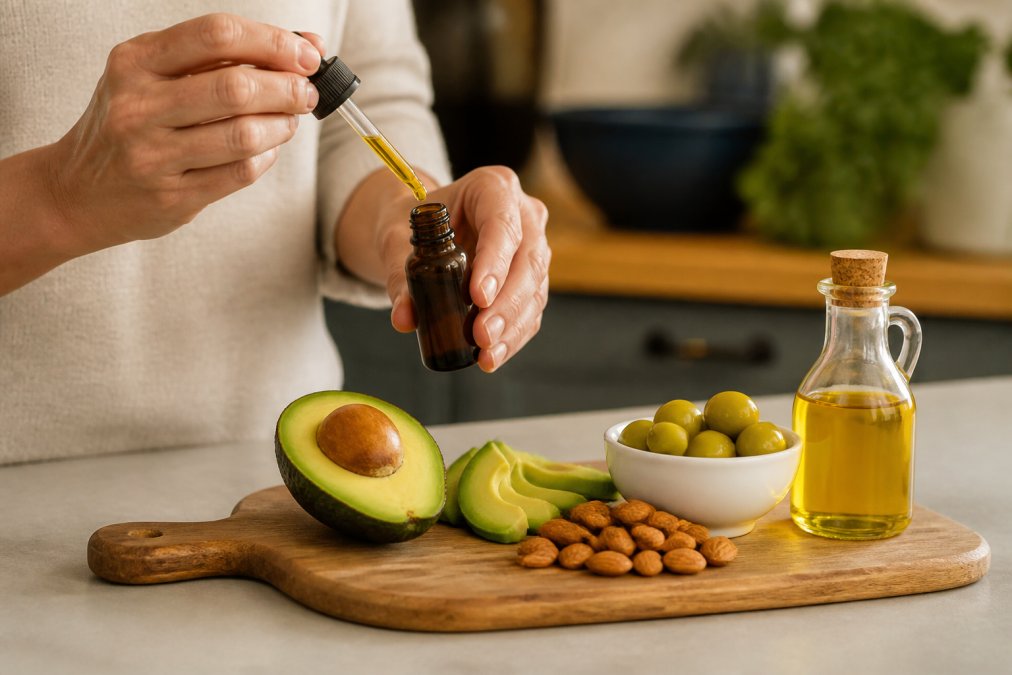
Timing matters as well. Take CBD with or shortly after your largest meal of the day, when your digestive system is actively processing fats and your intestinal permeability is optimized. If you take CBD at the same time each day with the same type of meal, your body develops a predictable absorption pattern, which stabilizes therapeutic effects.
Sublingual administration, placing CBD oil under your tongue for 60-90 seconds before swallowing, offers another absorption advantage. The tissue under your tongue is highly vascularized and permeable, allowing some CBD to absorb directly into the bloodstream through the sublingual mucosa. This bypasses first-pass metabolism entirely for the portion absorbed sublingually. The practical effect is a modest improvement over standard oral ingestion, typically 10-15% better absorption.
Consistency in your consumption routine is critical. Your body adapts to regular CBD intake, and steady-state plasma concentrations build over time. Daily use for at least 2-4 weeks allows your system to establish baseline cannabinoid levels, after which you can more accurately assess whether a particular dose is effective.
CBD Dosage for Pain Management: Finding Your Optimal Dose
There’s no universal "correct" dose for CBD pain management because individual bioavailability varies significantly. The standard approach is to start low and titrate upward: begin with a smaller dose and gradually increase until you notice therapeutic effects.

A practical starting point for chronic pain is 10-15 mg of CBD daily, taken consistently with food. Track your pain levels, inflammation, and any changes in your condition for 2-3 weeks at this dose. If you notice improvement, maintain that dose. If you don’t feel meaningful change, increase by 5-10 mg and continue tracking for another 2-3 weeks.
Most people find effective pain relief in the 15-50 mg daily range, though some require higher doses. Keep a simple log noting your dose, what time you took it, what you ate it with, your pain level before and after, and any other relevant observations. After 4-6 weeks of consistent tracking, patterns emerge showing which doses, timing, and food combinations produce the best results for your specific situation.
CBD Health Collection’s approach emphasizes personalization. Rather than recommending a one-size-fits-all dose, the company provides tools to help you identify your optimal dose, then track how different products and dosages affect your pain levels over time.
Delivery Methods Compared: Oral, Sublingual, Topical, and Inhalation
Oral ingestion, swallowing CBD oil, capsules, or gummies, is the most common delivery method for systemic pain management. Bioavailability ranges from 4-20% depending on formulation and whether you take it with food. Effects take 1-2 hours to onset because CBD must travel through your digestive system. Oral delivery is best for chronic pain management where you’re taking CBD daily.
Sublingual administration improves on oral bioavailability by allowing some CBD to absorb through the mucous membrane under your tongue. Bioavailability improves to roughly 12-35% depending on how long you hold the oil sublingually. Effects onset faster, typically 15-45 minutes. Sublingual dosing is ideal for people who want faster effects than oral delivery but prefer a non-inhalation method.
Topical application, creams, gels, and patches applied directly to skin over painful areas, works through localized absorption. CBD penetrates the skin and interacts with cannabinoid receptors in peripheral tissues without entering systemic circulation significantly. Topical bioavailability for systemic effects is minimal, but localized anti-inflammatory effects are substantial. CBD Health Collection’s topical freeze gel is specifically formulated for rapid absorption and localized pain relief, with customers reporting effects within 10-15 minutes of application.
Inhalation, vaping CBD, produces the highest bioavailability, typically 34-46%, because cannabinoids enter the lungs’ highly vascularized tissue and cross directly into the bloodstream. Effects onset within minutes. The disadvantage is that inhalation produces shorter duration effects, typically 3-4 hours compared to 6-8 hours for oral delivery. Inhalation is best for acute pain episodes where you need rapid relief.
| Delivery Method | Bioavailability | Onset Time | Duration | Best For |
| — | — | — | — |
| Oral (oil, capsules, gummies) | 4-20% | 1-2 hours | 6-8 hours | Chronic daily pain |
| Sublingual | 12-35% | 15-45 minutes | 4-6 hours | Faster effects, no inhalation |
| Topical (cream, gel, patch) | Localized only | 10-30 minutes | 4-6 hours | Localized joint/muscle pain |
| Inhalation (vaping) | 34-46% | 5-15 minutes | 3-4 hours | Acute pain episodes |
Common Mistakes That Reduce CBD Effectiveness
Taking CBD on an empty stomach is the most common mistake. Without dietary fat present, your intestinal system can’t efficiently absorb lipophilic cannabinoids. You’ll absorb perhaps 5-10% of your dose while the rest is eliminated. The fix is simple: take your CBD with breakfast, lunch, or dinner.
Switching between different products and doses constantly prevents your system from reaching steady-state cannabinoid levels. Commit to one product, one dose, and one consistent consumption pattern for at least 4 weeks before evaluating effectiveness.
Underestimating the importance of formulation quality is another widespread error. Poor extraction methods, low-quality carrier oils, and ineffective formulation technology all reduce bioavailability. Products lacking third-party lab testing may contain far less CBD than labeled. CBD Health Collection’s commitment to GMP-certified manufacturing, CO2 extraction, and independent third-party lab testing ensures formulation quality directly impacts your bioavailability.
Ignoring individual bioavailability variation leads people to dismiss CBD entirely. Someone reads that 20 mg is a typical dose, takes 20 mg once, feels nothing, and concludes CBD doesn’t work. They didn’t account for their personal absorption characteristics or give their system time to reach therapeutic levels.
Taking CBD inconsistently prevents steady-state accumulation. Sporadic use keeps your system below therapeutic thresholds, making pain relief inconsistent or absent.
If you’re taking other medications, particularly those metabolized by cytochrome P450 enzymes (like warfarin, certain statins, or benzodiazepines), CBD may interact with them by competing for enzyme activity. This can increase medication concentrations in your bloodstream. Always consult with a healthcare provider before adding CBD to an existing medication regimen.
Conclusion
Improving CBD bioavailability for pain relief comes down to three fundamentals: choosing a formulation optimized for absorption, taking it consistently with food, and tracking your individual response systematically. The difference between feeling relief and feeling nothing often isn’t whether CBD works, it’s whether your body is actually absorbing the CBD you’re taking.
CBD Health Collection’s water-soluble formulations and topical freeze gels are specifically designed to maximize bioavailability, meaning you absorb more cannabinoid per dose and experience more consistent pain relief. Combined with their commitment to third-party lab testing, GMP manufacturing, and a 30-day satisfaction guarantee, you can experiment with finding your optimal dose without financial risk. Start by taking CBD with food, tracking your pain levels daily, and adjusting your dose based on results. Most people find meaningful pain relief within 4-6 weeks of consistent, optimized CBD use.
Frequently Asked Questions
Does taking CBD with fat increase absorption?
Yes. CBD is lipophilic, meaning it dissolves in fat rather than water. Consuming CBD with fatty foods like nuts, avocados, coconut oil, or full-fat dairy increases plasma concentration and improves bioavailability. Taking your CBD dose with a meal containing 10-20 grams of fat can significantly enhance systemic circulation and therapeutic efficacy for pain management.
What form of CBD is most effective for pain relief?
Water-soluble and nano-emulsion CBD formulations offer superior bioavailability compared to standard oil-based products. These advanced delivery systems improve permeability and absorption rate, resulting in faster pain relief and steadier therapeutic levels. Sublingual administration of quality CBD oils also bypasses first-pass hepatic metabolism, allowing more cannabinoid to reach systemic circulation for joint inflammation and peripheral neuropathy.
How many mg of CBD is effective for pain relief?
Effective CBD dosage for pain varies by individual factors including body weight, pain severity, and previous cannabinoid experience. Many people find relief starting at 10-25 mg daily, with adjustments based on response. Dosage optimization requires tracking your symptoms and adjusting gradually. Consult a healthcare provider familiar with CBD to determine the appropriate dose for your specific pain condition and any medications you take.
Why is CBD bioavailability so low when taken orally?
Oral CBD undergoes first-pass hepatic metabolism, where the liver's cytochrome P450 enzymes break down the cannabinoid before it enters systemic circulation. This significantly reduces plasma concentration and therapeutic efficacy. Additionally, CBD's poor water solubility limits permeability across the intestinal barrier. Using lipid-based delivery systems, taking CBD sublingually, or choosing water-soluble formulations bypasses or reduces these absorption barriers.
This article was written using GrandRanker