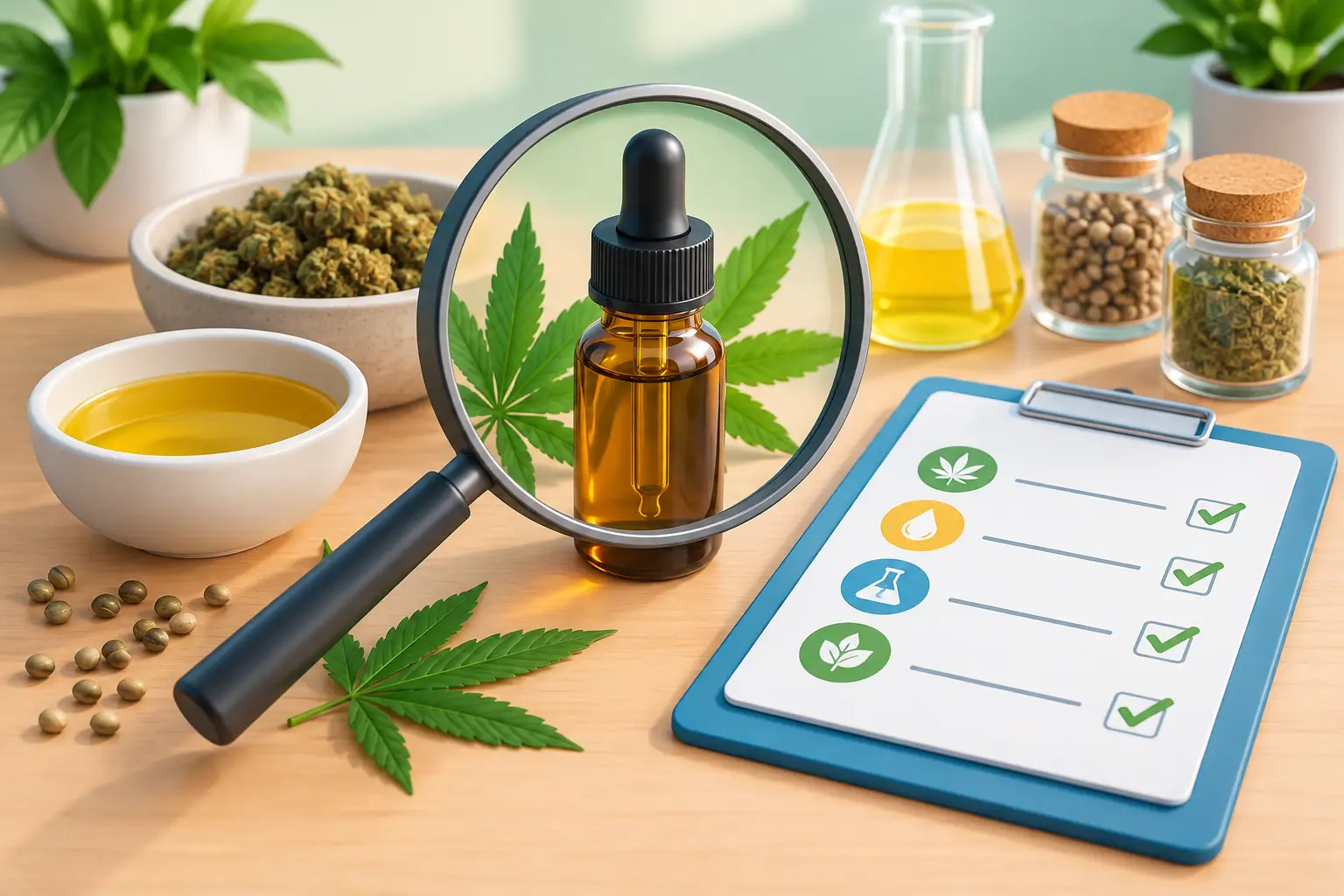
A CBD label can look reassuring while still leaving out the details that matter most. If you are wondering how to evaluate CBD ingredients, start with a simple principle: a quality product should make it easy to understand what is in it, where it came from, and how it was verified. You should not have to guess whether a formula fits your routine or your comfort level with THC.
For people shopping for support with everyday discomfort, sleep, stress, or pet wellness, the goal is not to find the longest ingredient list or the biggest milligram number. It is to find a clean, clearly labeled formula made with care. Here is what to look for before you bring a CBD product home.
Start With the Type of CBD
The first ingredient question is not always about a carrier oil or flavor. It is about the CBD extract itself. Most products use one of three broad extract types: full-spectrum, broad-spectrum, or CBD isolate.
Full-spectrum hemp extract contains CBD along with other naturally occurring hemp compounds, including trace levels of THC. While federally compliant hemp products are limited to a small amount of THC by dry weight, that does not mean they are the right fit for everyone. People who wish to avoid THC exposure, including those subject to workplace drug testing, should read these labels with extra care.
Broad-spectrum CBD contains CBD and may include other hemp compounds, but it is processed to remove THC. CBD isolate is a more refined ingredient that contains CBD without the additional hemp compounds. Neither option is automatically better for every person. The right choice depends on your preferences, sensitivity, and reasons for using CBD. If a product promises a THC-free experience, its independent test results should support that claim.
Check the Hemp Source and Growing Standards
Hemp is a plant, which means its growing conditions matter. Like other crops, it can absorb substances from the soil. A trustworthy brand should be willing to identify where its hemp is grown and describe its quality standards.
Look for hemp cultivated in the United States, where growers operate under established agricultural and hemp regulations. Organic cultivation can also be a meaningful signal, particularly when a brand explains its approach to pesticides, herbicides, and soil management. Organic language alone is not a replacement for testing, but it offers useful context about how the raw plant material was handled.
Be cautious with vague phrases such as “premium hemp” or “pure CBD” when no sourcing details appear nearby. Clear sourcing does not guarantee that a product will work the same way for every person, but it gives you a better foundation for evaluating its quality.
Look at How the CBD Was Extracted
Extraction is the process used to separate valuable hemp compounds from the plant. It can affect both purity and consistency.
CO2 extraction is widely respected because it can extract CBD without relying on harsh chemical solvents. When performed carefully, it helps preserve desirable plant compounds while supporting a clean final extract. Brands that use CO2 extraction should still provide third-party testing, because no extraction method removes the need for verification.
Some products are made with solvent-based extraction methods. That does not automatically make them unsafe, but it creates a greater need to review residual solvent test results. If the label or product information does not explain the extraction approach and no lab report is available, consider that a reason to keep looking.
How to Evaluate CBD Ingredients Beyond the CBD
CBD is only one part of the formula. Whether you choose an oil, gummy, topical, capsule, or pet product, read the full ingredient panel with the same attention you would give any wellness product.
For CBD oils, the carrier ingredient affects the experience. MCT oil, hemp seed oil, and olive oil are common choices. A carrier can influence flavor, texture, and how the product fits into your diet. Anyone with food sensitivities should check for coconut-derived MCT oil and other potential allergens.
For gummies, review the sweeteners, colors, flavorings, and gelatin or pectin base. Some shoppers prefer simpler formulas with recognizable ingredients and limited artificial additives. A gummy may contain a precise serving of CBD, but high added sugar or ingredients that do not suit your dietary needs can make it a poor everyday choice.
Topical products deserve a separate look. Ingredients such as menthol, camphor, arnica, essential oils, shea butter, and aloe may be included to create a cooling, warming, or moisturizing feel. These ingredients can be helpful for some users but irritating for others, especially on sensitive skin. Check the label, avoid applying topicals to broken skin unless the instructions specifically allow it, and patch test a new product when possible.
Pet formulas should be especially straightforward. Avoid giving a pet a human CBD gummy or flavored product without checking every ingredient. Xylitol is dangerous to dogs, and certain essential oils, flavorings, or added botanicals may not be appropriate for animals. A pet-specific product with clear serving guidance is the safer starting point, and a veterinarian can help with questions about medications or existing health conditions.
Verify the Certificate of Analysis
A certificate of analysis, often called a COA, is one of the clearest signs that a CBD brand takes transparency seriously. This report comes from an independent laboratory and should correspond to the actual product or batch you are considering.
First, compare the CBD amount on the COA with the label. If a bottle says it contains 1,000 mg of CBD, the lab report should show a result that reasonably matches that claim. Small variation can occur, but a major gap is a concern.
Next, check cannabinoid results. If you need THC-free CBD, look for a report showing no detectable THC. Pay attention to the laboratory’s reporting limits, since “non-detect” means the amount was below what that test could measure, not that the number is always mathematically zero.
A complete COA should also address contaminants. Quality testing commonly screens for pesticides, heavy metals, residual solvents, and microbial contaminants such as yeast, mold, or bacteria. A report that lists only CBD potency provides less reassurance than one that evaluates both potency and safety.
The timing matters as well. A current batch-specific COA is more useful than an old generic report. The product label, batch number, or a scannable code should help you connect the item in your hand to its corresponding test results.
Make Sense of Serving Size and Strength
A high total CBD number can be misleading without serving information. A 1,500 mg bottle may sound stronger than a 600 mg bottle, but the better comparison is how much CBD you receive per serving and how long the container lasts.
For example, an oil with 600 mg of CBD in 30 servings provides 20 mg per serving. A gummy label should likewise tell you the CBD amount per piece, not only the total amount in the jar. With topicals, the total CBD in the container is useful, but so are the application directions and the product size.
Your ideal strength depends on the product format, your experience with CBD, and your individual response. Starting with the labeled serving and adjusting slowly can be more practical than choosing the highest concentration right away. CBD is not one-size-fits-all, and more is not always better.
Watch for Claims That Go Too Far
A trustworthy CBD product should describe its ingredients and intended wellness use without claiming to diagnose, treat, cure, or prevent disease. Be skeptical of labels that promise instant results, guaranteed pain relief, or a cure for serious conditions. Those claims are not a sign of stronger CBD. They are a sign that the marketing may be ahead of the evidence.
Instead, look for brands that speak clearly about product quality, suggested use, testing, and customer support. Helpful guidance is specific without being pushy. It recognizes that people can have different experiences and that CBD may interact with certain medications. If you take prescription medication, are pregnant or nursing, or manage an ongoing medical condition, speak with a qualified healthcare professional before using CBD.
Build a Shortlist You Can Trust
Once you know what to check, choosing becomes less complicated. A product earns a place on your shortlist when its CBD type is clearly identified, the hemp source and extraction method are transparent, the full ingredient panel makes sense for your needs, and a current independent COA backs up its claims.
CBD Health Collection focuses on THC-free, independently tested CBD because clarity matters when you are choosing support for your everyday routine. Still, every shopper should review the label for themselves, especially when dietary preferences, medication use, sensitive skin, or pet care are part of the decision.
The best CBD ingredient list does not rely on vague promises. It gives you clear information, leaves room for informed questions, and helps you choose a product you can feel comfortable using consistently.