
Table of Contents
- What Is the Endocannabinoid System
- The Three Core Components of the Endocannabinoid System
- How the Endocannabinoid System Works
- Functions Regulated by the Endocannabinoid System
- How Does CBD Interact With the Endocannabinoid System
- How to Naturally Boost Endocannabinoids
- Conclusion
Last Updated: August 23, 2026
What Is the Endocannabinoid System
The endocannabinoid system is a cell-signaling mechanism throughout your body that maintains balance across physiological processes. Your body naturally produces its own cannabinoids, even without cannabis consumption. Understanding this system is essential for grasping how CBD and other compounds interact with your wellness.
The endocannabinoid system regulates homeostasis, the stable internal environment your body maintains despite external changes. It fine-tunes everything from inflammation and pain perception to sleep, mood, and immune function. When your body detects an imbalance, the system activates to restore equilibrium.
The term "endocannabinoid" means cannabinoids your body produces internally, distinct from phytocannabinoids derived from plants like hemp. This system works silently in the background, making micro-adjustments to keep you functioning optimally. When it operates efficiently, you experience better pain management, improved sleep, reduced stress, and stronger immune responses. When out of balance, you may notice persistent inflammation, sleep disruption, or heightened anxiety.
At CBD Health Collection, we’ve built our entire product line around supporting endocannabinoid system function with organically grown, USA-sourced hemp and clean CO2 extraction. Our science-based approach recognizes that optimal bioavailability matters, which is why we use water-based CBD formulations designed for better absorption.
The Three Core Components of the Endocannabinoid System
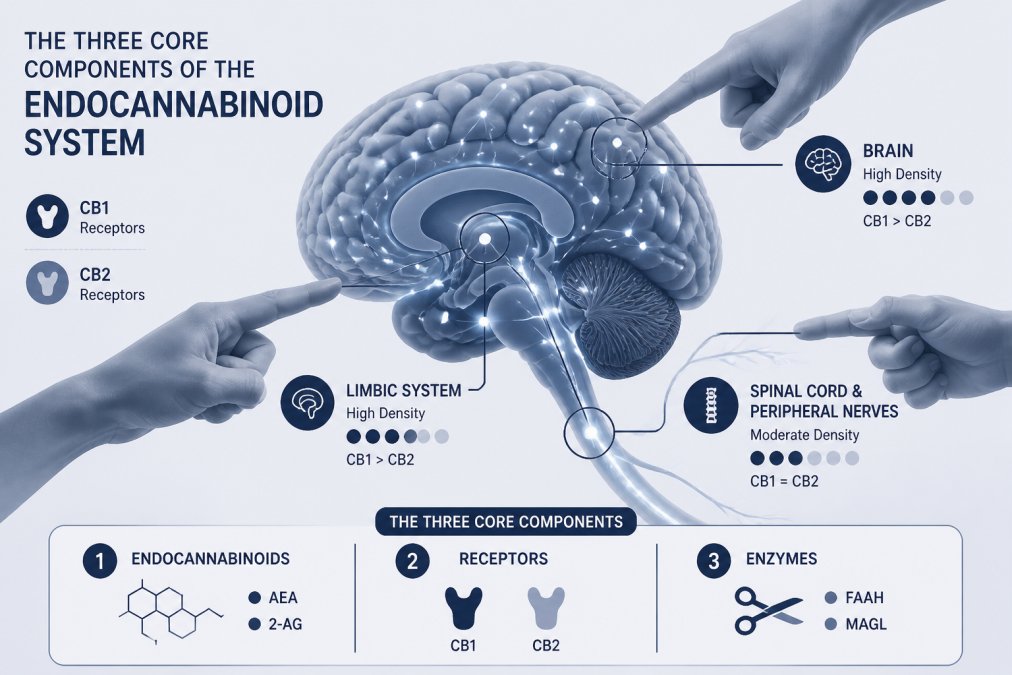
The endocannabinoid system consists of three interconnected elements: endocannabinoids, cannabinoid receptors, and metabolic enzymes. Understanding each component reveals how this system maintains your body’s internal balance and why external cannabinoids like CBD can influence your wellness.
Endocannabinoids: Your Body’s Signaling Molecules
Endocannabinoids are lipid signaling molecules your body synthesizes on demand to regulate physiological processes. When you experience pain, stress, or inflammation, your body generates endocannabinoids to address the imbalance.
The two primary endocannabinoids are anandamide and 2-arachidonoylglycerol (2-AG) (peer-reviewed research). Anandamide, often called the "bliss molecule," influences mood, pain perception, and memory formation. 2-AG plays a more prominent role in immune function and inflammation regulation. Both circulate through your nervous system and peripheral tissues, binding to receptors to trigger specific effects.
Endocannabinoids are created when needed and immediately deployed through retrograde signaling, allowing your brain and body to communicate bidirectionally. This feedback loop fine-tunes neural activity and prevents excessive neuron firing. Once they bind to receptors and complete their function, metabolic enzymes break them down quickly, preventing accumulation and ensuring your endocannabinoid system remains responsive to changing conditions.
Cannabinoid Receptors: CB1 and CB2
Cannabinoid receptors are proteins embedded in cell membranes that bind endocannabinoids and other cannabinoids. Two primary receptor types make up this system: CB1 and CB2, each with distinct locations and functions.
CB1 receptors predominate in the central nervous system, particularly in areas governing pain perception, emotion, appetite, and memory (the NIH). When endocannabinoids bind to CB1 receptors, they modulate synaptic transmission, reducing excessive neural firing that can lead to pain or anxiety.
CB2 receptors are primarily located in peripheral tissues and immune cells throughout your body. CB2 activation triggers immune responses that reduce inflammation and support tissue repair. This distinction matters significantly: CB2 activation generally produces anti-inflammatory effects without the psychoactive properties associated with CB1 in the brain.
The widespread receptor distribution explains why the endocannabinoid system influences such diverse functions. Pain modulation happens through CB1 receptors in the spinal cord and brain. Immune regulation occurs through CB2 receptors in lymph nodes and immune tissues. Sleep improvement involves CB1 receptors in the hypothalamus.
CB1 and CB2 receptors work differently with various compounds. CBD, for example, has low direct binding affinity for both receptors but influences their signaling indirectly, a key reason why [CBD produces different effects than THC](/cbd-vs-thc-effects/), which binds CB1 receptors strongly.
Metabolic Enzymes: Breaking Down Endocannabinoids
Two primary enzymes regulate endocannabinoid levels by breaking them down after they’ve completed their function: fatty acid amide hydrolase (FAAH) and monoacylglycerol lipase (MAGL). FAAH degrades anandamide, while MAGL breaks down 2-AG. These enzymes are essential for preventing endocannabinoid accumulation and dysregulation.
The speed at which these enzymes work directly affects endocannabinoid levels. Some people have genetic variations that slow enzyme activity, resulting in naturally higher endocannabinoid levels. Others have variations that accelerate enzyme activity, leading to lower baseline levels. These genetic differences partially explain why people respond differently to the same cannabinoid dosages.
While CBD doesn’t bind strongly to CB1 or CB2 receptors, it may influence FAAH activity, potentially allowing anandamide to persist longer in synapses. This indirect mechanism contributes to CBD’s effects on mood and pain perception without producing the psychoactive effects of direct CB1 activation.
How the Endocannabinoid System Works
The endocannabinoid system operates through a continuous cycle of detection, signaling, and regulation. Your body constantly monitors its internal state, and when it detects an imbalance, the system activates to restore equilibrium.
The process begins with a stimulus, pain, stress, inflammation, or disrupted sleep. Your body signals cells to produce endocannabinoids at the site of the problem. These newly synthesized molecules immediately bind to nearby cannabinoid receptors, triggering cellular events that address the imbalance. When inflammation occurs, CB2 receptors on immune cells bind endocannabinoids, which suppresses inflammatory signaling. Simultaneously, CB1 receptors in pain-processing regions bind endocannabinoids, reducing pain signals traveling to your brain.
Once endocannabinoids complete their regulatory function, metabolic enzymes rapidly degrade them. This swift breakdown prevents overstimulation and allows the system to respond dynamically to new signals. The entire cycle happens in milliseconds to seconds, enabling your body to maintain precise homeostasis.
The endocannabinoid system integrates with other neurotransmitter systems including serotonin, dopamine, and GABA, allowing coordinated regulation of mood, sleep, pain, and immune function. Disruption in any one system can cascade through others, which is why endocannabinoid system dysfunction may contribute to multiple symptoms simultaneously.
Clinical endocannabinoid deficiency, a theoretical state where your body produces insufficient endocannabinoids, may underlie conditions like fibromyalgia, migraines, and irritable bowel syndrome. While this remains an area of active research, the concept explains why some people experience multiple chronic conditions that seem unrelated.
::: certificate of analysis.
Functions Regulated by the Endocannabinoid System
The endocannabinoid system influences virtually every major physiological process through its widespread receptor distribution and neuromodulatory role.
Pain modulation is one of the system’s primary functions. CB1 receptors in the spinal cord and brain’s pain-processing regions directly suppress pain signal transmission. The endocannabinoid system can reduce both acute pain from injury and chronic pain from conditions like arthritis.
Sleep regulation depends heavily on endocannabinoid signaling in the hypothalamus and other brain regions controlling circadian rhythms. Endocannabinoids promote sleep onset and maintain sleep architecture by reducing arousal signals.
Immune response modulation occurs through CB2 receptors on immune cells. The endocannabinoid system fine-tunes immune activation, preventing both insufficient immune response and excessive inflammation.
Emotional processing and mood regulation involve CB1 receptors in limbic regions including the amygdala and prefrontal cortex. Adequate endocannabinoid signaling supports emotional resilience and reduces anxiety.
Appetite and metabolism are controlled through CB1 receptors in the hypothalamus. The endocannabinoid system signals hunger and satiety, influencing both food intake and metabolic rate.
Synaptic plasticity and learning depend on endocannabinoid signaling in the hippocampus and other memory centers, affecting memory formation and learning capacity.
| Function | Primary Receptor | Key Effect | Physiological Importance |
|---|---|---|---|
| Pain Suppression | CB1 (spinal/brain) | Reduces pain signal transmission | Enables pain-free movement and recovery |
| Sleep Promotion | CB1 (hypothalamus) | Facilitates sleep onset and maintenance | Supports restorative sleep cycles |
| Immune Regulation | CB2 (immune cells) | Balances inflammatory response | Prevents excessive or insufficient immunity |
| Mood Stability | CB1 (limbic system) | Reduces anxiety and fear responses | Supports emotional resilience |
| Metabolism | CB1 (hypothalamus) | Regulates appetite and energy expenditure | Maintains healthy weight and energy |
| Memory Formation | CB1 (hippocampus) | Modulates synaptic connections | Supports learning and recall |
How Does CBD Interact With the Endocannabinoid System
CBD’s mechanism differs fundamentally from THC, which directly activates CB1 receptors in the brain. CBD has low direct binding affinity for both CB1 and CB2 receptors but influences the endocannabinoid system through multiple indirect pathways.
One key mechanism involves FAAH inhibition, CBD may slow the enzyme that breaks down anandamide, allowing this endocannabinoid to persist longer in synapses and exert greater effects on CB1 and CB2 receptors. This indirect enhancement of anandamide signaling contributes to CBD’s mood and pain-relieving properties.
CBD also acts as an antagonist at CB1 receptors in some contexts, blocking excessive CB1 activation without activating the receptor itself. This antagonistic effect may explain why CBD can reduce anxiety without producing the sedation or impaired cognition associated with CB1 agonists like THC.
Additionally, CBD influences non-cannabinoid receptors that interact with the endocannabinoid system. It binds serotonin receptors, which modulate mood and anxiety through parallel pathways. CBD activates vanilloid receptors involved in pain perception and temperature regulation. These multi-target effects mean CBD’s influence extends beyond direct endocannabinoid system modulation.
The bioavailability of your CBD product matters significantly for these interactions. Water-based CBD formulations, like those from CBD Health Collection, achieve better absorption than traditional oil-based products. Improved bioavailability means more CBD reaches your endocannabinoid system receptors and can exert its regulatory effects.
:::takeaway
CBD doesn’t directly bind cannabinoid receptors strongly, but it enhances your body’s own endocannabinoid signaling and influences related neurotransmitter systems. This multi-pathway approach produces broad physiological effects without intoxication.
Research from the National Institutes of Health on cannabinoid pharmacology confirms that CBD’s indirect mechanisms of action differ substantially from direct receptor agonists, explaining its distinct safety and efficacy profile.
How to Naturally Boost Endocannabinoids
Your lifestyle choices directly influence endocannabinoid production and receptor sensitivity. Supporting your endocannabinoid system doesn’t require external compounds; optimizing these factors enhances your body’s natural cannabinoid signaling.
Regular physical exercise is one of the most potent endocannabinoid system boosters. Aerobic activity increases anandamide production, which is why people report improved mood and reduced pain after workouts. Aim for consistent moderate-to-vigorous exercise most days weekly to maintain elevated endocannabinoid levels.

Stress reduction practices directly influence endocannabinoid signaling. Chronic stress suppresses endocannabinoid production, while meditation, deep breathing, and mindfulness enhance it. Even brief daily meditation, 10-15 minutes, measurably improves endocannabinoid signaling.
Quality sleep supports endocannabinoid system health through multiple mechanisms. During deep sleep, your brain consolidates memories and resets stress responses, both processes dependent on endocannabinoid signaling. Prioritizing 7-9 hours of consistent sleep maintains healthy endocannabinoid levels and receptor sensitivity.
Dietary choices influence endocannabinoid system function. Omega-3 fatty acids from sources like fish, flaxseed, and walnuts support endocannabinoid synthesis. Antioxidant-rich foods reduce inflammation that dysregulates the endocannabinoid system. Limiting processed foods and refined sugars prevents inflammatory states that suppress endocannabinoid signaling.
Social connection activates endocannabinoid system function. Positive social interactions increase anandamide production, explaining why social engagement improves mood and pain tolerance.
Temperature exposure through activities like sauna use or cold water immersion triggers endocannabinoid release. Regular sauna use or cold exposure protocols may enhance endocannabinoid system resilience.
When lifestyle optimization alone isn’t sufficient, many people turn to CBD products to provide additional endocannabinoid system support. CBD Health Collection offers multiple product formats, oils, gummies, topical freeze gels, and sleep formulations, designed to complement your lifestyle efforts. Our broad-spectrum gummies and water-based oils are formulated for optimal bioavailability, ensuring your body efficiently absorbs and utilizes the CBD.
People seeking to support their endocannabinoid system naturally should prioritize exercise, stress reduction, and sleep quality first. These lifestyle factors produce measurable endocannabinoid increases. Adding CBD supplementation works synergistically with these practices rather than replacing them.
Supporting your endocannabinoid system is fundamental to achieving lasting wellness. This biological network regulates pain, sleep, mood, and immune function. While lifestyle optimization provides the foundation, many find that adding CBD supplementation accelerates their results.
CBD Health Collection’s science-based approach recognizes that quality matters. Our products use organically grown, USA-sourced hemp with clean CO2 extraction, independently verified through third-party lab testing. Every product is formulated with optimal bioavailability in mind; our water-based CBD absorbs better than traditional oils, meaning your body actually utilizes what you take. Start with our 30-day satisfaction guarantee, and if you don’t experience the endocannabinoid system support you’re seeking, we’ll refund your purchase completely. Get started with CBD Health Collection’s product selection and discover how supporting your endocannabinoid system transforms your pain management, sleep quality, and overall wellness.
Frequently Asked Questions
What are the three main components of the endocannabinoid system?
The endocannabinoid system consists of three essential parts: endocannabinoids (signaling molecules your body produces naturally, including anandamide and 2-arachidonoylglycerol), cannabinoid receptors (CB1 and CB2) that receive these signals, and metabolic enzymes (fatty acid amide hydrolase and monoacylglycerol lipase) that break down endocannabinoids after they've done their job. Together, these components maintain homeostasis and regulate critical physiological processes.
Does CBD activate the endocannabinoid system?
CBD interacts with the endocannabinoid system differently than THC. Rather than directly binding to CB1 or CB2 receptors, CBD influences the system indirectly by slowing the breakdown of your body's natural endocannabinoids, allowing them to remain active longer. This approach supports the endocannabinoid system's ability to maintain balance without the psychoactive effects associated with THC, making it suitable for those seeking natural wellness support.
How does the endocannabinoid system affect sleep and mood?
The endocannabinoid system plays a central role in emotional processing and sleep regulation through receptors in the central nervous system. Endocannabinoids help modulate neurotransmitter release and synaptic transmission, which influence stress response, anxiety levels, and sleep-wake cycles. When the endocannabinoid system functions optimally, it supports more stable mood and more restorative sleep. Supporting this system through lifestyle choices or CBD products may help promote relaxation and better sleep quality.
What triggers the release of endocannabinoids?
Your body releases endocannabinoids in response to various physiological demands, including stress, pain, inflammation, and changes in body temperature. Physical activity, certain foods, and even social interaction can trigger endocannabinoid production. This retrograde signaling mechanism allows your nervous system to respond dynamically to maintain homeostasis. Understanding these natural triggers helps explain why lifestyle factors like exercise and stress management support endocannabinoid system health.
This article was written using GrandRanker