Table of Contents
- What Is Hemp Cream for Pain?
- How Hemp Cream Works for Pain Relief
- Key Ingredients to Look For in Hemp Cream
- Hemp Cream Benefits for Muscle and Joint Pain
- How to Use Hemp Cream for Optimal Results
- Verifying Quality: Third-Party Lab Testing and COA
- Hemp Cream Side Effects and Safety Considerations
- Choosing the Right Hemp Cream for Your Needs
Last Updated: July 27, 2026
What Is Hemp Cream for Pain?
Hemp cream for pain is a topical cannabinoid product designed to deliver localized relief without entering the bloodstream. These creams contain hemp extract, the full plant material including multiple cannabinoids, terpenes, and phytonutrients, rather than isolated CBD alone. Full-spectrum hemp extract contains cannabidiol (CBD) alongside cannabinol (CBN), cannabigerol (CBG), and other minor cannabinoids that work synergistically. This "entourage effect" may amplify therapeutic benefits compared to single-molecule formulations.
How Hemp Extract Differs from CBD Isolate
Full-spectrum hemp extract retains the complete plant profile with 100+ phytocompounds working together. CBD isolate contains only pure cannabidiol, removing terpenes and minor cannabinoids that contribute to overall effect. Research suggests full-spectrum formulations may provide superior pain relief outcomes. Broad-spectrum products occupy the middle ground: multiple cannabinoids and terpenes with THC removed. For topical applications, both broad-spectrum and full-spectrum offer advantages over isolate because additional compounds enhance skin penetration and localized therapeutic action.
How Hemp Cream Works for Pain Relief
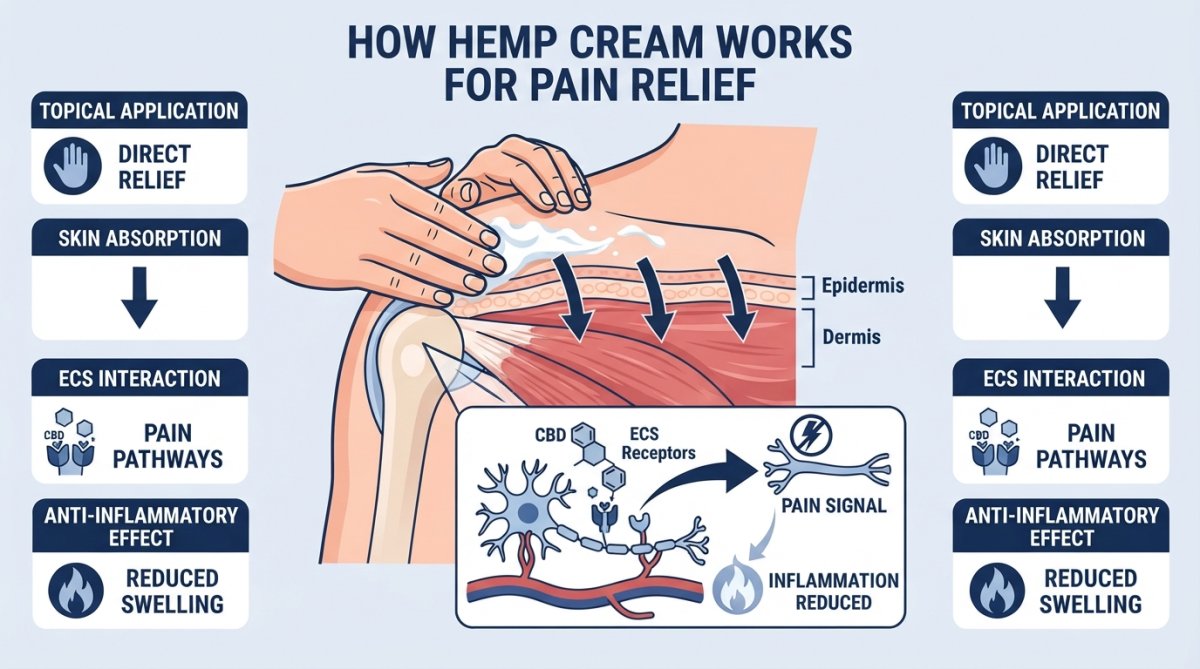
When applied topically, cannabinoids bind to CB1 and CB2 receptors in the skin, nerve endings, and surrounding tissues without requiring bloodstream absorption. This localized action produces rapid effects, many users report noticeable relief within 10-15 minutes.
The Endocannabinoid System and Topical Absorption
Your body maintains an endocannabinoid system (ECS) throughout skin and connective tissues, regulating inflammation, pain signaling, and immune response at the local level. When you apply hemp cream for pain, cannabinoids activate ECS receptors in the dermis and subcutaneous layers, reducing inflammatory signals and modulating pain perception without systemic effects. Nerve endings in the skin contain both CB1 and CB2 receptors; activation interrupts pain signal transmission to the brain.
Bioavailability and Water-Based Formulations
Bioavailability determines how effectively a topical cream works. Traditional oil-based hemp creams struggle because cannabinoids are fat-soluble and don’t penetrate the skin’s aqueous layers efficiently. Water-based formulations use advanced emulsification technology to break cannabinoids into nano-sized particles that traverse skin layers more effectively. A water-based hemp cream typically penetrates the stratum corneum within 5-10 minutes and reaches deeper tissue within 15-20 minutes, while oil-based products may require 30-45 minutes.
Key Ingredients to Look For in Hemp Cream
Effective pain relief creams combine hemp extract with complementary botanical and mineral compounds that enhance anti-inflammatory and soothing properties.
MSM, Glucosamine, and Chondroitin for Joint Support
Methylsulfonylmethane (MSM) is an organic sulfur compound that reduces joint inflammation and supports collagen formation in cartilage. When combined with hemp extract, MSM addresses pain from multiple angles, cannabinoids reduce inflammatory signaling while MSM strengthens connective tissue integrity. Glucosamine and chondroitin provide building blocks for cartilage repair and reduce joint degradation progression. MSM typically appears in concentrations of 1,000-3,000 mg per ounce of cream, while glucosamine and chondroitin usually combine in a 2:1 ratio with effective topical doses ranging from 500-1,500 mg per application.
Arnica and Additional Soothing Compounds
Arnica montana extract has been used for centuries to reduce bruising, swelling, and muscle soreness. The plant contains helenalin, a compound that inhibits inflammatory pathways similar to cannabinoids. Menthol, camphor, and eucalyptus oil create a cooling sensation that provides immediate comfort and may reduce pain perception through gate-control theory. Lavender and chamomile add anti-inflammatory benefits while promoting relaxation. A high-quality hemp cream should contain at least 3-4 complementary ingredients beyond hemp extract alone.
Hemp Cream Benefits for Muscle and Joint Pain
Arthritis, Inflammation, and Nerve Relief
Arthritis involves chronic inflammation in joint tissue, leading to pain, stiffness, and reduced mobility. Hemp cream addresses arthritis through multiple mechanisms: cannabinoids reduce inflammatory cytokine production, while MSM and glucosamine support cartilage integrity. Users with osteoarthritis or rheumatoid arthritis frequently report improved mobility and reduced morning stiffness within 2-3 days of consistent application.
Inflammation extends to general muscle soreness from exercise, repetitive strain, or minor injury. Nerve pain, particularly neuropathic pain from compression or irritation, responds well to topical cannabinoids because CB2 receptor activation on nerve endings directly modulates pain signal transmission. Tennis elbow, carpal tunnel syndrome, and repetitive strain injuries benefit significantly from hemp cream applied directly to affected areas. Many users find consistent application over 1-2 weeks produces sustained relief lasting hours after each application.
Apply hemp cream for pain immediately after activity when inflammation is highest. The first 30 minutes after exercise or strain represent the optimal window for topical anti-inflammatory intervention.
How to Use Hemp Cream for Optimal Results
Application Instructions and Dosage Guidelines
Cleanse the affected area with mild soap and water, then pat dry completely. Wet skin creates a barrier that reduces cannabinoid penetration. Apply a quarter-sized amount to the affected area and massage gently for 1-2 minutes using circular motions. For larger areas, use a half-dollar-sized amount. Most users experience noticeable relief within 15-30 minutes. Reapply every 4-6 hours as needed, or up to 3-4 times daily for acute pain.
Consistency matters more than quantity. Daily application for 3-5 days produces cumulative benefits as cannabinoids build up in tissue. After a week of consistent use, pain relief becomes more pronounced and lasts longer between applications.
Condition-Specific Protocols for Pain Management
For acute injury, apply hemp cream immediately and reapply every 3-4 hours for the first 48 hours. After 48 hours, switch to 2-3 daily applications as the injury transitions to healing phase. Chronic pain from arthritis responds best to twice-daily application, morning and evening, combined with gentle movement or stretching. For post-workout soreness, apply within 30 minutes of exercise completion. This preventive approach often reduces next-day soreness by 40-60% compared to waiting until soreness develops.
The most effective hemp cream for pain protocol involves consistent, daily application at specific times rather than sporadic use when pain becomes severe. Preventive application outperforms reactive application by a significant margin.
Verifying Quality: Third-Party Lab Testing and COA
The hemp and CBD market remains largely unregulated, making third-party lab testing the only reliable way to verify product quality, potency, and purity.
What to Look for in a Certificate of Analysis
A Certificate of Analysis (COA) is an independent laboratory report documenting exact cannabinoid content, microbial contamination levels, pesticide residues, and heavy metal concentrations. Legitimate companies provide COAs for every batch. The COA should list:
- Cannabinoid potency: Exact milligrams of CBD, THC, CBN, CBG, and other cannabinoids per serving
- Microbial testing: Absence of E. coli, salmonella, and mold species
- Pesticide screening: Confirmation of no prohibited pesticides
- Heavy metals: Lead, cadmium, arsenic, and mercury levels below safety thresholds
- Solvent residues: Confirmation that no extraction solvents remain
CBD Health Collection publishes COAs for every topical product, derived from organically grown, USA-sourced hemp extracted using clean CO2 methods in a GMP- and FDA-registered facility. Red flags include missing COAs, vague potency claims, or COAs older than 18 months.
Hemp Cream Side Effects and Safety Considerations
Hemp cream for pain is generally well-tolerated, though certain precautions apply.
Drug Interaction Warnings and Medical Consultation
Topical cannabinoids have minimal systemic absorption, meaning they rarely interact with oral medications. Some individuals experience mild localized reactions, skin irritation, redness, or warmth, which typically resolve within 24 hours. If you take blood thinners or immunosuppressants, consult your healthcare provider before using hemp cream. Pregnant and nursing individuals should avoid hemp cream due to limited safety data. Avoid application to open wounds or severe dermatitis without consulting a healthcare provider.
Never apply hemp cream for pain to open wounds, broken skin, or areas with severe inflammation without consulting a healthcare provider.
Choosing the Right Hemp Cream for Your Needs
Full-Spectrum vs. Broad-Spectrum vs. Isolate
Full-spectrum hemp cream contains the entire plant profile: CBD, CBN, CBG, terpenes, and other phytocompounds. This formulation typically produces the strongest pain relief due to the entourage effect. Full-spectrum products are ideal if you want maximum efficacy and don’t object to trace amounts of THC (typically 0.3% or less, non-psychoactive).
Broad-spectrum formulations contain multiple cannabinoids and terpenes but have had THC removed. They offer a middle ground between isolate and full-spectrum, more potent than isolate but without detectable THC. CBD isolate contains only pure cannabidiol with no other plant compounds. While technically refined, isolate products are less effective for pain relief than full-spectrum alternatives because they lack supporting compounds that enhance cannabinoid action.
For most users seeking hemp cream for pain relief, full-spectrum formulations deliver superior results. The complete cannabinoid and terpene profile ensures you receive the full therapeutic benefit of the hemp plant.
Localized pain from arthritis, muscle soreness, or repetitive strain often persists despite conventional approaches. A high-quality hemp cream for pain addresses inflammation and pain signaling through multiple mechanisms, cannabinoids, MSM, glucosamine, and botanical compounds working synergistically. CBD Health Collection formulates their topical freeze gels with full-spectrum hemp extract derived from organically grown USA hemp, extracted using clean CO2 processing in a GMP-registered facility, and independently third-party lab tested for purity and potency. Start with consistent twice-daily application for 10-14 days to assess effectiveness, and reference the COA to verify you’re receiving the exact potency listed on the label.
Frequently Asked Questions
Does hemp cream actually help with pain, or is it just a placebo?
Hemp cream works through the endocannabinoid system, which is involved in pain regulation and inflammation. When applied topically, cannabinoids and supporting ingredients like MSM and arnica interact with localized receptors to reduce inflammation and soothe discomfort. Many users report fast-acting relief within 10-15 minutes of application. Results vary by individual, product quality, and condition severity. Third-party lab testing ensures potency and purity, always verify a COA (Certificate of Analysis) to confirm you're getting a therapeutic-grade product.
What is the difference between hemp cream and CBD cream for pain?
Hemp cream typically contains full-spectrum hemp extract, which includes cannabinoids, terpenes, and other plant compounds. CBD cream focuses specifically on cannabidiol (CBD) isolate or broad-spectrum formulations. Full-spectrum hemp cream may offer enhanced benefits through the entourage effect, where multiple compounds work synergistically. Both are topical pain relievers, but full-spectrum hemp extract generally provides broader therapeutic support. The choice depends on your preference for whole-plant benefits versus isolated CBD. Always check the label and COA to confirm what's in the product.
How long does hemp cream take to work for pain relief?
Most users experience relief within 10-30 minutes of application, with peak effects typically occurring within 30-60 minutes. Fast-acting formulations, especially those using water-based technology for improved bioavailability, may work more quickly. Results depend on the severity of pain, product potency, application technique, and individual body chemistry. For chronic conditions like arthritis, consistent daily use often produces better results over time. If you don't notice improvement after the first application, ensure you're applying enough product to the affected area and allowing adequate absorption time.
Are there any drug interactions I should know about before using hemp cream for pain?
While topical hemp cream has minimal systemic absorption compared to oils or edibles, it's important to consult your doctor if you take blood thinners, pain medications, or other drugs metabolized by the liver. Hemp contains compounds that may interact with certain medications. Additionally, avoid using hemp cream on broken skin or open wounds unless directed by a healthcare provider. If you're on prescription pain management, discuss hemp cream as a complementary option with your physician before adding it to your routine. Always disclose all supplements and topicals to your medical team.
This article was written using GrandRanker