Table of Contents
- How CBD Helps With Inflammation: Understanding the Mechanism
- Why Bioavailability Matters for CBD’s Anti-Inflammatory Effects
- CBD Dosage for Inflammation: Finding Your Optimal Amount
- CBD Topical vs Oral for Inflammation: Choosing the Right Method
- CBD vs NSAIDs for Inflammation: What the Evidence Shows
- Factors That Influence How Well CBD Works for Inflammation
- Common Mistakes When Using CBD for Inflammation
- Conclusion
Last Updated: June 29, 2026
How CBD Helps With Inflammation: Understanding the Mechanism
CBD interacts with your body’s endocannabinoid system to modulate immune activity and reduce inflammatory responses. Unlike NSAIDs that block enzyme activity, CBD takes a regulatory approach, it helps your body restore balance rather than simply suppressing inflammation. This is why some people experience relief within days while others need weeks of consistent use.
IMAGE: Close-up of a person holding a CBD oil tincture bottle with dropper in natural sunlight, with wellness items like hemp leaves and a journal on a wooden table | section:Why [Bioavailability Matters for CBD’s Anti-Inflammatory Effects]
The Endocannabinoid System and Immune Response
Your endocannabinoid system maintains balance across physiological processes, including immune function and inflammation management. When inflammation persists beyond the acute phase, it becomes problematic. CBD amplifies your body’s natural regulatory signals by enhancing endocannabinoid signaling. Research from the National Center for Complementary and Integrative Health indicates that cannabinoids interact with immune cells to reduce excessive inflammatory signaling, optimizing rather than suppressing your immune response.
CBD’s Interaction With CB2 Receptors
CB2 receptors are concentrated in immune cells and inflamed tissues. When CBD activates these receptors, it triggers molecular events that reduce inflammatory signaling. Unlike CB1 receptors found in the brain, CB2 activation doesn’t produce psychoactive effects, allowing your immune cells to respond while your cognitive function remains normal.
Individual variation in CB2 receptor density explains why people experience different timelines for relief. Someone with naturally higher CB2 receptor expression may notice effects within 3-5 days, while others need 2-3 weeks as their system adjusts to CBD’s regulatory signals.
Why Bioavailability Matters for CBD’s Anti-Inflammatory Effects
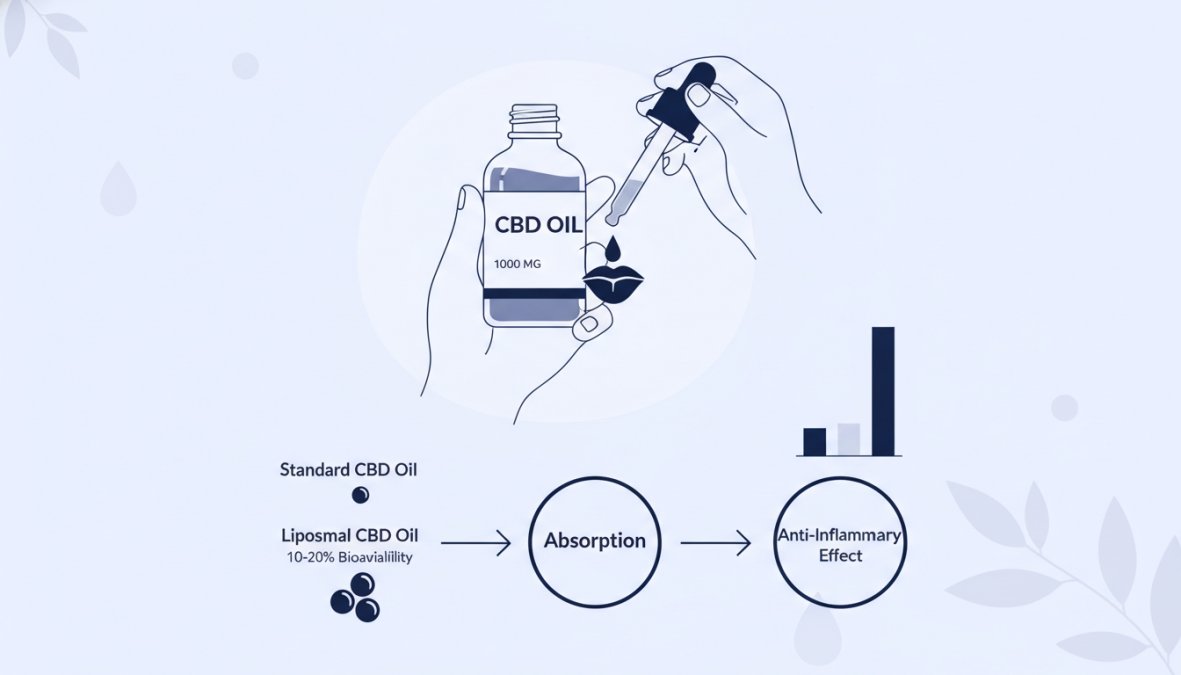
Bioavailability determines what percentage of consumed CBD reaches your systemic circulation. Taking 50mg means nothing if only 5mg reaches your bloodstream. Your delivery method dramatically impacts this: oral CBD must survive stomach acid and liver metabolism, while inhalation bypasses these barriers entirely.
| Delivery Method | Approximate Bioavailability | Onset Time | Duration | Best For |
|---|---|---|---|---|
| Oral (with food) | 4-20% | 1-2 hours | 4-6 hours | Systemic inflammation |
| Sublingual | 12-35% | 15-30 minutes | 4-8 hours | Joint and muscle pain |
| Inhalation | 34-56% | 2-15 minutes | 3-4 hours | Acute flare-ups |
| Topical | Local only | 15-30 minutes | 4-5 hours | Localized inflammation |
First-Pass Metabolism and Systemic Circulation
When you swallow CBD, it travels through your digestive system and liver, where CYP450 enzymes metabolize a significant portion before it reaches your bloodstream. This is why oral CBD requires higher doses to achieve therapeutic blood levels. High-fat meals significantly enhance oral CBD absorption by increasing chylomicron formation, which transports CBD more efficiently. Eating CBD oil with a meal containing healthy fats can increase bioavailability from 4% to 20% or higher.
Peak Plasma Concentration and Therapeutic Effect
Peak plasma concentration, the highest blood level after consuming CBD, typically occurs 1-2 hours after oral consumption, 15-30 minutes after sublingual administration, and within minutes after inhalation. Reaching adequate peak plasma concentration is essential for anti-inflammatory effects. Individual metabolic rate significantly influences when and how high your peak plasma concentration climbs.
Track your inflammatory symptoms against timing patterns for 2-3 weeks. This personal data reveals your individual pharmacokinetic profile and helps you optimize dosing frequency for maximum anti-inflammatory benefit.
CBD Dosage for Inflammation: Finding Your Optimal Amount
Finding your optimal CBD dosage requires understanding that there’s no universal dose. Start with titration: begin with 5-10mg daily for 5-7 days, then assess your inflammation levels. If you’re seeing meaningful relief, stay at that dose for another week to confirm consistency. If inflammation persists, increase by 5mg and repeat. Most people find their optimal range between 10-40mg daily for mild to moderate inflammation.
Starting Low and Titrating Upward
After identifying your effective dose, use it consistently for 2-3 weeks before concluding whether CBD is working. Many people make the mistake of switching methods or doses too frequently, never giving their system time to establish the baseline needed for accurate assessment.
Individual Biological Variability and Metabolic Rate
Your genetics influence how quickly your liver metabolizes CBD through CYP450 enzyme activity. Some people are rapid metabolizers and may need higher doses or more frequent administration. Others are slow metabolizers and do well with smaller doses taken less frequently. Age, body weight, and overall liver function also influence CBD metabolism.
Your optimal CBD dose for inflammation is personal and based on your body’s unique pharmacokinetics. Systematic titration based on your own observations is far more reliable than following generic dosing recommendations.
CBD Topical vs Oral for Inflammation: Choosing the Right Method
The best CBD delivery method depends on your inflammation’s location. Localized inflammation like arthritis in your hands benefits from topical application. Systemic inflammation affecting multiple joints or organs requires oral or sublingual administration. Many people use both methods: topical for immediate localized relief, oral for underlying systemic issues.
Topical Delivery for Localized Joint and Muscle Inflammation
Topical CBD products work best for inflammation you can physically reach, joint pain in hands, wrists, elbows, knees, and ankles, or muscle soreness from exercise or injury. Local CB2 receptors respond within 15-30 minutes. The limitation is penetration depth; topical CBD reaches tissues near the skin surface effectively but doesn’t penetrate deeply enough to address inflammation in joint capsules or deep muscle tissue.
Oral Delivery for Systemic Inflammatory Conditions
Oral CBD reaches your entire body through systemic circulation, making it ideal for widespread inflammation affecting multiple joints or organs. Effects take 1-2 hours to manifest, but once peak plasma concentration is reached, oral CBD maintains therapeutic levels for 4-6 hours. Taking oral CBD with a high-fat meal dramatically improves absorption, this is essential pharmacokinetics, not optional.
Sublingual Administration for Faster Absorption
Sublingual CBD, held under your tongue for 60-90 seconds before swallowing, bypasses some digestive challenges while achieving 12-35% bioavailability. This produces effects in 15-30 minutes, faster than oral but slower than inhalation. Hold the CBD oil under your tongue without swallowing for a full minute, allowing sublingual blood vessels time to absorb cannabinoids before swallowing the remainder.
CBD vs NSAIDs for Inflammation: What the Evidence Shows
NSAIDs like ibuprofen and naproxen inhibit cyclooxygenase enzymes that produce prostaglandins, signaling molecules that mediate inflammation and pain. CBD modulates endocannabinoid signaling and CB2 receptor activity. Both reduce inflammation but through distinct biological pathways. Research indicates that CBD and NSAIDs may be complementary rather than competitive.
How NSAIDs Work Versus CBD’s Mechanism
NSAIDs provide rapid relief within 30-60 minutes by quickly suppressing prostaglandin production, making them excellent for acute pain. However, chronic NSAID use carries documented risks including gastrointestinal ulcers, cardiovascular complications, and kidney damage. CBD works more slowly through a regulatory mechanism, producing more gradual relief without the side effect profile of chronic NSAID use.
Interaction With Common Medications
CBD inhibits CYP450 enzymes in your liver, potentially affecting how your body metabolizes other medications. If you take regular medications, discussing CBD use with your healthcare provider is wise. They can assess whether CBD might affect your medication’s effectiveness or blood levels.
If you take blood thinners, immunosuppressants, or medications metabolized by CYP450 enzymes, consult your healthcare provider before starting CBD. Some interactions require dose adjustments or closer monitoring.
Factors That Influence How Well CBD Works for Inflammation
Your results with CBD depend on formulation quality, your individual biology, concurrent medications, diet, and lifestyle. Understanding these variables helps you optimize your approach.
Formulation Quality and Bio-Enhancement
Not all CBD products are created equal. CBD extracted using clean CO2 processes and formulated with bio-enhancing ingredients achieves significantly higher bioavailability. Bio-enhancers like black pepper extract (piperine) and ginger increase CBD absorption and use. Water-based formulations achieve superior bioavailability compared to traditional oil-based products.
Third-party lab testing ensures formulation accuracy. When a product is independently tested and verified for CBD content, you know you’re getting the dose listed on the label.
High-Fat Meals and Absorption Rate
Taking oral CBD with high-fat meals increases bioavailability by 400-500%. Medium-chain triglycerides (MCTs) found in coconut oil are particularly effective. A full meal with 15-20 grams of fat produces maximum effect. If you’re taking CBD for inflammation and not seeing results, examine whether you’re consistently taking it with adequate food.
Nano-Emulsion and Advanced Delivery Systems
Nano-emulsion technology breaks CBD into particles small enough for rapid absorption through your digestive system, significantly increasing bioavailability. Liposomal delivery systems work similarly, encapsulating CBD in tiny fat-based vesicles that protect it through digestion and enhance absorption.
Common Mistakes When Using CBD for Inflammation
Taking inconsistent doses is the most common error. CBD works best with consistent daily administration. Your endocannabinoid system needs consistent signaling to establish regulatory balance. Commit to a daily schedule and maintain it for at least 3-4 weeks before assessing effectiveness.
Switching products or doses too frequently prevents accurate assessment. Many people try CBD for one week, notice minimal effect, and assume it doesn’t work. This constant changing prevents their system from ever establishing stable CBD levels needed for anti-inflammatory effects.
Taking CBD on an empty stomach with oral products wastes money and produces inconsistent results. Without food, oral CBD bioavailability plummets. Ignoring individual biological variability leads people to assume their friend’s optimal dose should be their optimal dose, it rarely is.
Expecting instant results causes disappointment. CBD’s anti-inflammatory effects build gradually as your endocannabinoid system adjusts. Some people notice effects within days; others need 2-3 weeks.
Chronic inflammation drains quality of life, limiting movement, disrupting sleep, and creating constant discomfort. CBD Health Collection offers a science-based alternative that works through your body’s natural regulatory systems rather than suppressing inflammation through enzyme inhibition. Our water-based, nano-emulsified formulations maximize bioavailability so you get genuine therapeutic benefit from every dose. With a 30-day satisfaction guarantee and FREE shipping nationwide, there’s no risk in discovering whether CBD can help restore your comfort and mobility.
Frequently Asked Questions
How long does it take for CBD to work for inflammation?
The timeline depends on delivery method and individual factors. Sublingual CBD typically reaches peak plasma concentration within 30-90 minutes, while oral products may take 1-2 hours due to first-pass metabolism. Topical CBD for localized inflammation may provide relief within 15-30 minutes. Individual biological variability, metabolic rate, and formulation quality significantly affect absorption rate and therapeutic effect onset.
What is the best CBD dosage for inflammation?
There is no universal dosage; individual needs vary based on the severity of inflammation, body weight, and metabolic rate. Most users start with 10-20mg daily and gradually increase (titrate upward) every 1-2 weeks. For systemic inflammation, oral delivery typically requires higher doses than topical application. Consult a healthcare provider familiar with CBD pharmacokinetics to determine your optimal dosage.
Is CBD better than ibuprofen for inflammation?
CBD and NSAIDs like ibuprofen work through different mechanisms. NSAIDs inhibit prostaglandins directly, while CBD modulates the endocannabinoid system and reduces inflammatory cytokines. CBD may offer advantages for chronic inflammation without the gastrointestinal side effects associated with long-term NSAID use. However, CBD can interact with common medications that involve CYP450 enzymes, so discuss with your doctor before combining treatments.
Does CBD oil reduce inflammation throughout the body?
Yes, oral CBD can address systemic inflammation because it enters systemic circulation and reaches cannabinoid receptors throughout the body. The bio-accessibility and effectiveness depend on formulation quality, absorption rate, and individual factors like metabolic rate and body composition. Water-based or nano-emulsion formulations may enhance bioavailability compared to standard lipid-based delivery systems, improving therapeutic effect for widespread inflammatory conditions.
This article was written using GrandRanker