Table of Contents
- What Is CBD and How Does It Work for Joint Pain?
- Full Spectrum vs. Isolate CBD Cream: Which Works Better?
- Key Ingredients to Look for in a CBD Topical Cream for Joint Pain
- Best CBD Topical Creams for Joint Pain: Our Top Picks
- Comparison Table: Top CBD Creams at a Glance
- 1. CBD Health Collection Topical Freeze Gel, Best Overall
- 2. Aspen Green Relief Cooling Cream, Best Physician-Formulated
- 3. Soul CBD Rapid Relief Cream, Best for Fast Absorption
- 4. Joy Organics Premium CBD Sports Cream, Best THC-Free Option
- 5. Extract Labs CBD Muscle Cream, Best Herbal Formula
- 6. Neurogan CBD Cooling Cream, Best for High Potency
- 7. CBDistillery CBDol Topical Salve, Best for Deep-Tissue Relief
- 8. Zatural CBD Hot Cream, Best Budget Warming Cream
- 9. CBDfx Muscle and Joint Cooling Balm Stick, Best Portable Option
- 10. Elixinol Active Hemp Balm, Best Botanical-Rich Formula
- How to Use CBD Cream for Pain: Application Techniques by Joint
- How Long Does CBD Cream Take to Work on Joints?
- CBD Cream Side Effects, Safety, and FDA Regulation
- How to Choose the Right CBD Topical Cream for Joint Pain
Last Updated: June 17, 2026
Choosing the right cbd topical cream for joint pain is harder than it looks. The market is flooded with products making identical claims, and most buyers have no framework for separating a well-formulated cream from an overpriced moisturizer with trace amounts of cannabidiol. The answer almost always comes down to three things: ingredient synergy, CBD spectrum, and third-party verification.
Most guides rank CBD topicals purely by milligram count. Potency matters, but a high-dose cream with poor carrier oils and no complementary actives will often underperform a mid-potency formula built around transdermal bioavailability.
What Is CBD and How Does It Work for Joint Pain?
Cannabidiol (CBD) is a non-psychoactive compound derived from hemp that interacts with the body’s endocannabinoid system to modulate pain and inflammation. It’s federally legal in the United States when derived from hemp containing no more than 0.3% THC. When applied topically, CBD interacts with cannabinoid receptors in skin, subcutaneous tissue, and surrounding musculature, making it relevant for conditions like osteoarthritis and rheumatoid arthritis where peripheral inflammation drives pain.
The Endocannabinoid System and Topical Application
The endocannabinoid system (ECS) regulates pain perception, immune response, and inflammation through CB1 and CB2 receptors. CBD has particular affinity for CB2 receptors, concentrated in immune cells and peripheral tissues, producing localized anti-inflammatory and analgesic effects without systemic exposure. Transdermal absorption depends heavily on formulation, water-based creams penetrate the skin barrier more efficiently than heavy wax-based salves.
Anecdotal Evidence vs. Clinical Trials: What We Know
Clinical trial data on CBD topicals remains limited. According to the National Institutes of Health’s research database on cannabinoids, early-stage research suggests CBD has anti-inflammatory properties, but large-scale human trials for topical joint pain are still underway. Products citing "clinical studies" without a verifiable certificate of analysis (COA) deserve extra scrutiny.
Full Spectrum vs. Isolate CBD Cream: Which Works Better?
Full-spectrum CBD cream is generally the stronger choice for joint pain because it contains the complete range of hemp-derived cannabinoids, terpenes, and flavonoids that work synergistically, the "entourage effect." CBD isolate is pure cannabidiol with all other compounds removed; it’s right for people who must avoid THC entirely, but typically requires higher concentrations to achieve comparable results.
Broad-Spectrum as a Middle Ground
Broad-spectrum CBD cream retains most cannabinoids and terpenes while removing detectable THC. For most joint pain sufferers, it offers a practical balance: multi-compound synergy without THC concerns. This is the formulation approach used by CBD Health Collection, which prioritizes water-based delivery for improved bioavailability.
If you’re subject to drug testing, choose broad-spectrum or isolate products from brands that publish a COA confirming non-detectable THC levels. “THC-free” on a label is not the same as a verified lab result.
Key Ingredients to Look for in a CBD Topical Cream for Joint Pain
The best CBD topical cream for joint pain is never just CBD. The surrounding formula determines how well cannabidiol reaches target tissue and how much additional relief the product delivers.
Active Ingredients: Menthol, Capsaicin, Arnica Montana, and MSM
- Menthol triggers cold-sensitive receptors, creating immediate cooling that interrupts pain signaling and acts as a mild vasodilator to improve local circulation.
- Capsaicin produces a warming effect by depleting substance P, a neurotransmitter that carries pain signals, particularly useful for nerve pain and chronic joint stiffness.
- Arnica montana has well-documented anti-inflammatory and analgesic properties, especially effective for swelling and post-activity soreness around joints.
- MSM (methylsulfonylmethane) is an organic sulfur compound that supports connective tissue repair and reduces joint inflammation, one of the most underappreciated ingredients in CBD topicals.
Carrier Oils and Their Role in Bioavailability
The carrier oil determines how efficiently CBD and other actives cross the skin barrier. Water-based formulations often outperform oil-heavy bases for transdermal delivery because they interact more favorably with the skin’s aqueous environment. A 1,000mg cream in a water-based formula can outperform a 2,500mg product in a thick salve base.
Avoid products that list petroleum jelly or mineral oil as primary carrier ingredients. These create an occlusive layer on the skin that limits absorption of active ingredients, including CBD.
Best CBD Topical Creams for Joint Pain: Our Top Picks
The ten products below were evaluated across four criteria: CBD spectrum and potency, active ingredient quality, third-party lab testing transparency, and real-world user feedback.
Comparison Table: Top CBD Creams at a Glance
| Product | Price | Spectrum | Key Actives | Best For |
|---|---|---|---|---|
| CBD Health Collection Topical Freeze Gel | Visit site | Broad-spectrum | Menthol, water-based CBD | Best overall |
| Aspen Green Relief Cooling Cream | $89.99 | Full-spectrum | Cooling complex | Physician-formulated |
| Soul CBD Rapid Relief Cream | $60.00 | Full-spectrum | Fast-absorbing base | Fast absorption |
| Joy Organics Premium CBD Sports Cream | $39.95 | Broad-spectrum | Menthol | THC-free |
| Extract Labs CBD Muscle Cream | $40.00 | Full-spectrum | Arnica, menthol | Herbal formula |
| Neurogan CBD Cooling Cream | $45.00+ | Full-spectrum | Cooling oils | High potency |
| CBDistillery CBDol Topical Salve | $50.00 | Full-spectrum | Rich salve base | Deep-tissue |
| Zatural CBD Hot Cream | $17.99 | Various | Capsicum | Budget warming |
| CBDfx Balm Stick | $34.99 | Broad-spectrum | Menthol, white willow bark | Portable |
| Elixinol Active Hemp Balm | $30.00 | Full-spectrum | Arnica, essential oils | Botanical blend |
1. CBD Health Collection Topical Freeze Gel, Best Overall
CBD Health Collection’s Topical Freeze Gel is formulated on a water-based delivery system, giving it a meaningful bioavailability advantage over competitors relying on oil or wax carriers. It’s produced in a GMP- and FDA-registered facility, extracted via CO2 from organically grown USA-sourced hemp, and independently third-party lab tested with publicly available COA documentation. The broad-spectrum formula absorbs quickly without leaving residue, and a 30-day satisfaction guarantee with free shipping lowers the barrier to trying it.
Pros: Water-based formula for superior absorption, COA-verified purity, GMP-registered facility, broad-spectrum with no detectable THC, 30-day guarantee
Cons: Only available direct through cbdhealthcollection.com
2. Aspen Green Relief Cooling Cream, Best Physician-Formulated
At $89.99, Aspen Green is the premium option. The physician-formulated designation is meaningful, the formula was developed with dermatological safety and efficacy in mind, using full-spectrum CBD in a water-based cooling cream with notably immediate effect. For users with severe chronic joint pain who want clinical credibility, it earns the cost; for occasional discomfort, better-value options exist below.
Pros: Physician-formulated, full-spectrum, effective cooling effect, water-based absorption
Cons: Premium pricing limits accessibility for regular use
3. Soul CBD Rapid Relief Cream, Best for Fast Absorption
Soul CBD’s Rapid Relief Cream at $60.00 is built around speed, making it the right choice for pre-activity application. It’s highly rated for muscle and joint pain with a non-greasy texture. The fast-absorption formula may sacrifice some duration compared to thicker salve-based products.
Pros: Fast absorption, highly rated for joint and muscle pain, clean texture
Cons: Higher price point, shorter duration of effect than salve-based alternatives

4. Joy Organics Premium CBD Sports Cream, Best THC-Free Option
Joy Organics has built a reputation around verified THC-free products. The Sports Cream is broad-spectrum, menthol-infused, non-greasy, and third-party lab tested at $39.95. It performs well for mild-to-moderate joint discomfort and post-exercise recovery, but may not be potent enough for severe deep-tissue pain.
Pros: Verified THC-free, non-greasy texture, menthol cooling, third-party tested
Cons: Less effective for severe or deep-tissue joint pain
5. Extract Labs CBD Muscle Cream, Best Herbal Formula
Extract Labs combines full-spectrum CBD with arnica and menthol in a certified organic formulation. Arnica handles inflammation, menthol provides cooling analgesia, and full-spectrum CBD adds the endocannabinoid layer. At $40.00, the value-to-quality ratio is strong. The one consistent complaint is a strong herbal scent that may not suit workplace use.
Pros: High-quality herbal ingredients, arnica + menthol synergy, certified organic, strong potency
Cons: Distinctive herbal scent that won’t suit all users
6. Neurogan CBD Cooling Cream, Best for High Potency
Neurogan’s standout feature is potency range, products go up to 16,000mg, exceptional for users with severe chronic pain who have found standard-potency products insufficient. All products are third-party tested. High-strength versions are expensive and represent a step-up option, not a starting point.
Pros: Extremely high-potency options available, good variety of strengths, third-party tested
Cons: High-strength versions are expensive; overkill for mild-to-moderate pain
7. CBDistillery CBDol Topical Salve, Best for Deep-Tissue Relief
CBDistillery’s CBDol Salve uses a rich, thick base that stays on skin longer than lighter creams, improving penetration into deeper tissue layers around larger joints like hips and knees. At $50.00, it’s mid-range on price. The greasiness makes it best suited for home use before bed rather than daytime application.
Pros: High potency, long-lasting on skin, full-spectrum, simple ingredient list
Cons: Greasy texture limits when and where you can comfortably apply it
8. Zatural CBD Hot Cream, Best Budget Warming Cream
At $17.99, Zatural is the only budget option that doesn’t feel like a compromise. Capsicum drives the warming effect, increasing local blood flow and addressing joint stiffness. The warming sensation can be intense on sensitive skin, patch test first and avoid contact with eyes or broken skin.
Pros: Very affordable, effective warming sensation, cruelty-free, multiple concentrations
Cons: Warming intensity may be too strong for sensitive skin
9. CBDfx Muscle and Joint Cooling Balm Stick, Best Portable Option
The stick format means no mess, no residue on hands, and easy application on the go. It combines broad-spectrum CBD with menthol and white willow bark (a natural salicylate with anti-inflammatory properties) at $34.99. Frequent users will go through it faster than a standard jar.
Pros: Mess-free application, portable, broad-spectrum, menthol + white willow bark
Cons: Smaller volume than jar formats; less economical for daily use
10. Elixinol Active Hemp Balm, Best Botanical-Rich Formula
Elixinol’s Active Hemp Balm offers full-spectrum hemp extract enriched with arnica and essential oils at $30.00. It’s non-GMO, toxin-free, and supports skin health alongside joint relief. Regional availability is more limited than other brands on this list.
Pros: Arnica-enriched, good value, non-GMO, supports skin health alongside joint relief
Cons: Limited availability in some regions
How to Use CBD Cream for Pain: Application Techniques by Joint
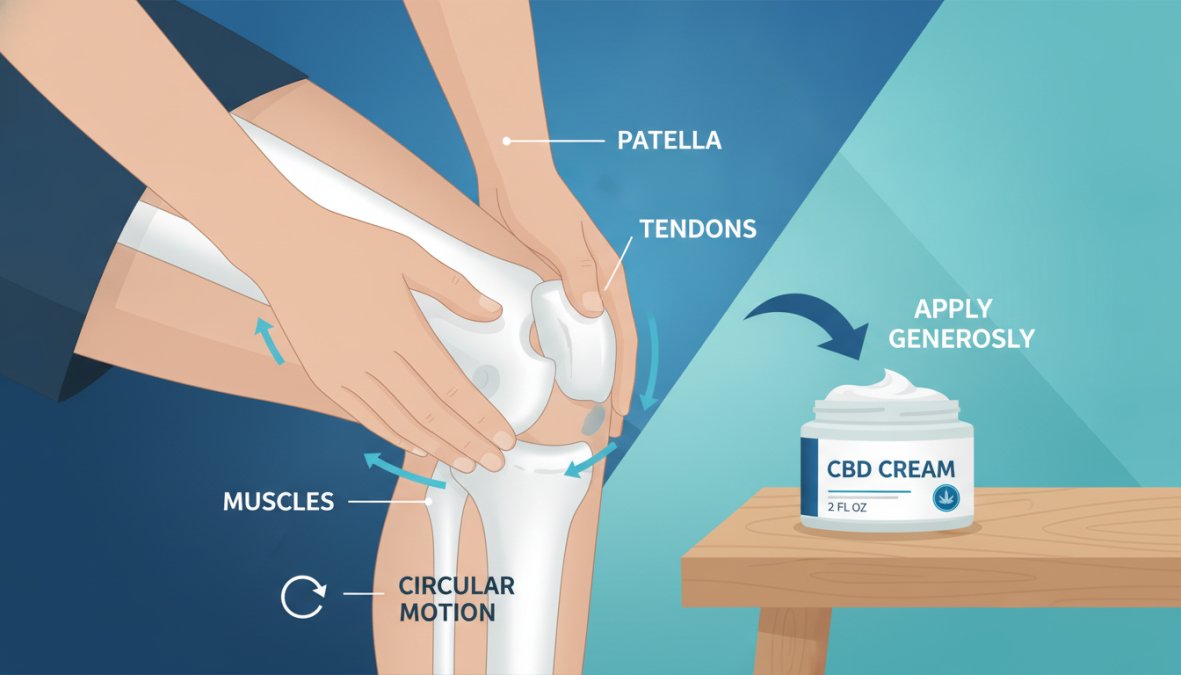
Most people apply CBD topicals incorrectly. The correct method is to apply a generous amount, then massage with firm circular pressure for 60-90 seconds. This warms the tissue, increases local blood flow, and actively drives the cream past the superficial skin layer toward the joint capsule.
(/how-cbd-works-for-pain/): Application Techniques by Joint]
Knees, Hips, and Large Joints
Large joints require more product and more time. For knees, apply to the entire joint complex, front, both sides, and back. For hips, apply to the lateral hip, groin crease, and lower gluteal area, since hip pain often radiates from multiple attachment points. Apply twice daily for chronic conditions: morning for stiffness, before bed for overnight recovery.
Hands, Wrists, and Small Joints
Use your thumb to apply targeted pressure along each finger joint in small circles. For wrists, wrap your opposite hand around the joint and massage along the joint line. For rheumatoid arthritis, apply before activity to reduce morning stiffness, capsaicin-containing formulas are particularly useful here.
Pairing CBD Cream with Physical Therapy
CBD topicals work best applied immediately before or after physical therapy exercises. Applied before PT, they reduce the pain threshold during movement, allowing better form and greater range of motion. Applied after PT, they address post-exercise inflammation and accelerate local recovery. According to the Arthritis Foundation’s guidance on complementary therapies, topical analgesics can be a useful adjunct, not a replacement, for prescribed PT exercises.
Apply CBD topical cream 10-15 minutes before physical therapy exercises to reduce pain-limited movement. Apply again within 30 minutes after your session to address post-exercise inflammation while tissue is still warm and receptive.
How Long Does CBD Cream Take to Work on Joints?
CBD topical cream typically produces noticeable effects within 15-45 minutes, with peak effect around 60-90 minutes. Onset varies based on skin thickness, formula type, application technique, and active ingredients, menthol produces near-immediate cooling, while CBD’s anti-inflammatory effect builds over 30-60 minutes. For chronic conditions, consistent twice-daily application produces cumulative benefit over days and weeks. Don’t judge a product’s effectiveness based on a single application.
CBD Cream Side Effects, Safety, and FDA Regulation
Side effects are generally mild and localized, most commonly skin irritation or contact dermatitis caused by fragrance additives rather than CBD itself. Systemic side effects are rare because meaningful amounts of CBD don’t typically enter the bloodstream through intact skin.
Dermatological Safety and Skin Absorption Considerations
Users with sensitive skin should patch-test any new CBD topical on the inner forearm for 24 hours before full application. Products containing capsaicin require particular care: avoid contact with eyes, wash hands thoroughly after application, and don’t apply to broken or irritated skin. As documented in FDA’s current position on CBD products, the FDA has not approved CBD topicals as drugs, which is precisely why third-party testing and COA transparency matter so much.
HSA/FSA Eligibility: Can You Pay with Pre-Tax Dollars?
As of 2026, the IRS does not classify CBD products as eligible medical expenses for HSA or FSA reimbursement because they are not FDA-approved drugs. However, some HSA/FSA administrators have begun approving certain topical analgesics that contain CBD alongside FDA-approved active ingredients like menthol or capsaicin at regulated concentrations, the key distinction being whether the product carries a drug facts panel. Check with your administrator before purchasing, as plan flexibility varies.
How to Choose the Right CBD Topical Cream for Joint Pain
The right cbd topical cream for joint pain depends on your condition type, sensitivity to active ingredients, and lifestyle:
- For osteoarthritis with chronic stiffness: Choose a warming formula with capsaicin or broad-spectrum CBD with MSM. Apply in the morning when stiffness is worst.
- For rheumatoid arthritis with inflammation: Prioritize anti-inflammatory actives like arnica and full-spectrum or broad-spectrum CBD. Cooling formulas with menthol help during flares.
- For post-exercise joint soreness: A fast-absorbing cooling cream with menthol applied within 30 minutes of activity produces the best results.
- For drug-testing concerns: Verified THC-free broad-spectrum or isolate products only, with COA confirmation.
Third-Party Testing and Certificate of Analysis (COA)
A certificate of analysis (COA) is a lab report from an independent testing facility that verifies CBD concentration, confirms absence of pesticides and heavy metals, and documents THC levels. If a brand doesn’t publish its COA, that’s a disqualifying signal. According to Project CBD’s consumer guidance on lab testing, verify that testing was performed by an ISO-accredited laboratory, not an in-house facility operated by the manufacturer.
Osteoarthritis vs. Rheumatoid Arthritis: Does Product Type Matter?
Yes, meaningfully. Osteoarthritis is degenerative, warming topicals with MSM and capsaicin tend to perform well. Rheumatoid arthritis is autoimmune, producing systemic inflammation where CBD’s interaction with CB2 receptors in immune cells is particularly relevant; full-spectrum or broad-spectrum products with arnica are the better fit, and cooling formulas help manage acute flares. Critically, using a warming capsaicin cream during an active RA flare can aggravate inflamed tissue, match the formula to the condition, not just the joint.
Finding a cbd topical cream for joint pain that actually works requires looking past the label and into the formulation. CBD Health Collection’s Topical Freeze Gel addresses the core challenge directly: a water-based delivery system for superior bioavailability, organically grown USA-sourced hemp, CO2 extraction, and independently verified COA lab testing for every batch. Produced in a GMP- and FDA-registered facility with a 30-day satisfaction guarantee, it’s the option we’d recommend to anyone starting their search. Visit cbdhealthcollection.com to find the right product for your specific needs.
Frequently Asked Questions
Does CBD topical cream actually help with joint pain?
Many users report meaningful relief from joint stiffness, muscle soreness, and chronic pain when using CBD topical cream for joint pain consistently. CBD interacts with receptors in the skin and underlying tissue through the endocannabinoid system, potentially producing anti-inflammatory and analgesic effects. While large-scale clinical trials are still limited, anecdotal evidence is strong, particularly for osteoarthritis and rheumatoid arthritis sufferers who use lab-tested, third-party verified products with complementary ingredients like arnica montana, menthol, or MSM.
How long does CBD cream take to work on joints?
Most users notice the initial effects of a CBD topical cream within 15 to 45 minutes of application, particularly products containing menthol or capsaicin that produce an immediate cooling sensation or warming effect. Deeper anti-inflammatory benefits may build over several days of consistent use. Bioavailability varies based on the cream's formulation, water-based and fast-absorbing formulas tend to deliver faster skin absorption than thick salves or balms.
How often should you apply CBD cream for joint pain?
Most CBD topical creams recommend applying two to three times daily to the affected joint, though application frequency depends on the product's potency and your individual pain level. For chronic pain conditions like osteoarthritis, consistent daily use tends to produce better results than sporadic application. Always follow the specific dosage guidance on your product's label, and start with a smaller amount to assess your skin's response before increasing.
What is the difference between full-spectrum and isolate CBD cream?
Full-spectrum CBD cream contains all naturally occurring hemp compounds, including trace amounts of THC (below 0.3%), which may create an 'entourage effect' that enhances anti-inflammatory and analgesic benefits. CBD isolate creams contain only pure cannabidiol with no other cannabinoids, making them a good choice for those avoiding THC entirely. Broad-spectrum is a middle option: it retains beneficial hemp-derived compounds but has THC removed, making it popular for drug-tested individuals.
Are there any side effects of using CBD topical cream?
CBD topical creams are generally well-tolerated with a strong dermatological safety profile since cannabidiol does not enter the bloodstream in significant amounts through skin absorption. The most common side effects are localized skin reactions such as mild redness or irritation, often caused by additional active ingredients like menthol or capsaicin rather than CBD itself. Always perform a patch test before widespread use, and consult a healthcare provider if you are pregnant, nursing, or taking medications.
Is CBD cream eligible for HSA or FSA reimbursement?
HSA and FSA eligibility for CBD topical cream for joint pain is a gray area under current FDA regulation. Because the FDA has not formally approved CBD as a medicine (outside of Epidiolex), most HSA/FSA administrators classify CBD products as ineligible. However, some accounts may approve reimbursement when a product is clearly marketed for pain relief and accompanied by a Letter of Medical Necessity from a physician. Always check with your specific plan administrator before purchasing.
This article was written using GrandRanker