
Table of Contents
- How Yoga Eases Lower Back Pain
- 7 Yoga Poses for Lower Back Pain Relief
- How Long to Hold Yoga Poses for Pain Relief
- Modifications for Yoga Back Stretches
- Yoga Poses to Avoid With Back Pain
- Desk-Friendly Yoga for Workplace Relief
- Conclusion: Building a Safe Practice
- Frequently Asked Questions
Last Updated: September 15, 2026
How Yoga Eases Lower Back Pain
Yoga poses for lower back pain relief work because they combine gentle stretching, controlled breathing, and targeted muscle activation in a single practice. This guide from CBD Health Collection walks through seven poses you can start today, how long to hold each one, and the modifications that keep your spine safe.
The mechanics matter more than the mystique. Your lumbar spine supports most of your upper body weight, and when the muscles around it stay tight or weak, that load shifts onto structures that weren’t built to carry it. Yoga addresses both sides of that equation: it lengthens tight tissue and wakes up muscles that have gone quiet.
The Science of Stretching and Spinal Alignment
Spinal alignment refers to the natural curves of your vertebrae stacking in a way that distributes pressure evenly. When muscle tension pulls that stack out of position, the lumbar spine takes the strain.
A pelvic tilt changes how force travels through your lower back. Tight hamstring flexibility limits that tilt, which is why hamstring work shows up in nearly every back-focused sequence. Core stability and glute activation then hold the new position in place.
Movement quality matters here. Flexion and extension through a controlled range of motion build proprioception, your sense of where your spine is in space. That awareness is what prevents the next flare-up.
The American College of Physicians low back pain guideline recommends nonpharmacologic approaches such as yoga, tai chi, and massage as first-line treatment for acute and chronic low back pain.
7 Yoga Poses for Lower Back Pain Relief
Seven poses cover the full range your lower back needs: flexion, extension, decompression, and stabilization. Move through them slowly, and stop any pose that produces sharp or radiating pain.
| Pose | Primary Benefit | Hold Time | Best For |
|---|---|---|---|
| Cat-Cow | Spinal flexion and extension | 8-10 rounds | Morning stiffness |
| Child’s Pose | Decompression | 1-3 minutes | Acute tension |
| Bridge | Glute activation | 3-5 breaths | Weak glutes |
| Sphinx | Gentle extension | 1-2 minutes | Disc pressure |
| Supine Twist | Rotation and release | 30-60 seconds per side | Muscle tightness |
| Bird Dog | Core stability | 5 reps per side | Injury prevention |
| Seated Forward Fold | Hamstring flexibility | 1-2 minutes | Posterior chain tightness |
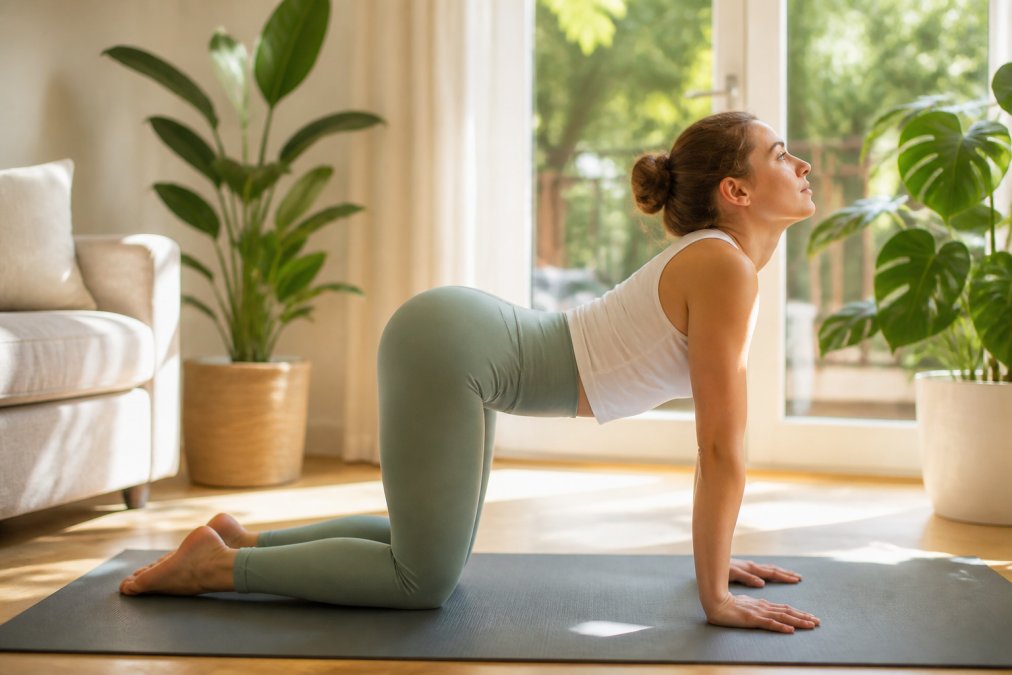
Cat-Cow for Spinal Flexion and Extension
Start on hands and knees with a neutral spine. Inhale as you drop your belly and lift your chest into extension. Exhale as you round your back and tuck your chin into flexion.
Move with your breath, not against it. Eight to ten slow rounds warm the vertebrae and surrounding tissue before you ask anything harder of them.
Child’s Pose for Decompression
Knees wide, hips back toward your heels, arms extended forward. This is the gentlest decompression available to most people with a sore back.
Breathe into your back ribs rather than your chest. Diaphragmatic breathing here relaxes the deep muscle tension that keeps pain cycling. Hold one to three minutes.
Bridge Pose for Glute Activation
Lie supine with knees bent and feet hip-width apart. Press through your feet and lift your hips until your body forms a line from knees to shoulders.
Squeeze your glutes at the top, not your lower back. Weak glute activation is one of the most common reasons lower back pain keeps returning, because the lumbar spine ends up doing work the hips should handle.
How Long to Hold Yoga Poses for Pain Relief
The research-backed answer is 30 seconds to 3 minutes per pose, depending on the pose type and your comfort level. Stretching research generally supports holding a static stretch for at least 30 seconds to see lasting changes in tissue length (pubmed.ncbi.nlm.nih.gov).
For gentle stretching of tight muscles, 30 to 60 seconds per side works well. Restorative poses like Child’s Pose can run longer, up to three minutes, because the goal is nervous system downregulation rather than tissue lengthening.
A practical rule: hold until you feel a mild stretch, then stay for five more slow breaths. If the sensation sharpens, you’ve gone past the useful range.
Holding a pose longer isn’t automatically better. Past roughly two minutes, most people start bracing against the stretch, which defeats the purpose. Come out, reset, and repeat the pose instead.
Modifications for Yoga Back Stretches
Modifications for yoga back stretches let you keep the benefit of a pose while reducing load on the lumbar spine. The right modification depends on whether your pain is acute pain or a longer-term chronic pain pattern, and on how much mobility you have on a given day.
Using Props for Support
Props aren’t a beginner’s crutch. They’re how experienced practitioners keep a pose in the range where it actually helps. Here’s how to set each one up:
- Blocks under your hands in Child’s Pose. Place one or two blocks under each hand so your forearms rest at hip height. This shortens the reach and reduces the stretch through a stiff lower back. Use the tallest height that lets your forehead rest comfortably.
- A folded blanket under your hips in Bridge. Slide a folded blanket or thin bolster under your sacrum once your hips are lifted. This supports the pelvis and keeps the lumbar spine from overextending at the top of the pose.
- A bolster under your chest in Sphinx. A bolster or rolled blanket under the forearms raises the torso so the lower back stays in a gentle, supported extension instead of a deep one. This is often the difference between a comfortable Sphinx and one that pinches.
- A strap around your feet in Seated Forward Fold. Loop the strap around the balls of your feet and hold the ends with bent knees. This protects the hamstrings from overstretching and keeps the lower back from rounding under load.
- A block between the thighs in Bridge. Squeezing a block lightly activates the inner thighs and helps you feel glute engagement rather than lumbar arching.
Modifying by Pain Type
Sciatica. Favor supine and side-lying variations where the spine stays neutral. Replace seated forward folds with a supine hamstring stretch using a strap. Replace deep twists with a supine twist where both knees rest on a bolster.
Muscle strain. Keep ranges small and holds short. Use a bolster under the chest for Sphinx and a blanket under the hips for Bridge. If a pose reproduces the sharp catch, back off the range by half. Maintaining this gentle approach to alignment often requires the stability provided by supportive meditation cushions to ensure the pelvis remains neutral during longer periods of restorative practice.
Herniated disc. Bias toward extension-friendly poses with support. Sphinx on a bolster and a supported Bridge are usually better tolerated than any forward fold. Avoid rounding the spine under load.
When to Graduate Off a Prop
Props are not a permanent downgrade. A simple rule: if you can hold the pose for the full target time with steady breathing and no increase in symptoms, try the next smaller prop or remove it. If symptoms return, go back. Progress is not linear, and a flare-up week is a good week to bring the props back out.
Prop-based modifications matter most when you’re returning to movement after a flare-up. They let you practice daily without provoking symptoms, which is what actually builds tolerance over time.
Keep a block, a strap, and a folded blanket within arm’s reach of your mat. The easier props are to grab, the more likely you are to use them on the days your back actually needs them.
Yoga Poses to Avoid With Back Pain
Most back-pain yoga guides hand you a blanket list of forbidden poses.
Why Certain Poses Aggravate a Sensitive Spine
Three mechanical forces drive most yoga-related back flare-ups:
Matching Poses to Your Pain Type
Pain that travels below the knee, numbness, tingling, or new weakness in a leg is a red flag for nerve involvement (Sciatica: MedlinePlus Medical Encyclopedia). Do not stretch through it. See a healthcare provider before continuing your practice.
Poses to Skip or Heavily Modify
What to Do Instead
Desk-Friendly Yoga for Workplace Relief
The most effective workplace intervention isn’t a longer yoga session. It’s breaking up sitting more often, since musculoskeletal strain builds from uninterrupted static posture.
Conclusion: Building a Safe Practice
Frequently Asked Questions
Which yoga pose is most effective for treating lower back pain?
There is no single best pose, but Cat-Cow is often recommended as a starting point because it gently moves the spine through flexion and extension without loading it heavily. Child’s Pose is another effective option for decompression. The most effective pose for you depends on whether your pain stems from muscle tension, a herniated disc, or sciatic nerve irritation. A physical therapist can help identify which movements suit your specific condition.
How often should you practice yoga for back pain relief?
Most people benefit from practicing 3 to 4 times per week, with sessions lasting 15 to 30 minutes. Consistency matters more than duration. If you are new to yoga, start with 10-minute sessions and gradually increase. Stop immediately if any pose increases sharp pain or numbness, and consult a healthcare provider before starting a new routine, especially if you have a diagnosed spinal condition.
Which yoga poses should be avoided if you have lower back pain?
Deep forward folds like seated forward fold, intense backbends, and unsupported twists can aggravate lower back pain. Poses that combine forward bending with twisting, such as revolved triangle, place uneven stress on the vertebrae and discs. If you have sciatica or a herniated disc, avoid any pose that causes shooting pain down the leg. Always check with a doctor or physical therapist before trying new poses.
Can yoga help resolve chronic lower back pain?
Research suggests yoga can reduce chronic lower back pain and improve function when practiced regularly. It works by improving core stability, hamstring flexibility, and posture correction while reducing muscle tension. However, yoga is not a cure for all back conditions. For persistent or severe pain, combine yoga with guidance from a healthcare provider and consider other treatments as recommended.