
Table of Contents
- What Is CBD and How Does It Work in the Body?
- The Full CBD Health Benefits List: 10 Evidence-Informed Effects
- Bioavailability by Delivery Method: Which Format Works Best?
- CBD Side Effects and Drug Interactions You Need to Know
- CBD Dosage for Beginners: How to Start Safely
- How to Verify Quality: Third-Party Lab Testing and Certificates of Analysis
- Who Benefits Most? CBD for Specific Demographics
- Conclusion: Using the CBD Health Benefits List to Make Smarter Choices
Last Updated: June 6, 2026
Cannabidiol research has expanded significantly over the past decade, and the cbd health benefits list has grown alongside it. CBD Health Collection has compiled this guide to give you an honest, evidence-informed breakdown of what cannabidiol actually does in the body, how delivery methods compare, and what to watch for when buying. Below, we cover 10 documented effects, bioavailability differences by format, drug interaction risks, and how to verify product quality before you spend a dollar.
Cannabidiol is a non-psychoactive compound derived from hemp that interacts with the body’s endocannabinoid system to support homeostasis. It does not produce the "high" associated with tetrahydrocannabinol (THC), and its therapeutic efficacy varies meaningfully depending on dosage, delivery method, and individual metabolism.
What Is CBD and How Does It Work in the Body?
Cannabidiol (CBD) is a naturally occurring compound extracted from hemp plants that interacts with the human endocannabinoid system to help regulate pain, mood, sleep, and immune response. Unlike tetrahydrocannabinol, CBD produces no psychoactive effects, making it a practical option for daily wellness use.
The endocannabinoid system is a network of receptors, enzymes, and endogenous cannabinoids distributed throughout the brain, organs, and immune cells. CB1 receptors concentrate in the central nervous system; CB2 receptors appear primarily in immune tissue. CBD does not bind directly to either receptor with high affinity, instead, it modulates their activity indirectly and interacts with serotonin receptors, vanilloid receptors, and GPR55, which partly explains its broad range of reported effects.
Hemp-derived CBD products became federally legal in the United States under the 2018 Farm Bill, provided they contain less than 0.3% THC. FDA oversight remains limited for most CBD wellness products, making third-party lab testing critical.
CBD vs. THC: Key Differences You Should Know
Cannabidiol (CBD) is non-psychoactive, does not impair cognitive function, and is legal at the federal level when hemp-derived. Tetrahydrocannabinol (THC) is the primary psychoactive compound in cannabis and remains a Schedule I controlled substance federally.
| Property | CBD | THC |
|---|---|---|
| Psychoactive | No | Yes |
| Federal legal status | Legal (hemp-derived) | Federally illegal |
| Primary receptor | Indirect modulation | CB1 direct agonist |
| Common use | Wellness, pain, sleep | Recreation, appetite, pain |
| Drug test risk | Low (isolate) | High |
[Broad-spectrum and full-spectrum CBD products](/full-spectrum-vs-broad-spectrum-cbd/) contain trace cannabinoids that can accumulate with daily use. If you are subject to workplace drug testing, choose a verified CBD isolate product to minimize risk.
The Full CBD Health Benefits List: 10 Evidence-Informed Effects
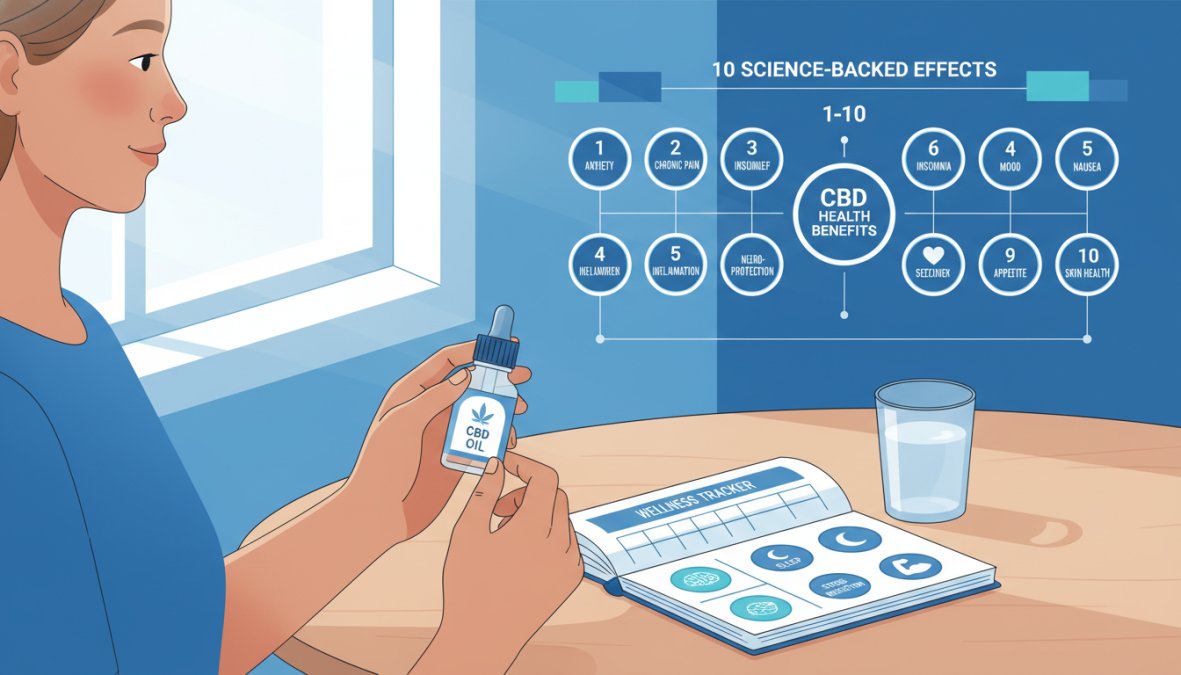
The complete cbd health benefits list spans pain relief, anxiety reduction, sleep improvement, seizure management, neuroprotection, skin health, gut support, cardiovascular effects, addiction recovery assistance, and pet wellness. Each benefit operates through distinct mechanisms, which is why dosage and delivery format matter as much as the compound itself.
1. Chronic Pain Relief and Anti-Inflammatory Effects
Chronic pain is the most common reason people seek out CBD. CBD interacts with vanilloid receptors (TRPV1) involved in pain signaling and suppresses inflammatory cytokine production via CB2 receptor modulation. Anti-inflammatory effects come without the gastrointestinal side effects commonly associated with NSAIDs. Topical applications such as CBD freeze gels and pain patches deliver cannabidiol directly to affected tissue, bypassing systemic metabolism entirely.
2. Anxiety and Depression Support
CBD’s anxiolytic properties are among its most studied effects. The compound enhances serotonin signaling at 5-HT1A receptors, the same pathway targeted by SSRIs. According to National Institutes of Health research on CBD and anxiety, preclinical and early clinical evidence supports CBD’s role in reducing anxiety-related behaviors across multiple models.
CBD’s anti-anxiety effects appear dose-dependent and can follow an inverted U-curve: too little produces minimal effect, too much can increase anxiety in some individuals. Start low, track your response, and adjust incrementally.
3. Improved Sleep Quality
CBD does not sedate you the way pharmaceutical sleep aids do. Its sleep benefits come primarily from reducing the anxiety and pain that prevent sleep, though at higher doses CBD shows mild sedative properties through interaction with GABA receptors. Formulations combining CBD with CBN and melatonin target multiple pathways simultaneously and are worth considering if anxiety is not your primary sleep barrier.
4. Seizure Disorders and Epilepsy Management
This is the one area where CBD has FDA-approved clinical evidence. Epidiolex, a pharmaceutical-grade CBD formulation, received FDA approval for treating Lennox-Gastaut syndrome and Dravet syndrome in pediatric patients following clinical trials demonstrating statistically significant seizure reduction versus placebo. General wellness CBD products are not FDA-approved drugs and should not be substituted for prescribed seizure medication without medical supervision.
5. Neuroprotection and Brain Health
CBD’s neuroprotective properties stem from its antioxidant activity and ability to reduce neuroinflammation. Research from National Library of Medicine studies on CBD neuroprotection suggests CBD may protect neurons against oxidative stress and excitotoxicity implicated in neurodegenerative conditions. The evidence remains preliminary; anyone managing a neurological condition should treat CBD as a complement to, not a replacement for, established medical care.
6-10. Additional Benefits: Skin, Gut, Heart, Addiction, and Pet Wellness
The remaining five entries on the cbd health benefits list cover emerging but credible areas of research:
- Skin health: CBD’s anti-inflammatory and sebum-regulating properties make it relevant for acne, eczema, and psoriasis. Topical CBD reduces localized inflammation without systemic exposure.
- Gut support: The endocannabinoid system plays a regulatory role in gastrointestinal motility and inflammation. CBD shows early promise for irritable bowel syndrome and inflammatory bowel conditions.
- Cardiovascular effects: CBD appears to reduce resting blood pressure and vascular inflammation in preliminary studies, though the mechanism is not fully established.
- Addiction recovery: CBD has been studied as a support tool for reducing cravings associated with opioid, alcohol, and nicotine dependence by modulating stress-response circuits.
- Pet wellness: Dogs and cats share a similar endocannabinoid system architecture. CBD products formulated specifically for pets address anxiety, joint pain, and age-related discomfort. CBD Health Collection offers dedicated pet wellness products for this purpose.
Bioavailability by Delivery Method: Which Format Works Best?
Bioavailability is the percentage of CBD that actually reaches systemic circulation and produces an effect. This number varies dramatically by delivery method and is the single most important variable most buyers ignore.
Sublingual Tinctures vs. Gummies vs. Topicals vs. Soft Gels
| Delivery Method | Estimated Bioavailability | Onset Time | Duration |
|---|---|---|---|
| Sublingual tinctures | 20-35% | 15-45 minutes | 4-6 hours |
| Soft gels / capsules | 6-19% | 45-90 minutes | 6-8 hours |
| Gummies | 6-15% | 30-60 minutes | 4-6 hours |
| Topicals | Local only | 15-30 minutes | 2-4 hours |
| Water-based CBD | Up to 90% (claimed) | 10-20 minutes | Variable |
Sublingual tinctures deliver CBD through the mucous membranes under the tongue, bypassing first-pass liver metabolism, which is why they work faster and more efficiently than gummies or soft gels. CBD is fat-soluble, and oil-based products lose much of their dose through the digestive tract. CBD Health Collection uses water-based CBD formulation technology designed to address this limitation and improve absorption significantly.
Hold sublingual [CBD oil](/cbd-oil-dosage-for-beginners/) under your tongue for 60-90 seconds before swallowing. Most people hold it for 10 seconds and wonder why results are inconsistent. The longer contact time allows more cannabidiol to absorb directly into the bloodstream.
Topicals do not enter systemic circulation, they work locally on skin, muscle, and joint tissue. Do not expect a CBD topical to address anxiety or sleep the way a tincture would.
CBD Side Effects and Drug Interactions You Need to Know
CBD side effects are generally mild and dose-dependent. Common reports include dry mouth, reduced appetite, fatigue, and loose stools at higher doses, typically resolving when dosage is reduced. The more serious concern is drug interactions.
CYP450 Enzymes and Medication Interactions
CBD inhibits the CYP450 enzyme family, particularly CYP3A4 and CYP2D6, which metabolize a significant portion of commonly prescribed medications including blood thinners (warfarin), antiepileptics, antidepressants, and certain heart medications. When CBD inhibits CYP3A4, it slows drug breakdown, potentially raising blood concentrations to levels that produce adverse effects. According to FDA guidance on CBD drug interactions and safety, this interaction mechanism is well-established and warrants medical consultation before combining CBD with prescription medications.
Assuming that because CBD is "natural" it cannot interfere with medications is wrong and can be dangerous. If you take any prescription drug, speak with your prescribing physician before adding CBD to your routine.
CBD can significantly increase blood levels of warfarin (Coumadin). If you are on anticoagulant therapy, do not start CBD without direct medical supervision and INR monitoring.
CBD Dosage for Beginners: How to Start Safely
CBD dosage for beginners should follow one rule: start low, go slow, and track your results. There is no universal dose because individual metabolism, body weight, the condition being addressed, and delivery method all influence how much CBD you need.
A practical starting framework:
- Week 1-2: 10-15mg per day, taken at the same time each day
- Week 3-4: Increase to 20-25mg per day if no meaningful effect is observed
- Week 5+: Adjust in 5-10mg increments based on response, up to a practical ceiling of 50-100mg for most wellness applications
For sleep support, take CBD 30-60 minutes before bed. For chronic pain or anxiety, split the dose morning and evening to maintain consistent blood levels. For acute relief, sublingual tinctures provide the fastest onset.
CBD follows a biphasic dose-response curve in some applications: low doses stimulate, high doses sedate. Finding your personal threshold takes 2-4 weeks of consistent use.
How to Verify Quality: Third-Party Lab Testing and Certificates of Analysis
Third-party lab testing is the only reliable way to verify what is actually in a CBD product. Without it, you are trusting a label.

A Certificate of Analysis (COA) is a document issued by an independent laboratory confirming a product’s cannabinoid content, THC levels, and absence of contaminants including heavy metals, pesticides, residual solvents, and microbial agents.
When reviewing a COA, check for:
- Issued by an ISO 17025-accredited laboratory
- Cannabinoid panel showing CBD concentration matches the label claim
- THC level at or below 0.3% (federal legal limit)
- Pesticide and heavy metal screens showing "pass" or "ND" (not detected)
- Batch number matching the product you purchased
- Test date within the past 12 months
CBD Health Collection provides independently verified COA lab testing for every product batch, with results accessible to consumers. Products are produced in a GMP- and FDA-registered facility and extracted using a clean CO2 process that avoids chemical solvents. According to Project CBD’s consumer guide to lab testing, a meaningful portion of CBD products sold online do not contain the cannabidiol concentration stated on the label, a COA from an accredited lab is your primary protection.
Who Benefits Most? CBD for Specific Demographics
Not everyone responds to CBD the same way, and the optimal approach varies by age, health status, and wellness goal.
Adults managing chronic pain: Full-spectrum or broad-spectrum CBD in tincture or topical form offers the most direct benefit. The entourage effect from multiple cannabinoids and terpenes in full-spectrum products appears to enhance pain relief compared to isolate alone.
Adults with anxiety or sleep issues: Broad-spectrum formulations avoid THC while preserving supporting cannabinoids. Evening dosing with a sublingual tincture or soft gel is a practical starting point.
Older adults: Metabolism slows with age, meaning CBD may remain active longer. Start at the lower end of the dosage range and monitor for interactions with existing medications. Topical products for joint pain carry minimal systemic risk for this group.
Athletes and active adults: CBD’s anti-inflammatory properties make it relevant for post-exercise recovery. Topical freeze gels and pain patches target localized soreness without affecting cognitive performance.
Pet owners: Dogs and cats have endocannabinoid systems that respond to cannabidiol similarly to humans, addressing separation anxiety, noise sensitivity, joint stiffness, and age-related discomfort. Always use pet-specific formulations with verified COAs, some carrier oils in human products (such as xylitol-containing formulations) are toxic to animals.
Finding a CBD product worth trusting is harder than it should be. The market is crowded with underdosed, mislabeled, and poorly manufactured options. CBD Health Collection addresses this directly: every product is derived from organically grown USA hemp, extracted with clean CO2 processing, independently lab-tested with accessible COAs, and produced in a GMP- and FDA-registered facility. For anyone serious about using the cbd health benefits list as a practical wellness guide, start with a brand that can prove what’s in the bottle. Explore the full product range at CBD Health Collection and use their product selector to find the right format for your specific needs in under a minute.
Frequently Asked Questions
What are the primary health benefits of CBD oil?
The CBD health benefits list commonly includes chronic pain relief, reduced inflammation, anxiety and stress reduction, improved sleep quality, and seizure management in certain epilepsy conditions. CBD interacts with the endocannabinoid system to help the body maintain homeostasis. While clinical trials support several of these benefits, most notably for epilepsy, many other effects are supported by early research and widespread anecdotal evidence. Always consult a healthcare provider before starting CBD for any specific condition.
Does CBD have side effects I should know about?
Yes, CBD side effects are generally mild but real. The most commonly reported include dry mouth, drowsiness, reduced appetite, and mild digestive upset. More importantly, CBD can interact with medications metabolized by CYP450 enzymes, including blood thinners and certain antidepressants, potentially altering their effectiveness. If you take prescription medications, speak with your doctor before adding CBD to your wellness routine. Starting with a low dose and increasing gradually helps minimize unwanted effects.
What is a good CBD dosage for beginners?
A practical CBD dosage for beginners is typically 10-25mg per day, taken once or twice daily. The standard approach is 'start low, go slow', begin at the lower end, assess your response over one to two weeks, then adjust upward in small increments if needed. Dosage can vary based on body weight, metabolism, the delivery method used, and the condition being addressed. Sublingual tinctures offer faster onset and easier dose adjustment, making them a popular starting point for new users.
What is the difference between CBD and THC in terms of health benefits?
Both cannabidiol (CBD) and tetrahydrocannabinol (THC) interact with the endocannabinoid system, but they produce very different effects. THC is psychoactive, it causes the 'high' associated with cannabis. CBD is non-psychoactive and hemp-derived, making it legal federally and suitable for daily wellness use. THC has its own therapeutic applications, including appetite stimulation and pain relief, but CBD is preferred by those seeking therapeutic efficacy without altered cognition, impairment, or the legal and occupational risks associated with THC.
How do I know if a CBD product is safe and high quality?
Look for products that provide a Certificate of Analysis (COA) from an independent, accredited third-party lab. A valid COA confirms cannabidiol potency, verifies that THC levels are within legal limits, and screens for contaminants like pesticides and heavy metals. Reputable brands use organically grown, USA-sourced hemp, clean CO2 extraction, and manufacture in GMP- and FDA-registered facilities. Always verify the COA matches the product batch number and was issued by a lab with no financial ties to the brand.
Is CBD legal and safe for daily use?
Hemp-derived CBD containing less than 0.3% THC is federally legal in the United States under the 2018 Farm Bill, though state laws vary. For most healthy adults, daily CBD use appears well-tolerated when taken at moderate doses. The FDA has approved one CBD-based prescription drug (Epidiolex) for seizure disorders, lending credibility to its therapeutic efficacy. That said, long-term safety data is still emerging, and daily users should periodically reassess their dosage and consult a healthcare provider, especially if taking other medications.
This article was written using GrandRanker