Table of Contents
- How a CBD Topical Addresses Joint Inflammation
- How to Apply CBD Topical for Inflammation
- CBD Topical Application Frequency: Finding Your Schedule
- Choosing High-Quality CBD Topicals
- Safety, Side Effects, and Medication Interactions
- Common Mistakes to Avoid With CBD Topicals
- Conclusion
- Frequently Asked Questions
Last Updated: September 15, 2026
How a CBD Topical Addresses Joint Inflammation
A CBD topical is a cannabidiol-infused cream, gel, or balm applied directly to the skin over a painful joint, and it works differently from anything you swallow. The cannabinoids bind to receptors in your skin and nearby tissue rather than traveling through your bloodstream first. That distinction matters more than most product pages admit.
Cannabidiol (CBD) is a non-psychoactive compound found in hemp that interacts with the body’s endocannabinoid system, a network of receptors involved in regulating pain signaling and inflammation.
Here’s what most guides get wrong: they promise systemic relief from a product that barely enters your bloodstream. The honest version is that a well-made CBD topical for joint inflammation targets localized pain relief at the application site, and that is exactly why people reach for it.
What the Research Says About Cannabinoids and Joint Pain
The evidence base is real but early. Preclinical studies suggest cannabinoid receptors in skin and joint tissue may influence inflammatory signaling, and researchers have identified therapeutic potential for topical cannabinoids in chronic pain management (pubmed.ncbi.nlm.nih.gov). Human randomized controlled trials focused specifically on arthritis topicals remain limited, so treat marketing claims that promise a cure with suspicion.
What we can say with confidence: topical application avoids the bioavailability problems that plague ingested CBD, because it bypasses first-pass liver metabolism. That is a meaningful advantage for anyone who wants effects where they hurt, not a full-body buzz. The National Center for Complementary and Integrative Health overview of cannabis and cannabinoids is a reasonable starting point for understanding where the science currently stands.
How to Apply CBD Topical for Inflammation
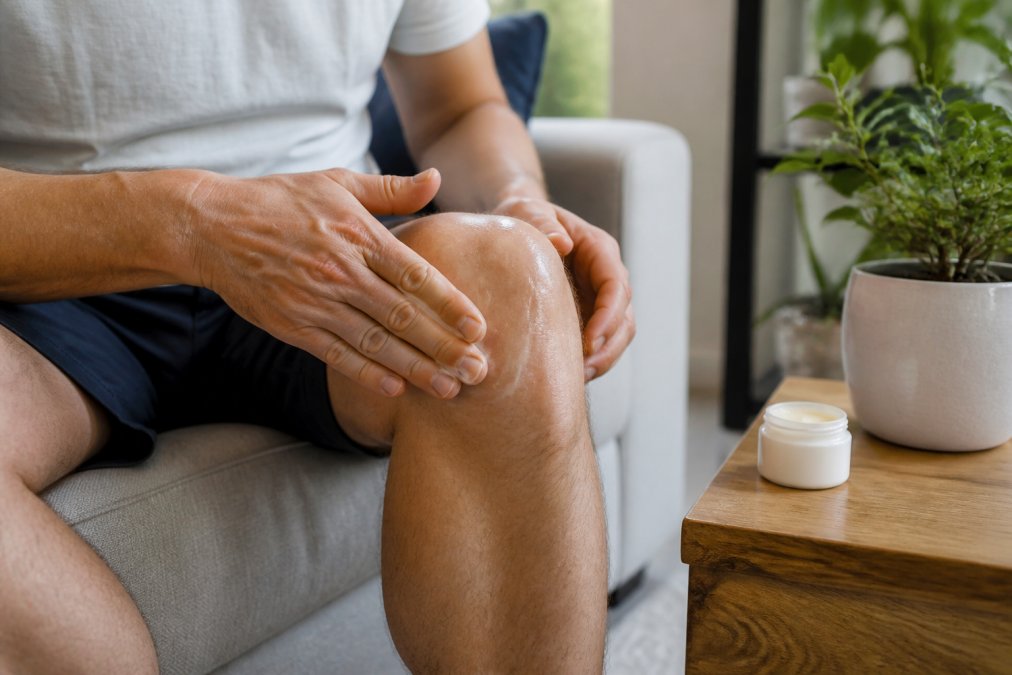
Apply a thin layer directly over the affected joint, massage it in for 30 to 60 seconds, and give it 15 to 30 minutes to take effect. More product does not mean more relief; absorption tops out once the skin is saturated.
Most guides stop there. The gap is that they treat application as a formality when it is actually the variable that decides whether a topical does anything at all. Cannabinoids are fat-soluble molecules trying to cross a skin barrier built to keep water in and everything else out. How you prep and work the skin changes how much gets through.
Why Technique Changes Absorption
Skin has two routes a topical can take. The first is through the stratum corneum, the outer layer of dead cells, which is the main barrier. The second is through hair follicles and sweat glands, which act as shortcuts straight to deeper tissue. Follicle-rich areas and thin-skinned joints absorb more readily than thick, calloused skin.
That is why the same product can feel stronger on a wrist than on a heel. It also explains why massage matters: working the product in raises local skin temperature, increases blood flow to the area, and helps push the formula into those follicular channels rather than leaving it sitting on the surface.
Step-by-Step Application for Maximum Absorption
Dermal penetration improves with a few simple habits. This is the part nobody tells you about, and it separates a product that works from one that sits on top of your skin.
- Clean and dry the area so nothing blocks absorption, but leave it slightly damp, not dripping
- Warm a small amount between your fingers first, body heat thins the formula so it spreads further
- Massage in circular motions over the joint, not just the sore spot, for a full 30 to 60 seconds
- Work the surrounding tissue, including the muscles that cross the joint, since referred tension often sits there
- Wait 10 minutes before covering with clothing so the product has time to absorb
- Wash your hands afterward unless you are treating your hands
Apply right after a warm shower. Warm, slightly damp skin absorbs topicals more readily than cold, dry skin, and the effect tends to come on faster. A warm compress for a few minutes before application does the same thing if a shower is not practical.
Joint-Specific Technique
Different joints need different handling. A knee or elbow has a broad, relatively flat surface where a circular massage works well. Fingers and wrists are small and close to the surface, so a smaller amount goes further and over-applying just wastes product. Hips and shoulders sit under thicker muscle and fat, so a longer massage and a slightly larger amount make more sense there.
For stiff, low-mobility joints, apply before gentle range-of-motion movement rather than after. The motion helps distribute the product and the warmth from movement supports absorption.
What Not to Do
- Do not apply to broken skin, rashes, or open wounds
- Do not layer multiple topicals at once, you will not know what is working
- Do not expect a topical to behave like something you swallow; it works where you put it
- Do not judge results after one use, consistency over one to two weeks is what reveals whether it helps
CBD Topical Application Frequency: Finding Your Schedule
Start with twice daily, morning and evening, then adjust based on how your joint responds. CBD topical application frequency is personal; there is no universal dosage guideline, and anyone who gives you an exact milligram target for a cream is guessing. Consistent application often serves as a foundation for broader joint support strategies that help maintain mobility during the physical demands of heavy lifting.
A practical schedule looks like this:
| Situation | Frequency | Timing |
|---|---|---|
| Mild morning stiffness | Once daily | After waking |
| Persistent joint stiffness | Twice daily | Morning and evening |
| Flare-up days | Up to 3 times | Spaced 4-6 hours apart |
| Maintenance | As needed | Before activity |
If you feel nothing after two weeks of consistent use, more product is unlikely to change that. Reassess the product, not the dose.
Choosing High-Quality CBD Topicals
The single best signal of a quality topical is a certificate of analysis from an independent lab, not the word “pure” on the front of the jar. Third-party testing confirms potency and screens for contaminants, and you should be able to find that document before you buy.
But “look for a COA” is where most guides stop, and that advice is useless if you do not know what you are reading. Here is how to actually use one.
How to Read a Certificate of Analysis
A COA is a lab report tied to a specific batch. If a brand shows one generic document for its whole product line, that is a red flag, potency varies batch to batch, and a real COA carries a batch or lot number that matches the label on your jar.
When you open one, check these fields:
- Cannabinoid profile, a breakdown of CBD, and if it is full-spectrum, minor cannabinoids like CBG, CBC, and trace THC. A single “total CBD” number with no breakdown tells you less.
- Potency versus label claim, the tested amount should match what the label promises. A meaningful gap in either direction is a quality problem.
- Contaminant panel, look for testing on heavy metals, pesticides, residual solvents, and microbials. A COA that only reports potency is only half a report.
- Testing lab name, it should be an independent lab, not the brand’s own facility.
- Date, an old COA may not reflect the batch you are buying.
If you cannot find any of this, treat the product as unverified regardless of how good the label looks.
Hemp Seed Oil vs. CBD Extract: Reading Labels Correctly
Hemp seed oil and CBD extract are not the same thing, and confusing them is the most common labeling trap in this category. Hemp seed oil is pressed from seeds and contains essentially no cannabidiol. CBD extract is drawn from the plant’s flowers and leaves, where the cannabinoids actually live.
If a topical lists “hemp oil” with no milligram amount of CBD, you are buying a moisturizer, not a cannabinoid product. Check the supplement facts panel for an actual CBD figure before you assume you are getting anything more than a nice-smelling lotion.
Supporting Ingredients Worth Knowing
Cannabinoids are not the only active in a good formula. Common complementary ingredients include:
Extraction and Sourcing
Safety, Side Effects, and Medication Interactions
Never apply a topical to broken skin, an open wound, or a rash. It increases irritation risk and speeds absorption in ways the product was not formulated for.
Common Mistakes to Avoid With CBD Topicals
Other frequent errors:
Conclusion
Frequently Asked Questions
How does a CBD topical work for joint inflammation?
A CBD topical delivers cannabidiol directly to the skin and underlying tissues, where it interacts with local cannabinoid receptors to help reduce inflammation and ease joint stiffness. Unlike oral CBD, which enters the bloodstream and affects the whole body, a topical provides localized pain relief with minimal systemic absorption. Many users report noticeable relief within 15 to 30 minutes of application.
How often can I apply a CBD topical to my joints?
Most people apply a CBD topical two to three times daily, or as needed for flare-ups. Start with once daily to see how your skin responds, then adjust. The effects of a topical typically last several hours, so reapply when discomfort returns. There is no standard dosage guideline for topicals, so track what works for you and mention regular use to your doctor.
What should I look for when choosing a high-quality CBD topical?
Look for third-party testing with a certificate of analysis (COA) that confirms potency and screens for heavy metals, pesticides, and solvents. Choose products labeled full-spectrum, broad-spectrum, or isolate so you know exactly what you are getting. Check that the label says CBD extract, not hemp seed oil, which contains little to no cannabidiol. Also look for beneficial ingredients like arnica, menthol, or capsaicin.
Are there any FDA-approved CBD products for joint inflammation?
No CBD topical is FDA-approved to treat joint inflammation. The FDA has approved one prescription CBD product for specific seizure disorders, but topicals for pain are not approved. That means quality varies widely, so third-party testing and transparent labeling matter. Talk to your doctor before using CBD alongside arthritis medications, since interactions are possible.
This article is for general information only and is not medical advice. Consult a qualified healthcare professional before using CBD, especially if you take prescription medication.