Table of Contents
- Is CBD Safe for Older Dogs? What You Need to Know
- Safety Profile: Side Effects and Drug Interactions for Aging Dogs
- Benefits of CBD for Dogs with Arthritis and Joint Health
- CBD Dosage for Senior Dogs: Guidelines and Titration
- How to Choose High-Quality CBD for Pets: What Matters Most
- Broad-Spectrum vs. Full-Spectrum vs. Isolate: Which Is Best for Older Dogs
- Integrating CBD with Veterinary Care and Behavioral Training
- Conclusion: Safe CBD Use for Senior Dogs
Is CBD Safe for Older Dogs? A Senior Pet Guide
Last Updated: July 10, 2026
When managing pain, anxiety, and age-related conditions in senior dogs, pet owners increasingly turn to cannabidiol (CBD) as a natural alternative. This guide walks you through CBD safety, dosing, quality standards, and how to integrate it responsibly into your older dog’s care routine.
The endocannabinoid system exists in all mammals, including dogs, and regulates pain, stress response, and inflammation. As dogs age, this system becomes less efficient, which is why veterinarians are exploring CBD as a supportive tool for senior canine health. Safety depends entirely on product quality, proper dosing, and understanding how CBD interacts with your dog’s existing medications and health conditions.
Is CBD Safe for Older Dogs? What You Need to Know
CBD can be safe for older dogs when sourced from reputable companies and administered at appropriate doses under veterinary guidance.
Senior dogs metabolize substances differently than younger dogs. Their liver and kidney function may be compromised by age or existing conditions, affecting how their bodies process CBD. The same dose that works safely for a three-year-old dog might accumulate to unsafe levels in a twelve-year-old dog with declining organ function. Older dogs are also more likely to be on multiple medications, creating potential interaction risks.
When you source CBD from a company that conducts third-party lab testing, provides transparent certificates of analysis, and uses clean extraction methods, the risk profile becomes manageable. CBD itself is non-psychoactive and doesn’t produce the "high" associated with THC. Most adverse effects are mild, drowsiness, dry mouth, or temporary appetite changes, and resolve quickly when dosing is adjusted.
The real safety concern isn’t CBD itself, but contaminated or mislabeled products. Some CBD products contain heavy metals, pesticides, or undisclosed THC levels. Third-party testing and certificate of analysis documentation are non-negotiable for senior dog owners.
Understanding CBD and the Canine Endocannabinoid System
Your dog’s endocannabinoid system is a network of cannabinoid receptors throughout their brain, nervous system, organs, and immune cells. This system regulates pain perception, inflammatory response, anxiety, appetite, and sleep cycles. In older dogs, the endocannabinoid system often becomes less responsive, contributing to increased pain sensitivity and inflammation-related joint stiffness.
CBD supports this system’s function by interacting with cannabinoid receptors and influencing neurotransmitter systems that affect mood and pain perception. It doesn’t replace the endocannabinoid system; it enhances its function.
The distinction between full-spectrum, broad-spectrum, and isolate CBD products matters. Full-spectrum contains all cannabinoids, terpenes, and plant compounds from hemp. Broad-spectrum contains multiple cannabinoids and terpenes but has THC removed. Isolate contains only pure CBD. For senior dogs, broad-spectrum products often represent the best balance, they retain some entourage effect while eliminating THC entirely.
Age-Related Considerations for Senior Dogs
Senior dogs (typically age seven and older) face specific health challenges that make CBD relevant. Arthritis and joint inflammation are nearly universal in older dogs, affecting mobility and quality of life. Cognitive decline becomes increasingly common in dogs over ten years old. Anxiety, whether separation anxiety, noise phobia, or general age-related stress, often worsens with age.
Senior dogs on thyroid medication, blood pressure medication, or seizure medication require extra caution with CBD. Always inform your veterinarian before starting CBD. Drug interactions can be serious.
The aging process reduces a dog’s ability to regulate body temperature, process medications efficiently, and recover from stress. This means older dogs are more sensitive to dosing errors and more likely to experience side effects from incorrect administration.
Safety Profile: Side Effects and Drug Interactions for Aging Dogs
When administered at appropriate doses, CBD produces minimal side effects in dogs. The most commonly reported effects are mild and dose-dependent: drowsiness, dry mouth, temporary appetite changes, or mild gastrointestinal upset. These effects typically resolve within 24-48 hours of dose adjustment.
Common Side Effects in Senior Dogs
Drowsiness is the most frequently observed effect, particularly in the first week. Many owners actually use CBD specifically for its calming effect. If your senior dog becomes excessively sedated, reduce the dose immediately.
Dry mouth can develop with regular CBD use. Ensure constant access to fresh water and monitor for signs of oral infection.
Appetite changes occur in some dogs. Track eating patterns for the first month. If appetite suppression persists beyond a week, stop CBD and consult your veterinarian.
Gastrointestinal upset, including loose stools or mild nausea, usually resolves within days. If it persists beyond a week, stop CBD and consult your veterinarian.
Medication Interactions and Liver Function
CBD is metabolized primarily by the liver enzyme cytochrome P450 (CYP3A4). Many medications, including phenobarbital (seizure control), prednisone (inflammation), and certain blood pressure medications, are also metabolized by this enzyme. When CBD and these medications compete for the same metabolic pathway, drug levels can increase, potentially causing overdose effects.
Inform your veterinarian about any CBD you’re considering and provide them with the product’s certificate of analysis. Ask them to monitor liver function through blood work before starting CBD and again at the 4-6 week mark. Dogs with pre-existing liver disease should avoid CBD unless specifically approved by their veterinarian.
Benefits of CBD for Dogs with Arthritis and Joint Health
Arthritis affects roughly 80% of dogs over the age of eight. Traditional treatments include NSAIDs like carprofen or meloxicam, which are effective but carry risks for senior dogs with compromised kidney function.
CBD offers a different mechanism. Rather than blocking inflammatory enzymes like NSAIDs do, CBD modulates the immune response and reduces inflammatory signaling throughout the body. For senior dogs with arthritis, this means potential pain relief without the gastrointestinal or kidney risks associated with long-term NSAID use.
Reducing Inflammation and Promoting Joint Flexibility
CBD activates receptors that suppress pro-inflammatory cytokines and interacts with serotonin receptors, which influence pain perception. Many owners report that their senior dogs move more freely, climb stairs more readily, and show increased willingness to play or walk after starting CBD. These improvements typically appear within 2-4 weeks of consistent dosing.
A dog that’s in less pain will naturally use their joints more, which maintains muscle tone and prevents the muscle atrophy that often accompanies arthritis.
Stress Response and Pain Management in Senior Dogs
Chronic pain and anxiety often co-occur in senior dogs. Pain causes stress, and stress lowers pain tolerance. CBD addresses both simultaneously by reducing pain signals and calming the nervous system.
For senior dogs with arthritis, CBD works best as part of a comprehensive approach that includes appropriate exercise, weight management, and possibly physical therapy. CBD alone won’t resolve arthritis, but it removes the pain barrier that prevents dogs from moving and strengthening their joints.
CBD Dosage for Senior Dogs: Guidelines and Titration
Dosing CBD for senior dogs requires precision. Too little produces no effect; too much causes unnecessary drowsiness or other side effects. A common starting point is 0.25 mg of CBD per pound of body weight, twice daily. For a 50-pound senior dog, this means approximately 12.5 mg twice daily, or 25 mg total daily.
Starting Low and Adjusting Gradually
Begin at the lowest recommended dose and maintain it for 7-10 days before assessing response. Your goal is to identify the minimum effective dose, the smallest amount that produces the desired effect without unnecessary side effects.
After 7-10 days, observe your dog carefully. Is their anxiety noticeably reduced? Are they moving more freely? If you see modest improvement, maintain that dose for another 2-3 weeks. If you see no change, increase the dose by 25% and observe for another 7-10 days.
This gradual titration process typically takes 4-6 weeks to identify the optimal dose. Senior dogs often respond well to twice-daily dosing rather than once daily, which helps maintain more stable CBD levels throughout the day.
Weight-Based Dosing and Monitoring Response
| Dog Weight | Starting Dose (2x daily) | Conservative Range | Monitoring Interval |
|---|---|---|---|
| 10-20 lbs | 2.5-5 mg | 2.5-10 mg | Every 7 days |
| 20-40 lbs | 5-10 mg | 5-20 mg | Every 7 days |
| 40-60 lbs | 10-15 mg | 10-30 mg | Every 7 days |
| 60-80 lbs | 15-20 mg | 15-40 mg | Every 10 days |
| 80+ lbs | 20-25 mg | 20-50 mg | Every 10 days |
Keep a simple log: date, dose given, time of day, and observations about your dog’s behavior and symptoms. After two weeks, review the log and adjust accordingly.
For senior dogs with liver compromise or on multiple medications, start at the absolute lowest end of the range.
How to Choose High-Quality CBD for Pets: What Matters Most
Not all CBD products are created equal. The pet CBD market is largely unregulated, meaning product quality varies wildly. For a senior dog whose health depends on product integrity, choosing the right source is critical.
The foundation of quality is transparency. A trustworthy CBD company will openly share their sourcing practices, extraction methods, and third-party lab results.
Third-Party Lab Testing and Certificate of Analysis
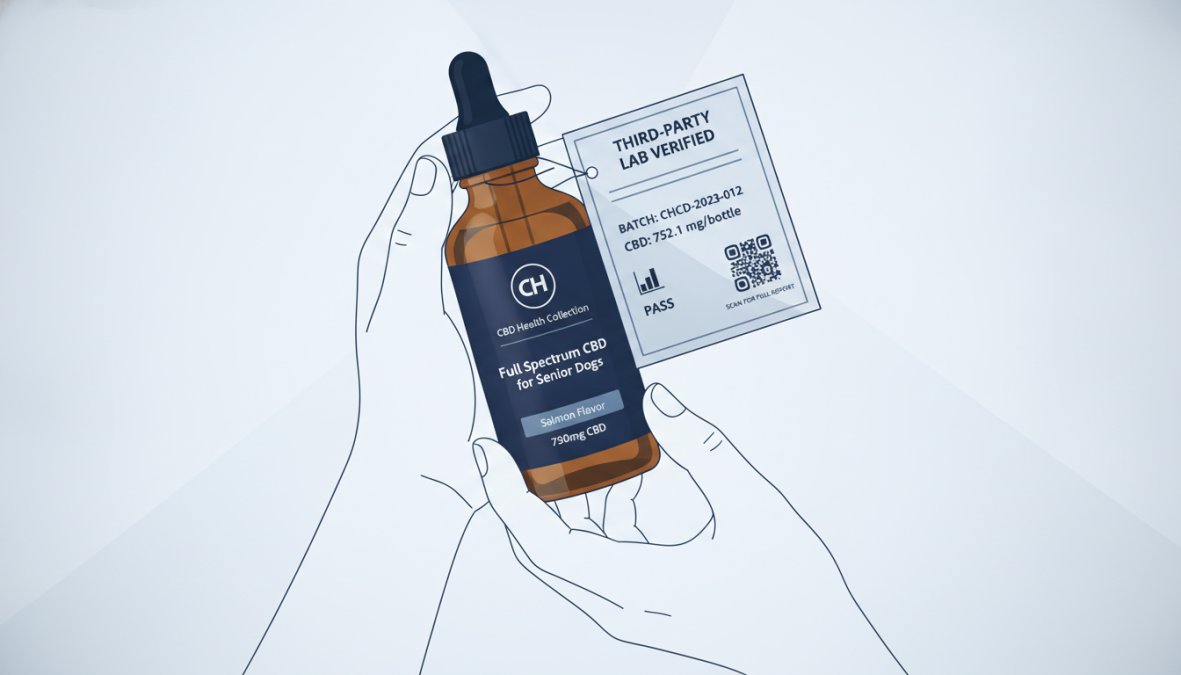
Third-party lab testing is non-negotiable. An independent laboratory (not the CBD company itself) should test the product and verify its contents. The result is a certificate of analysis (COA) that documents:
- CBD potency (actual milligrams of CBD per serving)
- THC content (should be 0% or below 0.3%)
- Presence of contaminants (pesticides, heavy metals, microbial pathogens, mold)
- Solvent residues
A legitimate company provides a COA for every batch produced. If a company refuses to provide a COA, avoid that product.
When reviewing the COA, verify that the CBD potency matches the label claim within a reasonable margin (±10% is acceptable).
Extraction Methods and Product Types for Senior Dogs
CBD is extracted from hemp using CO2 extraction, ethanol extraction, lipid extraction, or solvent-based extraction. For senior dogs, CO2 extraction is the gold standard. It’s a clean process that produces high-quality CBD without solvent residues.
For most senior dogs, a high-quality CBD oil offers the best combination of accuracy, control, and absorption. CBD oil allows precise dosing and is absorbed relatively quickly.
Broad-Spectrum vs. Full-Spectrum vs. Isolate: Which Is Best for Older Dogs
Full-spectrum CBD contains all cannabinoids, terpenes, and other compounds naturally present in hemp, including up to 0.3% THC. Even 0.3% THC is enough to produce mild psychoactive effects in some dogs, particularly small dogs or those with liver compromise.
Broad-spectrum CBD has THC removed but retains other cannabinoids, terpenes, and plant compounds. This preserves much of the entourage effect while eliminating THC entirely. For most senior dogs, broad-spectrum represents the optimal choice.
Understanding Cannabinoid Profiles and Bioavailability
Beyond CBD, hemp contains other cannabinoids like CBG (cannabigerol), CBC (cannabichromene), and CBN (cannabinol). Each has distinct properties. CBG has anti-inflammatory properties. CBC may support pain relief. CBN is associated with sedation and sleep support. In broad-spectrum products, these compounds work alongside CBD, potentially enhancing therapeutic effects.
Bioavailability, the percentage of CBD your dog’s body actually absorbs and uses, varies significantly across products. Always give CBD with food to maximize absorption.
THC-Free Options and Regulatory Compliance
THC-free products (isolates) contain only pure CBD, with all other cannabinoids and plant compounds removed. While this eliminates any THC risk, it also eliminates the potential entourage effect. For senior dogs, THC-free isolate is a reasonable choice if your dog has a history of sensitivity to other compounds.
When evaluating a product, watch for overstated claims. A company claiming CBD "cures arthritis" is making illegal medical claims. A company saying CBD "supports joint health" is making a reasonable supplement claim.
Integrating CBD with Veterinary Care and Behavioral Training
CBD works best as part of a comprehensive approach to senior dog wellness, not as a standalone solution. Before starting CBD, schedule a veterinary exam focused on your dog’s current medications, liver and kidney function, and overall health status.
Working with Your Veterinarian for Senior Dog Wellness
Your veterinarian can order baseline blood work to establish your dog’s liver and kidney function before CBD starts. After 4-6 weeks of CBD use, repeat blood work helps identify any negative changes. Your vet can also help you adjust other medications if needed. If your senior dog is on NSAIDs for arthritis and CBD proves effective at reducing pain, your vet might lower the NSAID dose, reducing the risk of long-term NSAID side effects.
Combining CBD with Anxiety Management Strategies
For senior dogs with anxiety, CBD enhances the effectiveness of behavioral training and environmental modifications. A dog that’s less anxious due to CBD is more capable of learning new behaviors and responding to training.
Never use CBD as an excuse to avoid addressing behavioral problems. Combine CBD with active behavioral work for lasting results.
Conclusion: Safe CBD Use for Senior Dogs
Managing health challenges in aging dogs requires balancing safety with quality of life. CBD offers a legitimate option for senior dogs struggling with arthritis, anxiety, and age-related stress, but only when sourced responsibly and administered carefully.
Choose products with third-party lab testing and transparent sourcing, start with low doses and titrate gradually, monitor your dog’s response closely, and work with your veterinarian throughout the process. This approach minimizes risk while maximizing the potential for meaningful improvement in your senior dog’s comfort and wellbeing.
Supporting your senior dog’s wellness doesn’t require choosing between safety and effectiveness. CBD Health Collection offers broad-spectrum pet CBD oils extracted using clean CO2 methods and independently third-party lab tested for purity and potency. Their formulations are designed for optimal bioavailability in dogs, and every product comes with a certificate of analysis and a 30-day satisfaction guarantee. Visit cbdhealthcollection.com to explore their pet wellness products and connect with their team for dosing guidance tailored to your senior dog’s specific needs.
External Sources Referenced
According to research on cannabinoid effects in companion animals, veterinary interest in CBD continues to grow as more evidence emerges about its safety profile in dogs.
The American Animal Hospital Association guidelines on supplement use in senior pets emphasize the importance of veterinary oversight when introducing any new supplement to an aging dog’s regimen.
A 2026 analysis of pet supplement quality standards found that third-party testing significantly reduces contamination risks in CBD products marketed to pet owners.
Frequently Asked Questions
Is CBD safe for older dogs with existing health conditions?
CBD is generally considered non-psychoactive and well-tolerated in senior dogs, but safety depends on your dog's specific health profile. Older dogs with liver disease, kidney issues, or those taking medications may have different safety considerations. Always consult your veterinarian before introducing CBD, especially if your senior dog takes prescription medications. Your vet can review your dog's medical history and recommend appropriate dosing or advise against CBD if interactions are a concern.
What are the side effects of CBD oil for senior dogs?
Common side effects in older dogs are typically mild and may include drowsiness, dry mouth, or slight changes in appetite. Some senior dogs may experience sedation, which can actually be beneficial for anxious or restless dogs. Gastrointestinal upset is rare but possible. Most side effects are dose-dependent and often resolve when dosage is adjusted. If your senior dog experiences persistent vomiting, lethargy, or behavioral changes, discontinue use and contact your veterinarian immediately.
How much CBD should I give my older dog, and how is dosage determined?
CBD dosage for senior dogs typically starts low (0.5-1 mg per pound of body weight) and is gradually increased based on response, a process called dosage titration. For example, a 50-pound senior dog might start with 25-50 mg daily, divided into doses. The right dose depends on your dog's weight, age, condition being treated, and product potency. Start conservatively, monitor your dog's response over 1-2 weeks, then adjust upward if needed. Always follow product-specific dosing guidelines and consult your veterinarian for personalized recommendations.
How do I know if a CBD pet product is high-quality and safe?
Look for products with third-party lab testing and a certificate of analysis (COA) that verifies purity and potency. High-quality CBD for pets should be derived from organically grown hemp, extracted using clean methods like CO2 extraction, and produced in a GMP- and FDA-registered facility. Check that the product is THC-free and free from pesticides, heavy metals, and contaminants. Reputable brands offer transparent labeling, clear dosing guidelines, and are willing to provide lab results upon request. Avoid products with vague sourcing or no third-party verification.
This article was written using GrandRanker