Table of Contents
- Understanding TSA CBD Regulations and Federal Guidelines
- Way 1: Travel-Sized CBD Oil in Carry-On Luggage
- Way 2: CBD Gummies and Edibles for Easy Airport Security
- Way 3: CBD Softgels and Capsules for Convenience
- Way 4: Travel-Friendly Topical CBD Creams and Salves
- Way 5: CBD Vape Pens With Battery Safety Considerations
- Essential Documentation: Certificate of Analysis and Labeling
- International Travel With CBD Oil: Country-Specific Rules
5 Best Ways to Travel With CBD Oil: TSA Rules & Tips
Last Updated: August 1, 2026
According to the Transportation Security Administration (TSA), hemp-derived CBD products containing no more than 0.3% THC by dry weight are legal to travel with domestically, though the regulatory landscape remains complex for travelers. The 5 best ways to travel with CBD oil depend on your destination, travel method, and product type. At CBD Health Collection, we’ve helped thousands of customers navigate these rules confidently, and this guide covers everything you need to know to travel safely and legally with your CBD products.
Understanding the rules around traveling with CBD oil isn’t just about avoiding airport hassles, it’s about ensuring you can maintain your wellness routine while away from home. Below, we’ll walk you through each travel method, packing strategies, documentation requirements, and international considerations so you can travel with CBD oil without worry.
The core rule: hemp-derived CBD products with less than 0.3% THC are federally legal in the United States, but state laws vary. Always carry a [Certificate of Analysis](/how-to-read-cbd-lab-reports/) (COA) proving your product meets federal standards. International travel requires country-specific research before you pack.
Understanding TSA CBD Regulations and Federal Guidelines
The TSA doesn’t specifically prohibit CBD products at security checkpoints, but this doesn’t mean all CBD products are TSA-approved. The distinction hinges on whether your CBD comes from hemp or cannabis, and whether it contains more than the legal 0.3% THC threshold.
Federal law, specifically the 2018 Farm Bill, legalized hemp-derived cannabidiol products nationwide. However, the TSA’s position is straightforward: they defer to federal law. If a product is legal under federal law, meaning it’s hemp-derived and contains no more than 0.3% THC, TSA agents should allow it through security. The problem arises when products lack proper labeling or documentation proving their legal status.
The 0.3% THC Threshold Explained
The 0.3% threshold isn’t arbitrary, it’s the legal ceiling established by the Farm Bill that distinguishes legal hemp from controlled cannabis. This percentage refers to THC content by dry weight of the plant material.
Here’s what this means in practical terms: a bottle of CBD oil labeled as containing 500mg of CBD can legally contain up to 1.5mg of THC (0.3% of 500mg). This tiny amount won’t produce psychoactive effects, but it must be documented. CBD products that exceed this threshold, even by a fraction, are technically controlled substances federally and absolutely cannot be transported through airports.
Third-party lab testing determines whether a product meets this standard. When you see a Certificate of Analysis from an independent lab, it specifically measures THC content and confirms compliance with federal regulations. This document becomes your proof at security checkpoints.
The TSA agent inspecting your bag likely hasn’t encountered CBD products hundreds of times. Have your COA ready and visible. A clear document showing your product is hemp-derived and contains less than 0.3% THC resolves most questions immediately.
Hemp-Derived vs. Cannabis-Derived Products
Not all CBD comes from the same source, and this distinction matters enormously for travel.
Hemp-derived CBD comes from the cannabis sativa plant bred specifically to contain less than 0.3% THC. These products are federally legal and can be transported domestically. Cannabis-derived CBD comes from plants bred to contain higher THC levels and is only legal in states with legalized cannabis. Never attempt to travel with cannabis-derived products across state lines, this violates federal law regardless of state legality.
CBD Health Collection produces only hemp-derived products extracted using clean CO2 processing from organically grown, USA-sourced hemp. Every product is independently third-party lab tested to verify the 0.3% THC threshold is met. This verification is what makes traveling with CBD Health Collection products straightforward: the documentation is already in place.
Way 1: Travel-Sized CBD Oil in Carry-On Luggage
Sublingual CBD oil, the kind you place under your tongue for absorption, is the fastest-acting form of CBD and ideal for travel when you need reliable relief. The challenge is that CBD oil is a liquid, which means it must comply with TSA liquid restrictions.
The TSA’s 3-1-1 rule limits liquids in carry-on bags to 3.4 ounces (100 milliliters) per container. Travel-sized CBD oil bottles typically come in 1-2 ounce sizes, fitting comfortably within this limit. The oil goes in your quart-sized liquid bag along with other permitted liquids like shampoo or toothpaste.
Meeting TSA Liquid Restrictions
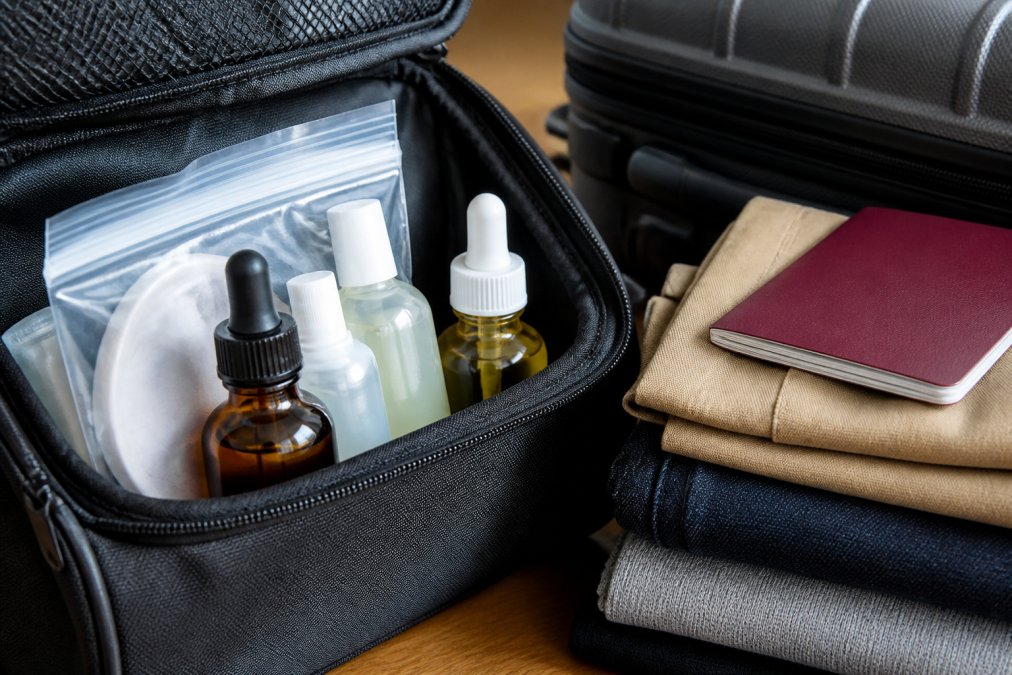
Packing CBD oil correctly means treating it like any other liquid: it goes in a clear quart-sized plastic bag, separate from your other carry-on items, and is removed at security screening.
Before packing, verify your bottle size. A 30ml bottle (approximately 1 ounce) is ideal for travel. A 60ml bottle (2 ounces) also works but leaves less room for other liquids. Anything larger than 3.4 ounces must go in checked baggage or be purchased after security.
The label on your bottle should clearly identify it as CBD oil and ideally note the THC content. Handwritten labels help, something as simple as "CBD Oil, Hemp-Derived, <0.3% THC" signals that you’ve done your homework. This small detail often prevents questions entirely.
Packing in a Quart-Sized Bag
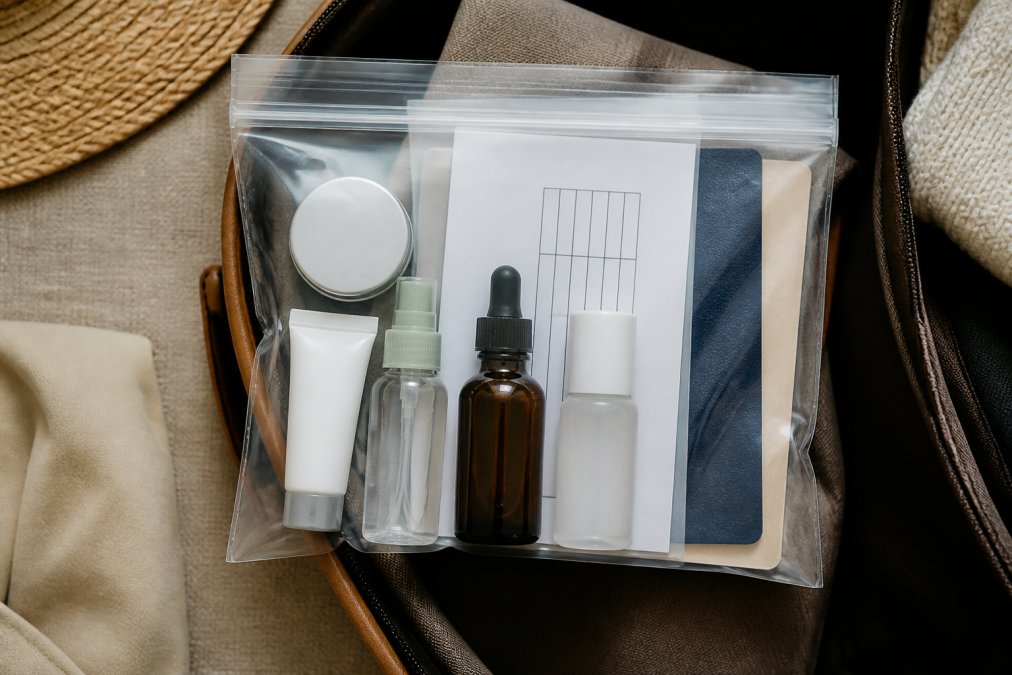
Your quart-sized liquid bag should be organized logically. Place the CBD oil in the center where it’s visible, surrounded by other permitted liquids. This arrangement makes it immediately obvious to TSA agents that you’re complying with regulations.
Wrap the CBD oil bottle in a small plastic bag within the larger quart bag as extra protection against leaks. Even though CBD oil is stable, the pressure changes during flight and baggage handling can cause unexpected leaks. A double-bag approach prevents your other items from getting soaked.
Keep your Certificate of Analysis separate but easily accessible, in an outer pocket of your carry-on or in your travel documents folder. You won’t need it at every checkpoint, but having it ready shows preparedness and resolves questions quickly.
Way 2: CBD Gummies and Edibles for Easy Airport Security
CBD gummies represent the most straightforward way to travel with CBD oil because they bypass liquid restrictions entirely. Gummies are solid products, not liquids, which means they don’t count toward the 3.4-ounce limit and can be packed in carry-on or checked luggage without special handling.
The convenience of gummies extends beyond security. They’re pre-dosed, discreet, taste pleasant, and don’t require any preparation. You can consume them anywhere, at the gate, on the plane, in your hotel, without drawing attention or needing special equipment.
Why Solid CBD Products Bypass Liquid Rules
The TSA classifies items as liquids, gels, or aerosols if they’re spreadable or pourable. CBD gummies are solid at room temperature, which means they’re exempt from liquid restrictions. This classification applies to all solid CBD edibles: gummies, chocolates, hard candies, and baked goods infused with CBD.
This distinction is significant because it eliminates an entire category of travel concerns. You don’t need to worry about the 3.4-ounce limit, quart-sized bags, or removing items at security. TSA agents may inspect gummies like any other food item, but they’re not subject to liquid screening protocols.
Broad-spectrum CBD gummies, which contain cannabidiol but have had THC removed, are the safest choice for travel because they contain zero THC. Full-spectrum gummies contain trace amounts of THC (under 0.3%) and are still legal, but broad-spectrum eliminates any ambiguity.
Discreet Packing Strategies
Pack CBD gummies in their original container or in a small resealable bag placed in your carry-on or checked luggage. The original packaging provides dosage information and ingredient lists, which is helpful if TSA agents ask questions.
For maximum discretion, keep gummies in a pocket of your carry-on where they’re easily accessible but not prominently displayed. Many travelers keep a small container of gummies in their personal item bag, making them accessible during the flight without opening checked luggage.
If you’re traveling internationally, research the destination country’s CBD regulations before packing. Some countries restrict CBD products entirely, while others have specific rules about THC content. Gummies are easier to hide than liquid oils, but crossing international borders with undeclared products, even legal ones in the US, can create serious legal problems.
| Travel Method | TSA Liquid Restriction | Carry-On Allowed | Checked Baggage Allowed | Discretion Level |
|---|---|---|---|---|
| CBD Oil (Liquid) | Yes (3.4 oz max) | Yes | Yes | Medium |
| CBD Gummies | No | Yes | Yes | High |
| CBD Softgels | No | Yes | Yes | High |
| CBD Topicals | Yes (3.4 oz max) | Yes | Yes | Medium |
| CBD Vape Pens | Battery restrictions | Carry-on only | No | Medium |
Way 3: CBD Softgels and Capsules for Convenience
CBD softgels and capsules offer pre-measured dosing and are among the most portable CBD products available. Each capsule contains a specific amount of CBD, typically 10mg, 25mg, or 50mg, eliminating guesswork about how much you’re taking.
Softgels and capsules are solid products, exempt from TSA liquid restrictions, and can be packed in either carry-on or checked luggage. They’re indistinguishable from standard vitamins or supplements, making them the most discreet CBD travel option.
Pre-Measured Dosing While Traveling
The consistency of softgels makes them ideal for travelers who need reliable effects. When you’re navigating airports, time zones, and unfamiliar environments, knowing exactly how much CBD you’re consuming reduces variables and uncertainty.
Travel-sized bottles typically contain 10-30 capsules, making them compact enough to fit in a toiletry bag or jacket pocket. A 30-capsule bottle takes up minimal space while providing a full month of daily CBD if you’re taking one capsule per day.
For travelers managing chronic pain, stress, or sleep issues, softgels provide consistency that’s harder to achieve with oils. You can’t accidentally take too much, each capsule contains its labeled amount. This predictability is especially valuable when you’re away from your normal routine and might be more stressed or experiencing more pain than usual.
Keep softgels in their original container so you have access to dosage information and the brand name. If TSA agents question them, the container clearly shows they’re a supplement product. The label also serves as documentation that you’re carrying a legitimate wellness product, not something questionable.
Don’t transfer softgels to unmarked containers or generic pill bottles for travel. The original packaging is your documentation. A generic pill bottle raises questions; a branded CBD softgel bottle answers them immediately.
Way 4: Travel-Friendly Topical CBD Creams and Salves
Topical CBD products, creams, salves, balms, and freeze gels, are applied directly to the skin for localized relief. They’re ideal for travelers experiencing muscle soreness, joint pain, or tension headaches that benefit from targeted application.
Topical CBD products are classified as creams or ointments, which means they’re subject to TSA liquid/gel restrictions. Travel-sized topical products typically come in 0.5-3.4 ounce containers, fitting within the limit for carry-on luggage.
TSA-Compliant Sizes and Application
A 3.4-ounce container of CBD topical is sufficient for 2-3 weeks of regular use. For longer trips, pack a smaller container in your carry-on and a larger one in checked baggage, or purchase a travel-sized option specifically designed for air travel.
Topical CBD products don’t require any special preparation or equipment. You simply apply the cream or salve directly to the affected area, your knee, shoulder, lower back, or temples, and the CBD absorbs through the skin. Effects typically appear within 15-30 minutes.
The advantage of topicals for travel is that they address specific pain points without systemic effects. If you have tennis elbow from carrying luggage or lower back pain from sitting on a plane, applying a CBD topical directly to that area provides targeted relief. You avoid the digestion time required for oils or capsules, and you don’t experience full-body effects if you only need localized help.
CBD Health Collection’s topical freeze gel, for example, combines CBD with cooling ingredients like menthol, providing both cannabinoid benefits and the soothing sensation of cold therapy. Many travelers pack this specifically for flights, applying it to sore muscles during the flight to reduce stiffness and pain.
Keep topical products in a small cosmetic bag within your quart-sized liquid bag, organized the same way as other gels or creams you’re traveling with. TSA agents treat CBD topicals identically to regular moisturizers or pain relief creams, they’re screened as liquids/gels, but there’s nothing suspicious about them.
Way 5: CBD Vape Pens With Battery Safety Considerations
CBD vape pens deliver cannabidiol through inhalation, producing effects within minutes, faster than any other consumption method. Disposable vape pens are pre-filled and pre-charged, requiring no setup or maintenance, making them appealing for travelers seeking quick relief.
However, vape pens contain lithium batteries, which are subject to strict TSA regulations. This is where traveling with CBD vape pens becomes complicated, more so than any other CBD product format.
Lithium Battery Regulations: Watt-Hour Limits and Carry-On Requirements
The TSA prohibits lithium batteries in checked baggage due to fire risk in cargo holds. This means CBD vape pens, which contain lithium batteries, must be carried in your personal item or carry-on bag only. Never pack a vape pen in checked luggage under any circumstances.
The TSA also limits passengers to a maximum of two spare lithium batteries in carry-on luggage. If you’re traveling with multiple vape pens, you’re exceeding this limit. For most travelers, carrying one disposable vape pen in your carry-on is acceptable; carrying three or four is not.
Before packing a vape pen, verify the battery’s watt-hour (Wh) rating. The TSA allows lithium batteries under 100Wh in carry-on luggage without airline approval. Batteries rated between 100Wh and 160Wh are permitted in carry-on but require airline approval. Batteries over 160Wh are prohibited entirely. Most disposable CBD vape pens contain batteries in the 5-15Wh range, well below the 100Wh threshold, which means they’re generally TSA-compliant without special approval.
To find your vape pen’s watt-hour rating, check the manufacturer’s specifications on the product packaging or the company’s website. The rating is usually listed alongside battery capacity (measured in milliamp-hours, or mAh). If you can’t find the Wh rating, contact the manufacturer directly before traveling. A two-minute email can prevent security checkpoint delays.
Airline-Specific Vape Pen Policies: Beyond TSA Rules
TSA approval is only the first hurdle. Individual airlines impose additional restrictions on vaping devices that go beyond federal regulations.
Major U.S. carriers have varying policies:
Delta Air Lines permits electronic smoking devices in carry-on baggage only, with the battery removed and placed in a protective case. Vaping is prohibited on all flights and in airport terminals. The battery must be completely disconnected from the device before boarding.
United Airlines allows vaping devices in carry-on only, with batteries removed and protected. Vaping is prohibited on flights and in airport areas. United’s policy is stricter than TSA baseline, they require active battery removal, not just carry-on placement.
American Airlines permits vaping devices in carry-on with batteries installed, but vaping is prohibited on flights and in airport terminals. American’s policy is more permissive than Delta or United regarding battery placement.
Southwest Airlines allows electronic smoking devices in carry-on only, with batteries removed. Vaping is prohibited on flights and in airport terminals.
These policies change periodically, and some regional carriers have different rules. Before traveling with a vape pen, call your specific airline’s customer service line and confirm their current policy. A five-minute call prevents gate-area surprises. Provide the airline agent with your vape pen’s specifications (battery Wh rating, brand, model) so they can give you accurate guidance.
Many travelers assume that because TSA allows vape pens in carry-on, airlines automatically permit them. This assumption is incorrect. Airlines can impose stricter rules than TSA, and many do. Arriving at the gate with a vape pen only to learn your airline prohibits them is a frustrating situation that’s entirely preventable with advance research.
Practical Considerations: Pressure, Temperature, and Leakage
Beyond regulations, vape pens present practical challenges during flight. Cabin pressure changes during ascent and descent can cause e-liquid to leak from the device, damaging other items in your carry-on. Temperature fluctuations can affect battery performance and e-liquid consistency.
To prevent leakage, store your vape pen in an upright position in a small plastic bag within your carry-on. Avoid placing it in a pocket where pressure from other items might cause leaks. Some travelers wrap their vape pen in a paper towel for extra protection.
If your vape pen leaks during flight, the e-liquid (which contains CBD) can damage electronics, clothing, or documents. This is a common problem that most vape pen travelers encounter at least once. The solution is preventive: isolate the device in a protective bag and store it upright.
Temperature also affects vape pen performance. Cabin temperatures are typically 68-72°F, which is within the operating range for most vape pens. However, if you’re traveling to a cold destination and your vape pen is exposed to temperatures below 50°F, the battery may not function properly until it warms up. Conversely, if you’re traveling to a hot destination and your vape pen is exposed to temperatures above 85°F, the battery may drain faster than normal.
For international travel, vape pens present additional complications. Many countries prohibit vaping devices entirely, regardless of whether they contain CBD. The United Kingdom, European Union countries, Australia, and most Asian countries have restrictions on vaping devices. Even if CBD is legal in your destination, the vape pen itself may be prohibited. Research both the CBD regulations and vaping device regulations for your destination before packing.
Don’t assume your airline permits vape pens just because TSA does. Call your airline before traveling. Some airlines require battery removal; others prohibit vape pens entirely. A two-minute phone call prevents problems at the gate.
When Vape Pens Make Sense for Travel
Given the regulatory complexity, vape pens are best for travelers who:
- Are flying domestically on an airline they’ve confirmed permits vape pens
- Need rapid CBD effects and are willing to navigate battery regulations
- Are comfortable with the risk of leakage and will take preventive measures
- Don’t have access to other CBD formats they prefer
For most travelers, gummies, capsules, or oils are simpler alternatives that avoid battery regulations entirely. Vape pens are the most convenient consumption method, but they’re also the most regulated travel format. Choose this option only if the rapid effects justify the regulatory complexity.
Essential Documentation: Certificate of Analysis and Labeling
The single most important document for traveling with CBD is a Certificate of Analysis (COA). This third-party lab report verifies that your CBD product contains the amount of CBD claimed on the label and that THC content is below 0.3%.
A COA proves compliance with federal regulations. When a TSA agent or customs official questions your product, a COA immediately establishes that you’re carrying a legal, federally compliant item. Without it, you’re relying on the agent’s interpretation of what "legal CBD" means, a conversation that often goes poorly.
What a COA Proves and Why TSA Agents Need It
A COA contains specific information: the product name, batch number, CBD potency (how much CBD is actually in the product), THC content (verified to be under 0.3%), and testing date. It’s issued by an independent laboratory, not the manufacturer, which gives it credibility.
The document proves three critical things: (1) your product is hemp-derived CBD, not cannabis-derived; (2) it contains less than 0.3% THC, meeting federal standards; and (3) the product was tested recently enough to be relevant. A COA from 2024 is less useful than one from 2026, though both are acceptable.
TSA agents aren’t chemists. They can’t determine whether a liquid is actually CBD or whether it contains the legal amount of THC just by looking at it. A COA removes this uncertainty. The document is written in language the agent understands and provides the verification they need.
CBD Health Collection includes a COA with every product purchase. You can also request a COA for any batch of CBD Health Collection products by providing the batch number on the product label. This documentation is part of the company’s commitment to transparency and consumer protection.
Product Labeling and Batch Information
Your CBD product’s label should clearly state the following: the product name, CBD amount per serving, total servings in the container, THC content (ideally <0.3% or 0.0% for broad-spectrum), ingredients, and batch number.
The batch number is critical because it ties your physical product to its specific COA. If you have a COA but it’s for a different batch, the document doesn’t prove your specific bottle is compliant. Always verify that the batch number on your product matches the batch number on your COA.
Before traveling, photograph your product’s label and take a photo of your COA. Store these images in your phone or cloud storage. If you lose the physical COA during travel, you have a backup. If TSA questions your product and you don’t have the physical document, the photo provides evidence of compliance.
For international travel, print a copy of your COA and keep it in your travel documents folder, separate from your luggage. Customs officials in some countries require this documentation. Having it readily available speeds up border crossing and demonstrates good faith compliance with local regulations.
International Travel With CBD Oil: Country-Specific Rules
Traveling domestically with legal CBD is straightforward. International travel is significantly more complex because each country has its own CBD regulations, and many countries prohibit CBD entirely or impose restrictions stricter than U.S. federal law.
The United States permits hemp-derived CBD with less than 0.3% THC. The European Union permits CBD in most member countries but with varying THC thresholds and regulations. Canada permits CBD but requires specific licensing for importation. Australia, Japan, and most Asian countries prohibit CBD entirely, classifying it as a controlled substance.
The CBD Travel Red List: Countries With Strict Prohibitions
Before packing CBD for international travel, check whether your destination appears on this list of countries with severe CBD restrictions. These destinations have explicit prohibitions or criminal penalties for CBD possession, regardless of THC content or hemp-derived status.
Strict Prohibition Countries (Criminal Penalties for Possession):
-
Thailand: CBD is classified as a Schedule 1 controlled substance. Possession of any amount can result in criminal charges, imprisonment of up to 10 years, and fines up to 500,000 Thai Baht ($14,000 USD). Thailand’s enforcement is strict, and tourists are not exempt from penalties.
-
United Arab Emirates: CBD is prohibited entirely. Possession can result in imprisonment and deportation. The UAE has zero-tolerance drug policies, and CBD is treated as a controlled substance despite its legal status in the U.S.
-
Singapore: CBD is a controlled substance. Possession can result in imprisonment of up to 10 years and caning. Singapore’s drug laws are among the world’s strictest, and CBD is not distinguished from other cannabis products.
-
Japan: CBD is prohibited. Possession can result in criminal charges and imprisonment. Japan classifies all cannabis-derived products, including CBD, as controlled substances. Even hemp-derived CBD is prohibited.
-
South Korea: CBD is prohibited. Possession can result in criminal charges and imprisonment. South Korea has strict drug laws, and CBD is not permitted in any form.
-
Malaysia: CBD is prohibited. Possession can result in imprisonment of up to 12 years and caning. Malaysia’s drug laws are severe, and CBD is classified as a controlled substance.
-
Indonesia: CBD is prohibited. Possession can result in lengthy imprisonment and heavy fines. Indonesia has extremely strict drug laws, and CBD is treated as a narcotic.
-
Philippines: CBD is prohibited. Possession can result in criminal charges and imprisonment. The Philippines has strict drug enforcement, and CBD is classified as a controlled substance.
-
Vietnam: CBD is prohibited. Possession can result in criminal charges and imprisonment. Vietnam’s drug laws are strict, and CBD is not permitted.
-
Saudi Arabia and other Gulf States (except UAE, which is listed separately): CBD is prohibited. Possession can result in criminal charges, imprisonment, and deportation. Islamic law in these countries classifies cannabis products as prohibited substances.
Restricted Countries (Permitted With Specific Conditions or Significant Bureaucracy):
-
United Kingdom: CBD is permitted but only from products that meet strict regulatory standards. CBD products must be derived from industrial hemp and contain no more than 0.2% THC (stricter than the U.S. 0.3% threshold). Additionally, CBD products must be registered with the Food Standards Agency (FSA) or meet specific pharmaceutical standards. Many U.S. CBD products do not meet these requirements. Bringing U.S. CBD into the UK may violate these standards, and customs officials may confiscate the product.
-
Australia: CBD is prohibited for personal use. Possession can result in criminal charges. CBD is classified as a controlled substance, and there are no exceptions for hemp-derived products. Australia’s Therapeutic Goods Administration (TGA) does not permit personal importation of CBD.
-
Mexico: CBD is permitted but only from products derived from hemp. However, Mexico requires specific documentation, and the regulatory environment is unclear. Many travelers assume Mexico’s relaxed cannabis laws apply to CBD, but this is incorrect. Attempting to bring CBD into Mexico without proper documentation can result in confiscation and legal problems. Consult the Mexican embassy or a local attorney before traveling with CBD.
-
Canada: CBD is permitted, but only from licensed producers. Personal importation of CBD from the U.S. is prohibited. If you’re traveling to Canada and want to use CBD, you must purchase it from a licensed Canadian producer. Bringing U.S. CBD products into Canada violates Canadian law.
-
European Union Member States: Most EU countries permit CBD, but regulations vary significantly. The EU’s Novel Food Regulation requires CBD products to be approved as novel foods, a process that most U.S. CBD products have not completed. Individual member states have different THC thresholds (some 0.2%, some 0.3%, some higher). France, for example, permits only CBD isolate, not full-spectrum products. Germany permits full-spectrum CBD with up to 0.2% THC. Italy permits CBD with up to 0.6% THC. Before traveling to any EU country, research that specific country’s regulations.
Generally Permissive Countries (Minimal Restrictions):
-
Switzerland: CBD is permitted. Switzerland has permissive CBD regulations, and hemp-derived products with less than 1% THC are legal.
-
Netherlands: CBD is permitted. The Netherlands has permissive regulations, and CBD products are widely available.
-
Portugal: CBD is permitted. Portugal has permissive regulations, and CBD is not classified as a controlled substance.
-
Uruguay: CBD is permitted. Uruguay has permissive regulations, and CBD is legal for personal use.
-
Colombia: CBD is permitted. Colombia has permissive regulations, and CBD products are legal.
Research Protocol: How to Verify Your Destination’s Regulations
Don’t rely on assumptions or general regional knowledge. Each country has unique regulations, and neighboring countries often have vastly different rules. Thailand and Cambodia are geographically close, but Thailand’s CBD prohibition is severe while Cambodia’s regulations are less restrictive.
Before traveling internationally with CBD, follow this research protocol:
-
Check the destination country’s government website: Search for the country’s health ministry or customs authority website. Look for information about cannabis, hemp, or CBD regulations. Most countries publish this information in English.
-
Contact the embassy or consulate: Call or email the destination country’s embassy in the United States. Ask specifically about CBD regulations for personal use. Provide the product’s THC content and hemp-derived status. Embassy staff can provide authoritative guidance.
-
Consult a local attorney: If you’re traveling for business or an extended stay, consult a local attorney familiar with drug regulations. A 30-minute consultation costs $50-150 and provides definitive guidance.
-
Check airline policies: Some airlines prohibit CBD products entirely, regardless of destination country regulations. Verify your airline permits CBD in carry-on and checked baggage before booking.
-
Document everything: Print your Certificate of Analysis, product label, and any government guidance confirming CBD is permitted. Store these documents separately from your luggage.
Never assume a country’s CBD regulations based on neighboring countries or general region. Always verify the specific country before packing. A 30-minute research investment prevents serious legal consequences.
Customs Declaration and Border Crossing Best Practices
If you’re traveling to a country that permits CBD, declare your product to customs. Providing accurate information demonstrates good faith and prevents the appearance of smuggling.
When declaring CBD, have your Certificate of Analysis ready and be prepared to explain that your product is hemp-derived and contains less than 0.3% THC. Customs officials understand the distinction between hemp-derived CBD and cannabis-derived products; explaining it clearly speeds up the process.
Complete any required customs forms accurately. If a form asks about "cannabis products" or "controlled substances," answer honestly. CBD is not a controlled substance federally, but some countries classify it differently. Providing accurate information prevents problems if customs officials discover the product during inspection.
Keep your COA and product labeling visible in your luggage, not hidden. If customs officials search your bag and find CBD buried at the bottom without documentation, it raises suspicion. If they find it immediately accessible with clear labeling and a COA, it appears like a legitimate wellness product you’re transporting for personal use.
For countries with strict prohibitions, the safest approach is to leave your CBD products at home and resume use upon returning to the United States. No amount of documentation justifies the legal risk in countries where CBD is explicitly prohibited.
Frequently Asked Questions
Can you bring CBD oil on a plane in the US if it contains less than 0.3% THC?
Yes, you can travel with CBD oil on domestic flights if it's hemp-derived and contains no more than 0.3% THC by dry weight, the federal legal limit. TSA allows CBD oil in carry-on luggage if it meets the 3.4-ounce liquid restriction. Always carry a Certificate of Analysis (COA) from third-party lab testing to verify THC content. TSA agents may ask questions, but compliant hemp-derived CBD is permitted under federal law.
What documentation do I need when traveling with CBD oil by air?
Carry a Certificate of Analysis (COA) from an independent lab showing your CBD product contains less than 0.3% THC and is free of contaminants. Keep the product in its original labeled container with batch numbers clearly visible. Some travelers also print TSA guidelines or state-level CBD laws for reference. This documentation proves your product meets federal compliance standards and helps resolve any questions at security checkpoints.
Are CBD gummies easier to travel with than CBD oil?
Yes, CBD gummies and edibles are often easier for travel because they're solid products not subject to TSA liquid restrictions. You can pack them in carry-on or checked luggage without worrying about the 3.4-ounce limit. They're also more discreet and don't require a dropper or measuring. However, they have slower onset of effects than oils due to digestion, and dosing is less flexible than tinctures.
Can I travel internationally with CBD oil, and what countries allow it?
International CBD travel is complex and varies significantly by country. Many countries prohibit any cannabis-derived products, even hemp-derived CBD with 0.3% THC. Before traveling, research your destination's specific laws, some European countries allow it, while others strictly prohibit it. Always declare CBD products to customs. High-risk destinations include most Asian countries, Middle Eastern nations, and some Latin American countries. When in doubt, consult your destination's embassy or customs authority.
What should I do if TSA questions me about CBD oil at airport security?
Stay calm and proactive. If TSA agents ask, explain that your product is hemp-derived CBD with less than 0.3% THC, federally legal under the 2018 Farm Bill. Present your Certificate of Analysis immediately to verify THC content and purity. Keep your product in its original labeled container. If agents confiscate it, you can file a TSA claim. Most TSA officers are familiar with compliant CBD, but having documentation ready prevents confusion and delays.
This article was written using GrandRanker