Table of Contents
- What Safe CBD Dosage for Dogs Actually Means
- CBD Dosage for Dogs by Weight: Milligrams per Kilogram
- How to Give CBD Oil to Dogs: Sublingual, Food, and Treat Methods
- CBD Oil for Dog Anxiety Relief: Dosing Around Storms and Travel
- CBD Side Effects in Dogs: What to Watch For and When to Call Your Vet
- Tracking Your Dog’s Response: A Simple Dosing Log
- Frequently Asked Questions
Last Updated: September 16, 2026
What Safe CBD Dosage for Dogs Actually Means
Safe CBD dosage for dogs is the amount of cannabidiol that eases a specific problem, like anxiety or joint discomfort, without triggering side effects such as lethargy or wobbliness. There is no single universal number. The right amount depends on your dog’s weight, the condition you’re treating, and how your dog’s body absorbs the product. (Source: FDA’s consumer guidance on CBD products)
Why the Label’s Serving Size Is Not Your Dog’s Dose
A bottle that says “give one dropper” is telling you about volume, not milligrams. Two tinctures can both hold a full dropper and deliver wildly different amounts of CBD: a 30 mL bottle with 300 mg total is far weaker than a 30 mL bottle with 1,500 mg, same dropper, five times the cannabidiol. The label’s serving size is a starting point for a generic animal, and a 12-pound terrier and a 90-pound retriever need very different amounts of the same product.
Never assume a full dropper equals a standard dose. Always calculate milligrams per milliliter from the bottle’s total CBD content and volume before you give your dog anything.
The Therapeutic Window: Finding the Lowest Effective Dose
The therapeutic window is the range between the dose that starts helping and the dose that starts causing adverse effects. Your goal is to land in the lower half of that window, not the top.
CBD Dosage for Dogs by Weight: Milligrams per Kilogram
The most common veterinary starting point is roughly 0.1 to 0.2 milligrams of CBD per kilogram of body weight, given once or twice daily. That’s a conservative floor, not a ceiling, many dogs need more, but you only learn that by moving up slowly. Here’s how that translates into practical first doses, not target doses.
| Dog’s Weight | Starting Dose (Low End) | Starting Dose (Upper End) |
|---|---|---|
| 5 kg (11 lb) | 0.5 mg | 1 mg |
| 10 kg (22 lb) | 1 mg | 2 mg |
| 20 kg (44 lb) | 2 mg | 4 mg |
| 30 kg (66 lb) | 3 mg | 6 mg |
| 40 kg (88 lb) | 4 mg | 8 mg |
How to Read a Tincture Label in Milligrams per Milliliter
To dose accurately, you need two numbers: total CBD in the bottle and total volume. Divide the first by the second. A 30 mL bottle containing 600 mg of CBD works out to 20 mg per mL, so a 4 mg dose is 0.2 mL, a fraction of a standard 1 mL dropper. If the label only lists milligrams per drop, multiply by the number of drops in your dropper to get the per-mL figure.
Buy a cheap oral syringe marked in 0.1 mL increments. Eyeballing a dropper is the single biggest source of dosing error for small dogs.
How to Give CBD Oil to Dogs: Sublingual, Food, and Treat Methods
How you administer CBD oil changes how much your dog actually absorbs, and therefore how much you should give. Two dogs on the same milligram dose can end up with very different amounts in the bloodstream.
Bioavailability: Why the Same Dose Hits Differently
Bioavailability is the share of the dose that actually reaches your dog’s system, and the route you choose sets that share before weight even enters the math.
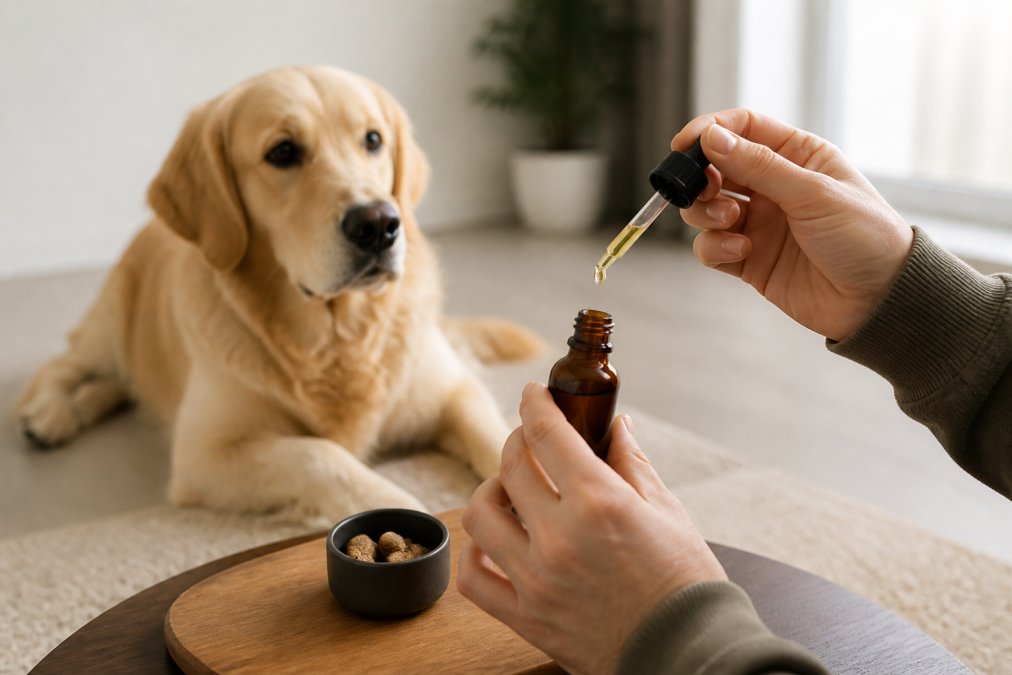
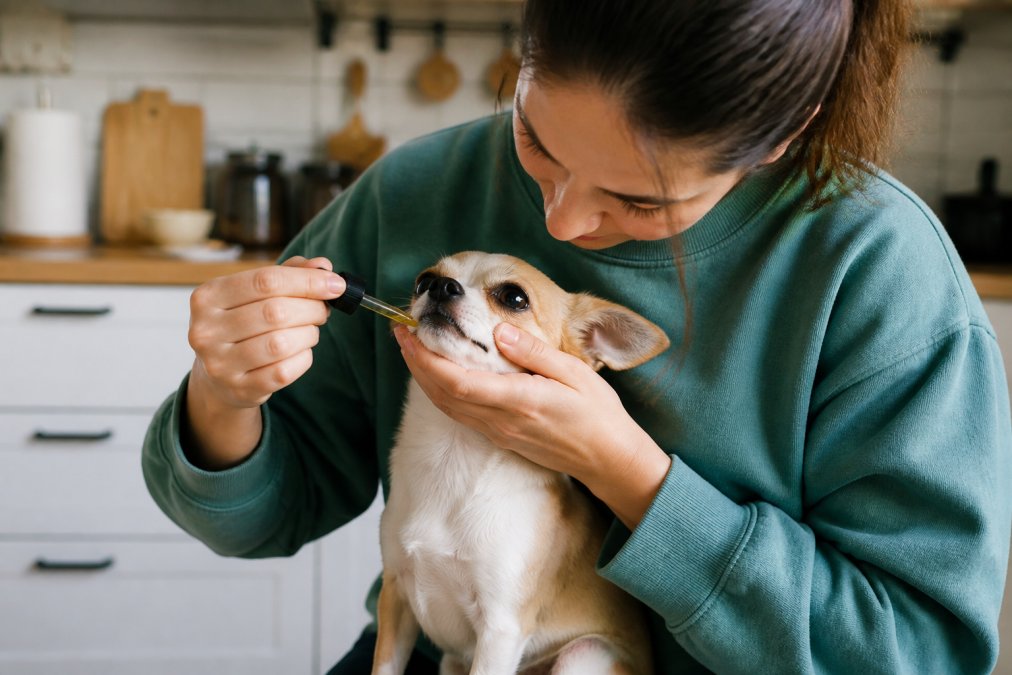
- Sublingual (along the gums): The most efficient route. Holding the oil against the gum line for 30 to 60 seconds lets a meaningful portion bypass the digestive tract and enter the bloodstream directly. Onset is fastest, often 15 to 30 minutes, and more of each milligram does useful work.
- In food: Easy and palatable, but the oil passes through the digestive tract first, where the liver breaks down much of it. Onset is slower, often 45 to 90 minutes, and the effective dose is lower than the same amount given sublingually.
- In treats: Convenient, though you have less control over exact milligrams unless the treat is pre-measured. Chewing and swallowing push the dose down the digestive route, so absorption tracks closer to the food method.
Pick one route and stay with it for at least a week before judging results. Changing route and dose at the same time makes it impossible to tell which one changed your dog’s response.
Breed and Genetic Sensitivity: The Factor Most Guides Ignore
Weight is the headline number, but it isn’t the whole story. Some dogs are genetically more sensitive to drugs that cross into the brain, and that sensitivity applies to cannabinoids too.
Matching the Method to the Dog
- Picky eaters or dogs that hate having their mouth handled: food or treats may be the only workable route, so plan for a slightly higher milligram dose.
- Dogs who need fast onset, such as before a storm or a car ride: sublingual gives you the best shot at having CBD active when it’s needed.
- Herding breeds and known MDR1 carriers: start lower regardless of route, and lean toward a measured tincture rather than a treat so you can adjust in small increments.
Whichever route you choose, measure in milliliters with an oral syringe rather than eyeballing a dropper, and keep the route consistent so your dosing log reflects a real pattern.
CBD Oil for Dog Anxiety Relief: Dosing Around Storms and Travel
For anxiety relief, timing matters as much as amount. Give CBD oil 60 to 90 minutes before the stressful event, storms, fireworks, car rides, vet visits, so it’s active when your dog needs it.
CBD Side Effects in Dogs: What to Watch For and When to Call Your Vet
The most common CBD side effects in dogs are lethargy, sleepiness, and mild stomach upset. These usually appear when the dose is too high and ease once you reduce it. A smaller share of dogs show the opposite reaction, restlessness or loose stool, so observe the first few days of any new dose rather than assuming.
Drug Interactions: The Safety Issue Most Guides Skip
CBD is metabolized by the same family of liver enzymes, the cytochrome P450 system, that processes a large share of prescription drugs (pubmed.ncbi.nlm.nih.gov). When CBD and another medication compete for those enzymes, one or both can build up, so a drug your dog already takes may behave differently once CBD is added. Medication classes that warrant a veterinary conversation before you start CBD include:
- Anti-seizure drugs such as phenobarbital, levetiracetam, and potassium bromide. CBD can raise blood levels of some of these, and the combination can affect liver values.
- Blood thinners such as warfarin and clopidogrel. Because CBD can influence how these are cleared, bleeding risk may change.
- NSAIDs and steroids used for joint or allergy relief, including carprofen, meloxicam, and prednisone. These already carry liver and GI considerations that CBD can compound.
- Heart medications, including those that widen blood vessels or control rhythm, where a shift in drug levels matters.
- Behavioral and sedative medications, including trazodone and gabapentin, where the combined calming effect can overshoot.
- Certain antibiotics and antifungals, such as ketoconazole and clarithromycin, which are processed by the same enzymes and can slow CBD clearance.
CBD can interact with prescription medications by competing for the same liver enzymes. Never start CBD on a dog taking other drugs without a veterinarian’s sign-off, and never change a prescription dose on your own to “make room” for CBD.
When to Stop and Call Your Vet
Stop the product and seek veterinary guidance if you see any of the following:
- Unsteady walking, head tilting, or trouble standing
- Vomiting that repeats or won’t settle
- Extreme drowsiness that doesn’t improve within a few hours
- Tremors, twitching, or a change in breathing
- A known or suspected overdose, even if the dog seems fine at first
Tracking Your Dog’s Response: A Simple Dosing Log
A dosing log turns guesswork into a repeatable process. Record the date, time, dose in milligrams, method, and what you observed. Within a week or two, patterns emerge that no single day can show.
| Date | Time | Dose (mg) | Method | Behavior Notes |
|---|---|---|---|---|
| 9/16 | 8:00 AM | 2 mg | Sublingual | Calmer during walk |
| 9/17 | 8:00 AM | 2 mg | In food | No change noted |
| 9/18 | 8:00 AM | 3 mg | Sublingual | Slept well, slightly drowsy |
Frequently Asked Questions
How do I calculate the correct CBD dosage for my dog’s weight?
Start at 0.1 to 0.2 milligrams per kilogram of body weight, once or twice daily. For a 10 kg dog, that is 1 to 2 mg per dose. Check your tincture’s concentration in milligrams per milliliter, then draw the matching amount with the dropper. Give the starting dose for three to five days, watch for lethargy or digestive upset, and increase in small steps until you see the response you want. Never exceed the amount a veterinarian familiar with your dog recommends.
Are there FDA-approved CBD products for pets?
No. The FDA has not approved any CBD product for animals, and it has warned companies against marketing CBD as a pet drug or making unproven health claims. That means every pet CBD product on the market is sold as a supplement, not a treatment. Because there is no federal approval pathway for pets, quality depends on the brand. Look for third-party lab testing, a certificate of analysis you can read, and organically grown, hemp-derived material processed in a registered facility.
What are the signs of CBD overdose in dogs?
The most common signs reported in veterinary literature are lethargy, ataxia (wobbliness), vomiting, diarrhea, and drooling. Drowsiness and unsteadiness usually appear within one to three hours of a large dose and often resolve with supportive care. If your dog is vomiting repeatedly, cannot stand, or seems disoriented, call your veterinarian or a pet poison hotline right away. Bring the product label so the vet knows the concentration and how much was given.
How long does it take for CBD to start working in dogs?
Most owners notice an effect within 30 minutes to two hours after a sublingual or oil dose. Food timing matters: giving CBD with a fatty meal can slow absorption but raise the total amount absorbed, while an empty stomach brings a faster, shorter effect. Effects typically last four to six hours, which is why twice-daily dosing is common. If you see nothing after a week at a low starting dose, increase gradually rather than doubling the amount at once.
Can I give my dog human CBD oil?
It is possible but risky. Human tinctures are often far more concentrated than pet formulas, so a single dropper can deliver many times the milligrams a small dog needs. Some human products also contain added flavorings, alcohol, or other ingredients that are not meant for animals. If you use a human product, confirm the milligrams per milliliter, calculate the dose by your dog’s weight, and choose a plain, hemp-derived oil with no additives. A pet-specific formula removes the guesswork.
Should I consult a veterinarian before starting my dog on CBD?
Yes, especially if your dog takes any prescription medication. CBD is metabolized by some of the same liver enzymes as common drugs, so it can change how quickly those drugs clear the body and raise the chance of adverse effects. A veterinarian can review interactions, confirm that anxiety or pain is not a sign of an untreated condition, and set a starting dose based on your dog’s health history. Bring the product label and its certificate of analysis to the visit.