Table of Contents
- How CBD for Veteran Stress Relief Fits Into a Daily Routine
- CBD Gummies for Stress Relief: What to Know Before You Buy
- Broad-Spectrum CBD Benefits for Stress and Sleep
- How to Choose Premium CBD Without Getting Burned
- Dosage Titration and Drug Interaction Safety for Veterans
- VA Policy Nuances and Legal Status of CBD for Veterans
- Conclusion: Building a Safe, Evidence-Informed Approach
- Frequently Asked Questions
Last Updated: September 20, 2026
How CBD for Veteran Stress Relief Fits Into a Daily Routine
Many veterans managing post-traumatic stress disorder look for something they can take consistently, not just in a crisis.
The goal isn’t a single “hero dose.” It’s a stable baseline you adjust slowly and measure honestly.
What CBD Does and Does Not Do for Stress
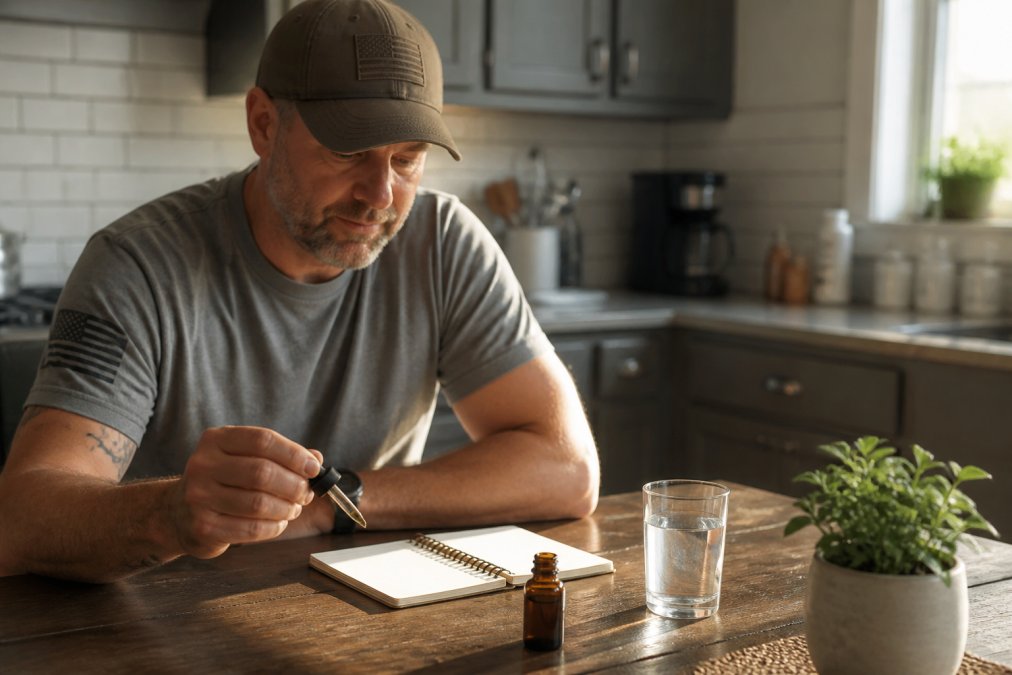
CBD may support stress response regulation and sleep quality; it is not a cure for PTSD and does not replace evidence-based medicine. Research into cannabinoids and psychiatric symptoms continues, but the honest answer is that therapeutic potential exists alongside real limits. A common mistake is expecting CBD to erase flashbacks or hyperarousal. It doesn’t. What many veterans report instead is a calmer baseline that makes therapy and sleep more workable.
Why Veterans Are Turning to Non-Intoxicating Options
Interest in non-intoxicating, hemp-derived products has grown because they don’t interfere with most daily obligations the way alcohol or high-THC products can. Veterans often want something they can take before a shift, a therapy appointment, or a family dinner without cognitive impairment. That’s the practical appeal, and it’s why product quality matters more than marketing claims.
CBD Gummies for Stress Relief: What to Know Before You Buy
CBD gummies for stress relief are popular because they deliver a consistent, pre-measured dose without measuring oil. The trade-off is slower onset and, in some products, added sugar or inconsistent potency. When evaluating gummies, check three things: the milligram amount per piece, whether the label says broad-spectrum or isolate, and whether a third-party test confirms the stated cannabinoid content.
| What to Check | Why It Matters | Red Flag |
|---|---|---|
| mg per gummy | Determines your starting dose | No milligram listed |
| Broad-spectrum vs. isolate | Affects cannabinoid range | “Proprietary blend” only |
| Third-party COA | Confirms potency and purity | No batch number |
| Added ingredients | Sugar, dyes, fillers | Undisclosed additives |
Broad-Spectrum CBD Benefits for Stress and Sleep
Broad-spectrum CBD benefits center on a middle path: it retains multiple naturally occurring cannabinoids and terpenes while removing THC. For veterans who want the fuller plant profile without any intoxicating compound, broad-spectrum is often the practical choice. Many users find the entourage effect, the idea that compounds work better together than in isolation, makes broad-spectrum feel more complete than a pure isolate.
Full-Spectrum vs. Broad-Spectrum vs. Isolate
- Full-spectrum: Contains trace THC; richest cannabinoid profile.
- Broad-spectrum: THC removed; retains other cannabinoids and terpenes.
- Isolate: Pure CBD only; no other plant compounds.
For anyone with drug-testing concerns, broad-spectrum or isolate is the safer lane.
How to Choose Premium CBD Without Getting Burned
Knowing how to choose premium CBD comes down to verification, not branding. Any reputable maker publishes an independent Certificate of Analysis for each batch, and you should be able to match that report to the batch number on your bottle.
Reading a Certificate of Analysis (COA)
A Certificate of Analysis is a third-party lab report confirming a product’s cannabinoid content and screening for contaminants. Look for the lab’s name, the test date, the batch number, and results for potency plus heavy metals, pesticides, and residual solvents. If the COA doesn’t match your product’s batch, it proves nothing. CBD Health Collection publishes independently verified COA lab-testing for purity and quality assurance, produced in a GMP- and FDA-registered facility using clean CO2 extraction from organically grown, USA-sourced hemp.
Buying from a seller who can’t produce a batch-matched COA means you have no way to confirm potency or rule out contaminants.
Dosage Titration and Drug Interaction Safety for Veterans
Start low, go slow, and log what changes. That advice is everywhere, but it is useless without a schedule.
A Practical Titration Protocol
CBD dosing is not weight-based the way many prescriptions are. Response varies widely by person, formulation, and the reason you are taking it, so the goal is to find the smallest dose that produces a steady effect and hold there.
Two mistakes derail this more than anything else.
Drug Interactions You Should Raise With Your Prescriber
CBD is metabolized by the same family of liver enzymes, primarily CYP3A4 and CYP2C19, that process a long list of common prescriptions. When two substances compete for the same enzymes, blood levels of one or both can rise or fall. That is a real interaction, not a theoretical one, and it applies to CBD even though CBD is sold as a supplement rather than a drug.
Side Effects to Monitor
CBD is generally well tolerated, but the effects people report most often are drowsiness, dry mouth, reduced appetite, loose stools, and, at higher doses, changes in liver enzyme readings. If you take a medication with a narrow safety window, or you have liver conditions, that is a strong reason to involve your prescriber before you start rather than after.
VA Policy Nuances and Legal Status of CBD for Veterans
Federal law allows hemp-derived CBD products containing no more than 0.3% THC on a dry-weight basis, which is why you can buy them in most states without a medical card. VA policy, however, is more cautious than the retail market, and the gap between the two is where most veteran confusion lives.
What VA Policy Actually Says
The Department of Veterans Affairs does not prescribe or recommend medical cannabis, and VA providers generally cannot fill out the paperwork some states require for a medical cannabis program (VA and Marijuana – What Veterans need to know). That is a policy position, not a statement that cannabis is dangerous or illegal.
What this means in practice:
- You can raise it. VA clinicians are permitted to discuss cannabis and CBD use with you. A blanket refusal to talk about it is not the policy.
- It may be documented. Because VA providers document what you report, some veterans choose to discuss CBD with a private practitioner or pharmacist instead, then bring only the relevant safety information back to their VA care team. That is a personal decision, and there is no single right answer.
- Benefits are not automatically at risk. Reporting cannabis use to a VA provider does not by itself terminate benefits, though it can affect specific determinations in individual cases. If you have concerns about how a disclosure could affect a rating or a claim, ask before you disclose.
- VA is not your only resource. Your pharmacist, a private primary care provider, or a state-licensed clinician can all answer interaction and dosing questions without involving your VA record.
Do not assume that because a product is legal to buy, your VA care team endorses it. Legal status and clinical guidance are two separate questions, and veterans are often caught between them.
State Law, Federal Law, and Drug Testing
Hemp-derived CBD is legal federally, but state rules vary. A few states restrict certain products or require specific labeling, and some localities treat CBD differently from hemp flower or THC-containing products. Check your own state’s regulations before you buy, especially if you travel or order online.
Where to Verify the Current Rules
Federal guidance and VA policy both change over time, so verify rather than rely on a blog post, including this one. For the current federal position on cannabis and CBD, review guidance from the U.S. Food and Drug Administration on cannabis and CBD. For veterans’ benefits and care questions, consult the U.S. Department of Veterans Affairs directly, and for state-level rules, check your state’s health or agriculture department.
Conclusion: Building a Safe, Evidence-Informed Approach
The hardest part isn’t finding a product; it’s building a routine you can trust and measure. Start with a batch-matched COA, titrate slowly, and loop in your prescriber about drug interactions before you commit. CBD Health Collection offers broad-spectrum gummies, oils, and sleep formulations that are independently third-party lab tested, made from organically grown, USA-sourced hemp with clean CO2 extraction, and backed by a 30-day satisfaction guarantee with FREE shipping.
Frequently Asked Questions
Can veterans take CBD gummies for stress?
Veterans can legally purchase hemp-derived CBD gummies in most states, provided the product contains no more than 0.3% THC by dry weight under the 2018 Farm Bill. CBD gummies for stress relief are non-intoxicating and do not produce a high. However, VA providers cannot prescribe or recommend CBD, and it remains a Schedule I substance under federal law outside the hemp framework. Before starting, review current medications with a pharmacist or physician to check for drug interactions, especially with blood thinners or anti-seizure drugs.
What does current research say about CBD and PTSD?
Clinical research on CBD for PTSD remains limited. Most published studies are small, short-term, or use animal models rather than human participants, so results cannot be generalized. Some early trials suggest CBD may influence stress response regulation and sleep quality through the endocannabinoid system, but no large placebo-controlled trial has confirmed these findings in veterans. Evidence-based medicine requires stronger data before CBD can be recommended as a primary treatment. Talk to a qualified professional about any symptom management plan.
How should veterans choose high-quality CBD products?
Look for a Certificate of Analysis (COA) from an independent third-party lab that confirms cannabinoid potency and screens for heavy metals, pesticides, and residual solvents. The COA should match the batch number on the product label. Choose companies that use organically grown hemp, clean CO2 extraction, and GMP-registered facilities. Avoid products that make disease-treatment claims or refuse to share lab results. CBD Health Collection, for example, publishes COAs for every batch and offers a 30-day satisfaction guarantee.
What are the potential side effects of taking CBD?
Common adverse events reported in studies include drowsiness, dry mouth, reduced appetite, and diarrhea. CBD can interact with prescription medications by affecting liver enzymes, particularly CYP450, which may raise or lower drug levels in the body. Veterans taking blood thinners, antidepressants, or anti-seizure medications should consult a pharmacist before use. Start with a low dose and increase gradually, a practice called dosage titration, to gauge tolerance. Stop use and seek medical advice if unusual symptoms appear.