Table of Contents
- What Is CBD Bioavailability Explained
- Factors Affecting CBD Efficacy and Absorption
- CBD Delivery Methods Comparison and Absorption Rates
- How to Increase CBD Absorption and Bioavailability
- What Is CBD Bioavailability Explained Through Pharmacokinetics
- Conclusion: Optimizing Your CBD Experience
CBD Bioavailability Explained: Why Absorption Matters
Last Updated: July 22, 2026
When you take CBD, you’re entering a complex biochemical process that determines whether the cannabinoid actually reaches your bloodstream and produces effects. Understanding CBD bioavailability is the difference between feeling real relief and wondering why nothing happened.
At CBD Health Collection, founded by pharmaceutical industry veteran Rick Bauer, we’ve learned that bioavailability isn’t just a technical term, it’s the reason why two identical doses of CBD can produce completely different outcomes depending on how you take it.
This guide covers everything you need to know about CBD bioavailability, from the molecular challenges that limit absorption to the delivery methods and formulation strategies that maximize it.
What Is CBD Bioavailability Explained
CBD bioavailability refers to the percentage of an administered dose that actually reaches your bloodstream in a form your body can use. Not all CBD you consume becomes active. Some gets broken down by your digestive system, some fails to cross the blood-brain barrier, and some gets metabolized before reaching target tissues.
Think of bioavailability as the efficiency score of your CBD delivery method. An oral CBD oil might have 6-15% bioavailability, meaning only a fraction of what you swallow enters circulation. A sublingual tincture (held under the tongue) might reach 13-35% bioavailability by bypassing first-pass metabolism. Inhalation can achieve 34-46% bioavailability because the cannabinoid enters the lungs directly, then the bloodstream, skipping hepatic processing entirely.
This difference matters enormously. If you’re taking 25mg of CBD orally with 10% bioavailability, your body is only using 2.5mg of active cannabinoid. That same 25mg dose sublingually might deliver 5-8mg to your system, a 2-3x improvement in actual therapeutic exposure.
Bioavailability isn’t the same as potency. A product can be pure and potent but still have low bioavailability if the delivery method doesn’t get the CBD into your bloodstream efficiently. The best CBD product combines both high purity AND optimized bioavailability through smart formulation.
Bioavailability vs. Efficacy: Understanding the Difference
Bioavailability is about absorption, how much CBD reaches your blood. Efficacy is about effect, what that CBD does once it’s in your system. You can have high bioavailability with low efficacy if the CBD doesn’t bind effectively to your endocannabinoid system receptors.
Efficacy also depends on individual factors: your endocannabinoid system sensitivity, your specific health condition, body composition, and genetics. Two people taking identical CBD products can experience different outcomes not because bioavailability differs, but because their bodies respond differently to the cannabinoid once absorbed.
Why Bioavailability Matters for CBD Results
If your CBD product has poor bioavailability, you’re essentially wasting money. Consider a chronic pain sufferer buying a $60 bottle of standard CBD oil with 10% bioavailability, taking 50mg daily. Their actual intake is 5mg. After two weeks with no results, they assume CBD doesn’t work. Meanwhile, a friend using a nano-emulsified CBD product with 40% bioavailability at the same 50mg dose receives 20mg of active cannabinoid, four times more, and experiences meaningful pain relief.
Bioavailability determines your effective dose. Optimizing bioavailability through better formulation or delivery method can reduce the amount you need to take while improving results.
The difference between “CBD doesn’t work for me” and “CBD works great” often comes down to bioavailability. Better absorption means better results at lower doses, which means better value and faster symptom relief.
Factors Affecting CBD Efficacy and Absorption
Bioavailability isn’t fixed. It’s influenced by dozens of variables that interact in complex ways.
First-Pass Metabolism and Hepatic Processing
When you swallow CBD, it travels through your digestive system and enters the portal vein, which carries it directly to your liver before reaching your general circulation. This is called first-pass metabolism, and it’s the primary reason oral CBD has such low bioavailability.
Your liver contains CYP450 enzymes, specifically CYP3A4 and CYP2C19, that break down foreign compounds, including cannabidiol. These enzymes metabolize a significant portion of the CBD before it ever enters your bloodstream.
Sublingual administration is more effective because when you hold CBD oil under your tongue, some of it absorbs through the sublingual mucosa and enters the bloodstream directly, bypassing the liver initially. This means more intact CBD reaches your target tissues before metabolism occurs.
If you’re taking medications that inhibit CYP3A4 or CYP2C19 enzymes, like certain statins or blood pressure medications, your CBD bioavailability may increase. Always discuss CBD use with your healthcare provider if you’re on medications.
Lipophilicity, Solubility, and Molecular Challenges
CBD is lipophilic, meaning it’s fat-soluble but poorly water-soluble. This creates a fundamental absorption problem. Your intestines absorb water-soluble compounds easily, but lipophilic compounds require special handling.
When you take standard CBD oil, the CBD must cross your intestinal epithelium to enter circulation. But the intestinal lining is aqueous (water-based). Lipophilic CBD doesn’t want to cross it and often passes through your digestive system largely unabsorbed.
Nano-emulsification technology solves this problem by breaking CBD into nano-sized particles and encapsulating them in water-compatible carriers. This creates an interface between the lipophilic CBD and the aqueous intestinal environment, allowing much more efficient absorption. Liposomal technology works similarly, encapsulating CBD in liposomes that mimic cell membranes and can fuse with intestinal cells.
Individual Biological Variability
Two people taking identical CBD products can experience vastly different bioavailability based on factors outside the product’s control.
Gut microbiota composition affects CBD absorption. Someone with a diverse, healthy microbiota may absorb CBD more efficiently than someone with dysbiosis. Body composition matters too, CBD distributes to fatty tissues, so someone with higher body fat percentage may experience different bioavailability than someone lean.
Genetic variations in CYP450 enzymes create "fast metabolizers" and "slow metabolizers." Fast metabolizers break down CBD quickly, reducing systemic exposure. Age influences absorption and metabolism as well. Taking CBD with food increases bioavailability for lipophilic compounds because dietary fats facilitate absorption.
CBD Delivery Methods Comparison and Absorption Rates
The method you use to deliver CBD to your body is the single biggest factor determining bioavailability.
Oral Ingestion vs. Sublingual vs. Inhalation vs. Topical
Oral Ingestion (swallowing CBD capsules or oil)
Bioavailability: 6-15% (standard formulations), up to 20% with optimized formulations
When you swallow CBD, it enters your digestive system, gets absorbed through the intestinal wall, travels to the liver for first-pass metabolism, then enters systemic circulation. This route is convenient and discreet, but bioavailability is low because of first-pass metabolism and the solubility challenge. Onset time is 30-120 minutes; effects last 4-8 hours.
Oral administration is best for consistent, long-lasting effects where you don’t need immediate relief, ideal for daily wellness routines or chronic condition management.
Sublingual Administration (tinctures held under the tongue)
Bioavailability: 13-35%
When you hold CBD oil under your tongue, some of it absorbs through the sublingual mucosa, which has rich blood supply and direct access to systemic circulation. This bypasses the liver initially, preserving more intact CBD. Onset time is 15-45 minutes; effects last 4-8 hours.
Sublingual is the sweet spot for most users: better bioavailability than oral, faster onset, still reasonably discreet, and no special equipment required.
Inhalation (smoking or vaping CBD)
Bioavailability: 34-46%
When you inhale CBD vapor, the cannabinoid enters your lungs, crosses the alveolar membrane, and enters the bloodstream directly. This completely bypasses first-pass hepatic metabolism. Onset time is 2-15 minutes; effects last 2-4 hours.
Inhalation is best when you need fast relief: acute pain, anxiety attacks, or situational stress. It’s not ideal for long-term daily use because effects are shorter-lived.
Topical Application (creams, gels, patches on skin)
Bioavailability: Highly variable, typically 0-10% for systemic circulation, but 100% local bioavailability at the application site
Topical CBD doesn’t enter systemic circulation efficiently because skin is a barrier. However, CBD accumulates in local tissues and can interact with cannabinoid receptors in skin, muscle, and nerve endings. Onset time is 15-45 minutes for local effects.
Topical is best for targeted relief: joint pain, muscle soreness, arthritis, or skin conditions. It’s not suitable for systemic conditions.
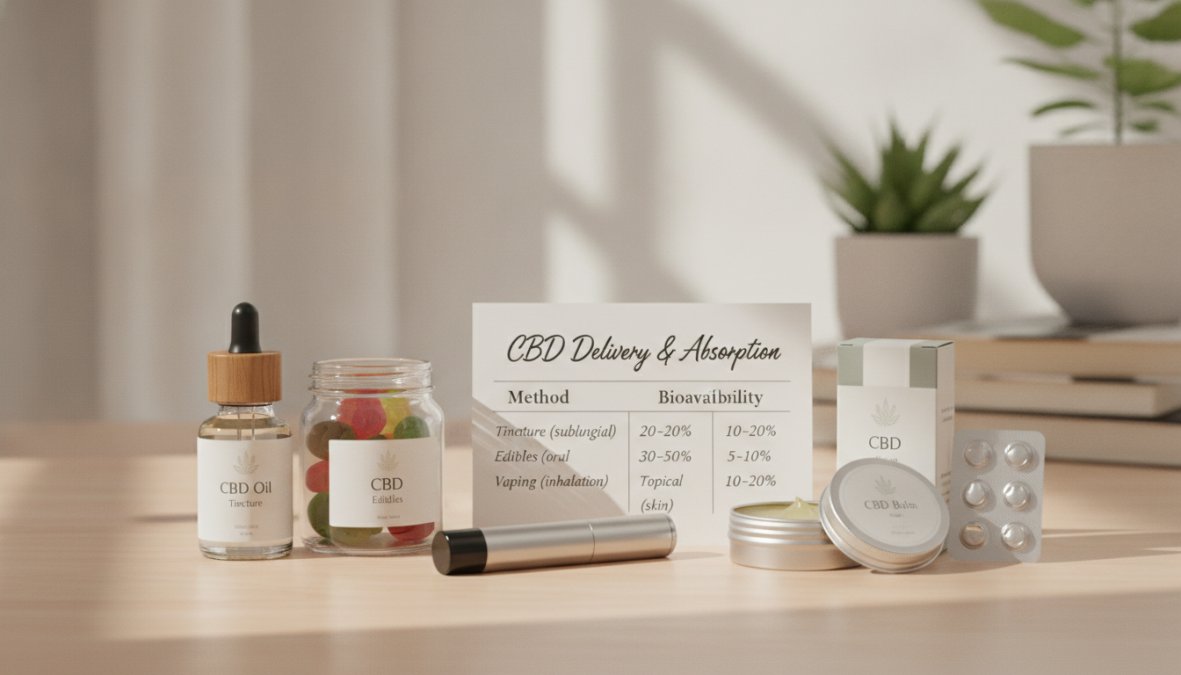
| Delivery Method | Bioavailability | Onset Time | Duration | Best For |
|---|---|---|---|---|
| Oral (capsules/oil) | 6-20% | 30-120 min | 4-8 hours | Daily wellness, chronic conditions |
| Sublingual (tincture) | 13-35% | 15-45 min | 4-8 hours | General use, balanced effect |
| Inhalation (vape/smoke) | 34-46% | 2-15 min | 2-4 hours | Acute symptoms, fast relief |
| Topical (cream/gel) | 0-10% systemic | 15-45 min | Variable | Localized pain, skin issues |
How to Increase CBD Absorption and Bioavailability
If you’re taking CBD and not getting results, the problem is likely bioavailability.
Nano-Emulsion vs. Liposomal Technology
Nano-Emulsion
Nano-emulsification breaks CBD into particles 50-100 nanometers in size and suspends them in a water-compatible carrier. This allows CBD particles to cross the intestinal epithelium much more efficiently. Bioavailability increases from 10-15% (standard oil) to 25-40% (nano-emulsified).
Nano-emulsions are currently the most practical and cost-effective bioavailability enhancement, used in many premium CBD products including CBD Health Collection’s water-based formulations.
Liposomal Technology
Liposomes are spherical structures made of lipid bilayers that can fuse directly with your intestinal cells, delivering CBD into the cellular interior. Liposomal CBD can achieve bioavailability of 40-60%, representing a significant improvement. However, liposomal products are more expensive to manufacture, less stable, and require more careful storage.
If you’re comparing CBD products and bioavailability matters to you, look for these terms: nano-emulsified, water-soluble, liposomal, or micellized. These indicate the manufacturer has specifically addressed the solubility challenge. Standard CBD oil without these technologies will have lower bioavailability regardless of quality.
Carrier Oils, Food Intake, and Formulation Science
Carrier Oil Selection
MCT oil (medium-chain triglycerides) is absorbed more efficiently than long-chain fats, so CBD in MCT oil has slightly better bioavailability than CBD in olive oil or hemp seed oil.
Food Intake Timing
Taking CBD with food increases bioavailability for lipophilic compounds. Dietary fats facilitate absorption of fat-soluble cannabinoids. A meal containing healthy fats can increase CBD bioavailability by 20-30% compared to taking CBD on an empty stomach.
Formulation Science: pH Buffers and Stabilizers
Premium CBD formulations include pH buffers that protect CBD from stomach acid degradation and stabilizers that prevent CBD from degrading during storage or in the digestive environment. These formulation details dramatically affect bioavailability.
Dosing Consistency and Timing
Taking CBD at the same time each day, with the same food, in the same way, creates stable plasma concentrations. Erratic dosing creates variable bioavailability and inconsistent results.
What Is CBD Bioavailability Explained Through Pharmacokinetics
Understanding pharmacokinetics clarifies why bioavailability matters and how different formulations work.
Plasma Concentration, Metabolic Pathways, and CYP450 Enzymes
When CBD enters your bloodstream, it reaches peak plasma concentration at different times depending on delivery method. For oral CBD, peak occurs 1-3 hours after ingestion. For sublingual, it’s 30-60 minutes. For inhalation, it’s 3-10 minutes.
Once CBD is in circulation, your liver begins metabolizing it through CYP3A4 and CYP2C19 enzymes, which convert CBD into metabolites like 7-OH-CBD and 6-OH-CBD. These metabolites have their own biological activity but may have different effects or potency at cannabinoid receptors.
Plasma half-life is typically 18-32 hours for CBD, meaning it takes roughly a day for your body to eliminate half of what you consumed. This is why daily dosing creates accumulation: each day’s dose adds to what’s still circulating from previous days.
Bio-Accessibility and Therapeutic Window
Bio-accessibility refers to how much of an administered dose is available for absorption. A poorly formulated CBD product might have low bio-accessibility because the CBD is locked in large oil droplets that can’t cross the intestinal barrier.
The therapeutic window is the range of plasma concentrations that produce therapeutic effects. Below this window, CBD doesn’t produce noticeable effects. If your bioavailability is too low, your plasma concentration stays below the therapeutic window.
Optimizing bioavailability through better formulation or delivery method raises your plasma concentration into the therapeutic window, which is why people often report that switching to a better-formulated product suddenly makes CBD "work" for them.
Your body processes CBD through a predictable pharmacokinetic pathway. Bioavailability determines whether your plasma concentration reaches the therapeutic window. Better bioavailability means lower doses achieve therapeutic effects, which means better results and better value.
Conclusion: Optimizing Your CBD Experience
The gap between "CBD didn’t work for me" and "CBD changed my life" often comes down to bioavailability. You can buy the purest, highest-potency CBD on the market, but if your body can’t absorb it efficiently, you’re wasting money.
CBD Health Collection addresses this directly. Their products combine organically grown USA-sourced hemp with water-based, nano-emulsified formulations specifically designed to maximize bioavailability. The company’s commitment to bioavailability optimization reflects founder Rick Bauer’s pharmaceutical background and understanding that formulation science matters as much as sourcing quality.
Every CBD Health Collection product is independently third-party lab tested for purity and potency, produced in a GMP- and FDA-registered facility, and backed by a 30-day satisfaction guarantee. Start with their sublingual tinctures for balanced bioavailability and practical flexibility, or explore their topical freeze gels for localized relief. With a science-based approach to absorption and transparent third-party testing, you’ll know exactly what you’re getting and how efficiently your body will use it.
Frequently Asked Questions
What is the most bioavailable form of CBD?
Inhalation (vaping or smoking) typically offers the highest bioavailability, bypassing first-pass metabolism and delivering cannabidiol directly to systemic circulation. Sublingual administration ranks second, as it allows absorption through oral mucosa tissues, avoiding hepatic metabolism. Oral ingestion has lower bioavailability due to first-pass metabolism in the liver, where CYP450 enzymes break down cannabidiol before it reaches the bloodstream. Nano-emulsified and liposomal formulations improve oral bioavailability significantly compared to standard oils, making them effective alternatives for those avoiding inhalation.
How can I increase CBD bioavailability and absorption?
Several strategies enhance CBD absorption: take oral products with fatty foods containing MCT oil or other lipids, since cannabidiol is lipophilic and fat-soluble; choose nano-emulsified or liposomal formulations designed for better bio-accessibility; use sublingual delivery to bypass first-pass metabolism; consider products with bio-enhancement ingredients; maintain consistent dosing to establish stable plasma concentration levels; and stay hydrated. Individual biological variability means results vary by person, so tracking your response helps identify what works best for your body's metabolic pathway.
What factors affect CBD efficacy and how does bioavailability play a role?
Bioavailability directly impacts efficacy, if your body absorbs less cannabidiol, you experience fewer therapeutic benefits. Key factors include delivery method, first-pass metabolism intensity, lipophilicity challenges, diet, body composition, CYP450 enzyme activity, and individual biological variability. Formulation science matters too: water-soluble or nano-emulsified CBD achieves better absorption than standard oils. Dosing consistency and therapeutic window also affect results. Even high-quality products underperform if bioavailability is low, which is why understanding absorption mechanisms helps you choose products optimized for your needs.
Does taking CBD with food increase bioavailability?
Yes, consuming CBD with food, particularly fatty meals, significantly improves bioavailability. Since cannabidiol is hydrophobic and lipophilic, dietary fats enhance its solubility and absorption through the digestive system. MCT oil and other carrier oils are especially effective. However, the timing and type of food matter: high-fat meals produce better results than low-fat options. This is why many CBD products include carrier oils and why CBD Health Collection emphasizes optimal formulation science. Individual responses vary, so tracking your intake with meals helps you determine your ideal protocol.
Ready to experience CBD that actually works? Visit CBD Health Collection to explore their full range of bioavailability-optimized products, with free shipping nationwide and a 30-day satisfaction guarantee on every purchase. Your first step to better CBD results starts with understanding bioavailability, your second step is choosing a product formulated for it.
This article was written using GrandRanker