
Table of Contents
- Why Veterans Are Turning to CBD for Pain Management
- How CBD Works: The Endocannabinoid System Explained
- What Research and Clinical Trials Actually Show
- VA Policy on CBD: What Veterans Need to Know
- CBD Side Effects and Drug Interactions Veterans Should Know
- How to Talk to Your VA Doctor About CBD
- Practical CBD Dosage, Formats, and Quality Verification for Veterans
- Conclusion
Last Updated: June 18, 2026
Veterans face a pain crisis that the conventional medical system has struggled to solve. Chronic pain affects a disproportionately large share of the veteran population, and the opioid epidemic has made the standard treatment path genuinely dangerous for many. CBD for veterans pain management has emerged as one of the most discussed alternatives, and this guide from CBD Health Collection covers what the research actually shows, what the VA allows, how to use CBD safely alongside other medications, and how to find products you can trust.
 with a glass of water nearby, natural morning light filtering through a window](https://cdn.grandranker.com/articles/cbd-for-veterans-pain-management-a-2026-guide-content-1-1781746281.jpg)
Why Veterans Are Turning to CBD for Pain Management
The scale of chronic pain among veterans is not a talking point. It is a documented medical reality that shapes millions of lives every day.
The Scale of Chronic Pain Among Veterans
Veterans experience chronic pain at significantly higher rates than the general civilian population. Combat injuries, traumatic brain injuries, musculoskeletal damage, and the psychological weight of PTSD all contribute to a pain burden that is both complex and persistent. Many veterans deal with neuropathic pain specifically, which is notoriously resistant to standard analgesics and tends to worsen without targeted intervention.
The VA pain clinic system is stretched thin. Wait times are long, treatment guidelines often default to opioid-based protocols, and for many veterans those protocols have created a second crisis layered on top of the first.
Opioid dependency among veterans is a serious and documented concern. Veterans considering any change to their pain management regimen, including adding cannabidiol, should consult their VA provider before making adjustments. Abrupt changes to opioid dosing carry real risks.
CBD as an Alternative to Opioid Therapy
The opioid epidemic has pushed both patients and clinicians to look harder at alternatives. According to American Legion survey on veteran cannabis use, a substantial majority of veterans surveyed reported interest in medical cannabis as a treatment option, and many had already tried it for pain, sleep, or anxiety.
Cannabidiol is a non-psychoactive compound derived from cannabis sativa that does not produce the intoxicating effects associated with THC. That distinction matters for veterans concerned about cognitive function, employment, or VA compliance. The case for CBD is not that it replaces opioids in severe acute pain scenarios, but that it may reduce the total symptom load enough to lower opioid reliance over time, a meaningful, realistic goal.
How CBD Works: The Endocannabinoid System Explained
Understanding the mechanism helps veterans have more productive conversations with their VA doctors and set realistic expectations.
Cannabidiol and Neuropathic Pain Relief
The endocannabinoid system is a biological signaling network throughout the brain, spinal cord, immune cells, and peripheral nervous system that regulates pain perception, inflammation, mood, sleep, and stress response. Cannabidiol interacts with this system primarily by inhibiting the breakdown of the body’s own endocannabinoids, allowing them to remain active longer. It also interacts with serotonin receptors and TRPV1 receptors directly involved in pain signaling.
CBD’s effect on neuropathic pain is mechanistically different from how opioids work. Opioids suppress pain signals centrally; CBD modulates the underlying inflammatory and neurological environment. The two approaches are not equivalent and not interchangeable.
Inflammation, Receptors, and Symptom Management
Chronic inflammation drives persistent pain in many conditions common among veterans, including joint injuries, degenerative disc disease, and post-traumatic arthritis. CBD has demonstrated anti-inflammatory properties in preclinical research, primarily through interactions with CB2 receptors in the immune system. It modulates their activity indirectly, which may help reduce the chronic low-grade inflammation that amplifies pain signals over time.
For symptom management, this means CBD may address both the pain itself and several of its most disabling companions: poor sleep, anxiety, and muscle tension, a broader effect profile that veterans managing multiple overlapping symptoms often find more useful than a single-target medication.
What Research and Clinical Trials Actually Show
The research landscape on CBD for veterans pain management is promising but still developing.
Several pragmatic trials and surveys have examined veteran use of cannabidiol for chronic pain, sleep disturbance, and PTSD-related symptoms, with generally positive self-reported outcomes. According to VA research on cannabis and veteran health outcomes, the VA has acknowledged the need for more rigorous clinical trials and has moved to support expanded research in veteran populations. Most existing evidence comes from observational studies rather than randomized controlled trials, not a reason to dismiss the findings, but a reason to interpret them carefully.
The current evidence on CBD for chronic pain is strongest for neuropathic pain and inflammation-driven conditions. It is weakest for acute severe pain. Veterans with complex, multi-source pain profiles should approach CBD as a complement to, not a replacement for, a broader treatment plan.
The VA’s position has shifted meaningfully. Clinicians are no longer prohibited from discussing cannabis with patients, and the department has funded several clinical trials whose results are expected to improve the evidence base significantly over the next several years.
VA Policy on CBD: What Veterans Need to Know
VA policy on CBD has evolved, and the current rules are more nuanced than most veterans realize.
Hemp vs. Marijuana: A Critical Legal Distinction
The 2018 Farm Bill federally legalized hemp-derived CBD products containing less than 0.3% THC. The VA operates under federal law, meaning VA providers cannot prescribe or recommend marijuana-derived cannabis products regardless of state law. Hemp-derived CBD occupies a different legal space: the VA’s current guidance does not prohibit veterans from using it, but VA providers cannot formally recommend it or adjust treatment plans around it.
Veterans using hemp-derived CBD are not violating federal law, but they are using a product outside the formal VA treatment framework, which means they need to be proactive about disclosure and monitoring.
Can CBD Show Up on a VA Drug Test?
Pure CBD isolate should not trigger a positive result on a standard drug test, which screens for THC metabolites, not cannabidiol. However, broad-spectrum and full-spectrum products contain trace amounts of THC that can accumulate and produce a positive result. The risk is not zero even with products labeled under 0.3% THC. Veterans subject to regular drug testing should use CBD isolate or broad-spectrum products independently verified to be THC-free, confirmed only through third-party lab testing, discussed later in this guide.
CBD Side Effects and Drug Interactions Veterans Should Know
Understanding the risk profile of CBD is essential.
Common Adverse Effects to Watch For
CBD is generally well-tolerated, but adverse effects do occur. The most commonly reported include:
- Fatigue and sedation, particularly at higher doses
- Gastrointestinal symptoms including nausea and diarrhea
- Dry mouth
- Appetite changes
- Dizziness, especially when standing quickly (orthostatic hypotension)
These effects are dose-dependent and tend to resolve when dosing is reduced. Serious adverse effects involving liver enzyme elevations have been observed primarily at very high doses in pharmaceutical CBD (Epidiolex) studies. Veterans with existing liver conditions should discuss this with their provider before starting CBD.
Interactions With Medications Common Among Veterans
CBD is metabolized by the cytochrome P450 enzyme system, specifically CYP3A4 and CYP2C19, the same enzymes responsible for metabolizing many common medications. When CBD inhibits these enzymes, it can increase the blood concentration of other drugs to dangerous levels.
Medications that warrant particular caution include:
- Blood thinners (warfarin): CBD can increase warfarin levels significantly, raising bleeding risk. This interaction is well-documented and requires INR monitoring.
- Antiepileptics (clobazam, valproate): CBD affects the metabolism of several seizure medications.
- Antidepressants and anxiolytics: SSRIs and benzodiazepines may interact through overlapping metabolic pathways.
- Opioids: Some evidence suggests CBD may potentiate opioid effects, meaning dose adjustments may be needed.
According to FDA guidance on drug interactions with cannabidiol, the agency has flagged CBD’s interaction potential as a significant clinical concern requiring provider oversight.
Veterans taking blood thinners, antiepileptic medications, or opioids should not start CBD without informing their VA provider. The drug interaction risk is real and can have serious consequences without proper monitoring.
How to Talk to Your VA Doctor About CBD
VA providers are now permitted to discuss cannabis with patients, even if they cannot formally recommend it. The key is framing the conversation around symptom management and safety.
A practical approach:
- Lead with your symptoms, not the solution. Describe what is not working in your current pain management plan, uncontrolled neuropathic pain, poor sleep, opioid side effects.
- Be specific about what you are considering. Clarify you are asking about hemp-derived CBD, legal under federal law, not marijuana or THC products.
- Ask about drug interactions directly. Bring your full medication list and ask your provider to flag any interactions.
- Request baseline labs if appropriate. If you have liver conditions or are on warfarin, ask about monitoring protocols before you start.
- Document the conversation. Note what your provider said and any guidance given.
The goal is not to convince your VA doctor that CBD works. The goal is to ensure you are using it safely within your overall treatment context.
Practical CBD Dosage, Formats, and Quality Verification for Veterans
There is no universal CBD dose. Anyone who tells you otherwise is selling something.
Choosing the Right CBD Format for Your Pain Type
Different CBD delivery formats serve different clinical needs.
| Format | Onset Time | Duration | Best For |
|---|---|---|---|
| CBD oil / tincture | 15-45 min | 4-6 hours | Systemic pain, anxiety, sleep |
| Soft gels / capsules | 30-90 min | 6-8 hours | Consistent daily dosing |
| Topical (freeze gel, patch) | 15-30 min | 4-6 hours | Localized joint or muscle pain |
| Broad-spectrum gummies | 30-60 min | 5-7 hours | Convenience, consistent dosing |
For localized pain such as a specific joint injury, topical formats deliver cannabidiol directly to affected tissue without systemic absorption. For neuropathic pain or widespread inflammation, oral formats are more appropriate.
A practical starting approach for veterans new to CBD:
- Start at a low dose (10-15mg per day for oral formats)
- Hold that dose for one to two weeks before adjusting
- Increase by 5-10mg increments until symptoms improve or side effects appear
- Keep a simple symptom log to track changes objectively
CBD Health Collection offers broad-spectrum gummies, soft gels, topical freeze gels, and pain patches, all derived from organically grown USA hemp and extracted using a clean CO2 process for consistent potency.
Third-Party Lab Testing: How to Verify What You’re Buying
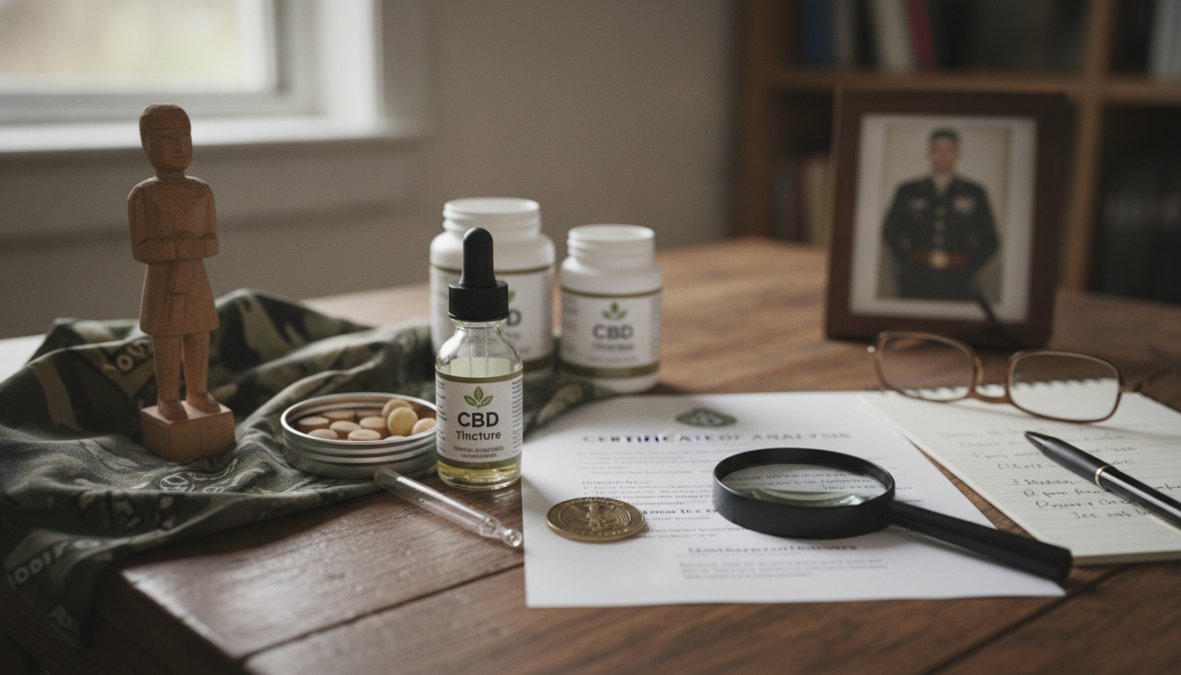
Product quality in the CBD market is uneven. The only way to verify what you are buying is through a Certificate of Analysis (COA) from an independent third-party laboratory.
A legitimate COA should confirm:
- Cannabinoid profile (CBD content matches label claim)
- THC concentration (below 0.3% for hemp-derived products)
- Absence of pesticides and herbicides
- Absence of heavy metals (lead, arsenic, mercury, cadmium)
- Absence of residual solvents from extraction
- Microbial safety (no harmful bacteria or mold)
- Batch number matches the product you received
If a brand cannot produce a current COA for the specific batch you are purchasing, do not buy from them. This is non-negotiable.
CBD Health Collection publishes independently verified COA lab testing for all products, produced in a GMP- and FDA-registered facility. According to U.S. Hemp Authority certification program for CBD quality standards, third-party testing and supply chain transparency are the core markers of a trustworthy CBD producer, a baseline standard, not a premium feature.
Chronic pain management for veterans is not a problem that resolves with a single solution, and CBD is not a replacement for comprehensive care. But for veterans seeking a non-psychoactive, non-opioid option to address neuropathic pain, inflammation, and sleep disruption, the evidence is strong enough to take seriously. Start with the format that fits your symptoms, verify the COA before you buy, and bring your provider into the conversation. Get started with CBD Health Collection and find a product matched to your specific pain management needs.
Frequently Asked Questions
Is CBD legal for veterans to use?
CBD derived from hemp containing less than 0.3% THC is federally legal under the 2018 Farm Bill, which means veterans can legally purchase and use hemp-based CBD products. However, the VA does not prescribe or recommend CBD, and policies on use can vary by state. Veterans in states with legal medical cannabis programs may have additional options. Always check your state's laws and consult a healthcare provider before starting CBD for pain management.
Does the VA cover CBD for veterans?
No. The VA does not cover, prescribe, or officially recommend CBD products for veterans. Current VA policy prohibits VA providers from completing paperwork for medical cannabis programs, and CBD is not reimbursable through VA benefits. This is largely because CBD remains unscheduled but unregulated as a therapeutic by the FDA for most conditions. Veterans interested in CBD for pain management must purchase it independently and discuss use openly with their VA care team.
Can CBD show up on a VA drug test?
Standard VA drug tests screen for THC, not CBD. However, broad-spectrum and full-spectrum CBD products may contain trace amounts of THC that could accumulate with regular use and trigger a positive result. To reduce this risk, veterans should choose THC-free, isolate-based products verified by third-party lab testing with a Certificate of Analysis (COA). Always disclose CBD use to your VA provider before any scheduled drug screening.
How should veterans talk to their VA doctor about CBD?
Be direct and non-defensive. Tell your VA provider you are considering or already using CBD for pain management and want to discuss safety, especially regarding drug interactions. Bring the product's Certificate of Analysis to the appointment. Ask specifically about interactions with any current medications, particularly blood thinners, antidepressants, or seizure medications. Framing the conversation around safety and symptom management tends to be more productive than seeking formal endorsement, which VA providers currently cannot provide.
What are the potential benefits of CBD for chronic pain in veterans?
CBD for veterans pain management is most often explored for neuropathic pain, inflammation-related joint pain, and conditions linked to combat injuries or PTSD. Preliminary research and self-reported surveys suggest some veterans experience reduced pain scores, improved sleep, and lower reliance on opioids. CBD interacts with the endocannabinoid system to modulate pain signaling and inflammation. While clinical evidence is still emerging, many veterans report meaningful symptom relief, particularly when using high-quality, third-party tested cannabidiol products consistently.
This article was written using GrandRanker