Table of Contents
- Is CBD Legal in Ohio? The Current Legal Status
- Senate Bill 57 and Ohio’s Intoxicating Hemp Ban
- CBD Age Limit in Ohio and Purchase Restrictions
- Delta-8 Legality in Ohio: What You Need to Know
- Consumer Safety: Lab Testing and Certificate of Analysis
- Workplace Drug Testing and CBD in Ohio
- Traveling with CBD in Ohio: Transport and Possession Laws
- Where to Buy Legal CBD in Ohio: Retail and Online Options
Is CBD Legal in Ohio? 2026 Guide to Laws & Compliance
Last Updated: July 1, 2026
When it comes to CBD legality, Ohio presents a complex landscape that shifted dramatically in 2024. The question of whether is CBD legal in Ohio requires a detailed answer because the state’s regulations now distinguish between standard CBD products and intoxicating hemp derivatives. Below, we’ll walk you through the current legal status, recent legislative changes, and practical compliance guidance you need to make informed purchasing decisions.
The short answer: standard CBD derived from hemp is legal in Ohio, but the state has implemented strict controls on intoxicating hemp products.
Is CBD Legal in Ohio? The Current Legal Status
Hemp-derived CBD containing no more than 0.3% Delta-9 THC by dry weight is permitted for retail sale and personal possession in Ohio. This threshold comes directly from the 2018 Federal Farm Bill and distinguishes legal hemp products from controlled marijuana substances. Products must be independently lab tested with a Certificate of Analysis (COA) documenting their cannabinoid profile.
In 2024, Ohio banned intoxicating hemp products, including Delta-9 THC beverages, edibles, and smokables designed to produce psychoactive effects. A CBD oil with 0.3% THC is legal. A hemp-derived Delta-9 gummy marketed for intoxication is not.
Just because something is “hemp-derived” does NOT mean it’s legal in Ohio if it’s formulated to produce intoxicating effects. Always verify the product’s intended use and THC content through the COA.
Hemp-Derived CBD vs. Marijuana-Derived CBD in Ohio
Hemp-derived CBD comes from industrial hemp plants containing 0.3% or less Delta-9 THC and is legal under federal law and permitted in Ohio. Marijuana-derived CBD comes from cannabis plants with higher THC content and is not permitted for retail sale outside of licensed medical marijuana dispensaries.
Ohio has a medical marijuana program operating separately from the broader CBD market. With a valid medical marijuana card, you can purchase cannabis products, including high-THC CBD, from licensed dispensaries. Without a card, only hemp-derived CBD products are available through retail channels.
The source plant matters legally. When shopping, verify the source plant and request the COA to confirm hemp origin and compliance with the 0.3% THC threshold.
Look for “hemp-derived” explicitly stated on product labels. If a retailer cannot provide documentation of the hemp source or a COA showing 0.3% or less THC, the product may not meet Ohio’s legal requirements.
The 0.3% THC Standard Explained
The 0.3% Delta-9 THC limit is the legal threshold separating hemp from marijuana under federal and Ohio state law. This percentage represents the maximum allowable THC content by dry weight. A product with 0.3% THC means that in a 1-gram sample of dried material, no more than 0.003 grams (3 milligrams) of Delta-9 THC are present.
This threshold comes from the 2018 Farm Bill and is low enough to prevent intoxication from standard CBD doses while allowing hemp cultivation as a legal crop. Ohio’s regulations adopt this federal standard directly.
Testing accuracy matters here. A product tested at 0.29% THC is compliant; one tested at 0.31% is not. This is why third-party lab testing from accredited facilities is essential. Retailers must ensure their products consistently test below the threshold across multiple batches.
Senate Bill 57 and Ohio’s Intoxicating Hemp Ban
In 2024, Ohio passed Senate Bill 57, which specifically targeted intoxicating hemp products, including Delta-9 THC beverages, edibles, and smokables designed to produce psychoactive effects. The legislation prohibits the manufacture, distribution, and sale of these products in Ohio, even though they technically meet the 0.3% THC threshold.
Governor Mike DeWine signed SB 57 into law, and it took effect in 2024. The law also grants the Ohio Department of Agriculture authority to establish rules for hemp product compliance and testing.
SB 57 did NOT ban CBD. It banned intoxicating hemp products. Non-intoxicating CBD oils, tinctures, topicals, and gummies remain legal as long as they meet testing and labeling requirements.
What Changed in 2024: Delta-9 THC Beverages and Products
Before 2024, Ohio permitted any hemp-derived product meeting the 0.3% THC threshold. Companies sold hemp-derived Delta-9 THC beverages and edibles containing high concentrations (sometimes 10-20mg per serving) that produced noticeable intoxication while remaining technically legal under federal hemp law.
Senate Bill 57 closed this loophole. Starting in 2024, intoxicating hemp products became illegal in Ohio. Non-intoxicating CBD products were unaffected. A CBD gummy containing 25mg of CBD with minimal THC remains legal; a Delta-9 THC gummy marketed for intoxication does not.
CBD Age Limit in Ohio and Purchase Restrictions
Ohio does not have a specific age restriction for purchasing standard CBD products. Unlike tobacco or alcohol, CBD is not subject to age-gating at the point of sale under state law. However, retailers may impose their own age restrictions.
This absence of legal age restriction does NOT mean CBD is recommended for minors. The FDA has not approved CBD for use in children, and medical guidance on pediatric CBD use remains limited. Parents and guardians should consult healthcare providers before giving CBD to minors.
The lack of legal age restrictions does not mean CBD is safe for children. Pediatric CBD use should only occur under medical supervision.
Delta-8 Legality in Ohio: What You Need to Know
Delta-8 THC occupies a legal gray area in Ohio. Unlike Delta-9 THC, which is explicitly regulated, Delta-8 is not directly addressed in Ohio’s hemp or marijuana statutes. The state has not explicitly banned Delta-8, but it also has not formally legalized it.
Federally, the 2018 Farm Bill legalized hemp and hemp-derived cannabinoids, which technically includes Delta-8. However, the DEA issued guidance suggesting that synthetically derived Delta-8 (created through chemical conversion rather than direct extraction) may violate the Controlled Substances Act.
The safest approach for Ohio consumers is to assume Delta-8 products carry legal risk. If you’re considering Delta-8, consult an attorney familiar with Ohio cannabis law, or stick to clearly legal CBD products.
Consumer Safety: Lab Testing and Certificate of Analysis
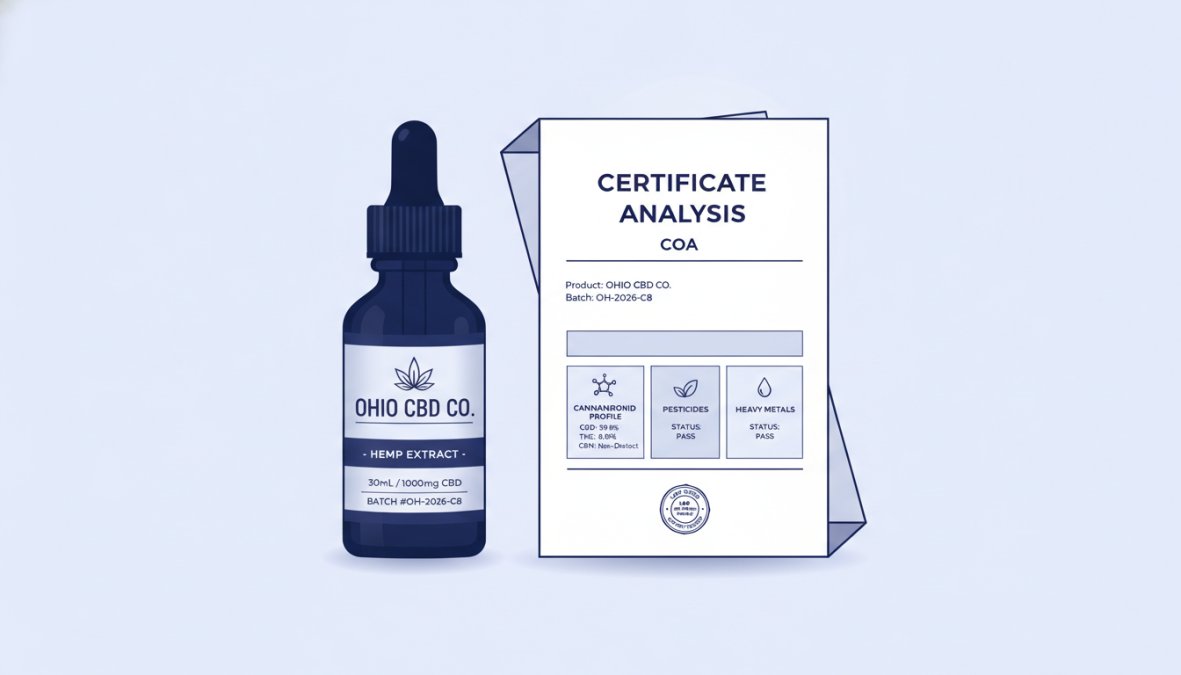
The most critical factor in purchasing legal, safe CBD in Ohio is third-party lab testing. A Certificate of Analysis (COA) is your proof that a product has been independently tested for cannabinoid content, potency, and contaminants.
Every reputable CBD product should come with a COA from an accredited third-party laboratory. This document shows:
- Exact cannabinoid profile (CBD, THC, and other cannabinoids present)
- Potency verification (does the product contain what the label claims?)
- Contaminant screening (heavy metals, pesticides, microbial contaminants, residual solvents)
- Testing date and laboratory accreditation information
Without a COA, you have no way to verify that a product meets Ohio’s 0.3% THC limit or contains the advertised amount of CBD.
Request the COA before buying. Legitimate retailers provide them freely. If a seller hesitates or claims the COA is “proprietary,” that’s a red flag.
Why Third-Party Lab Testing Matters
Third-party lab testing is the only objective way to verify CBD product safety and legality. Independent labs have no conflicts of interest and follow standardized testing protocols.
Accredited labs use validated testing methods to measure cannabinoid content precisely, detecting THC levels as low as 0.01%. Most accredited labs follow protocols established by organizations like the Association of Commercial Labs (ACL) or comply with ISO standards for analytical testing.
For Ohio consumers, third-party testing is the practical enforcement mechanism for the state’s CBD regulations. If you demand COAs, retailers must provide them or lose business.
How to Verify Product Compliance
Verifying product compliance involves three steps: reviewing the COA, checking the retailer’s credentials, and understanding what the test results mean.
First, obtain the COA and review the cannabinoid profile. Look for total Delta-9 THC content clearly listed (should be below 0.3%), CBD content matching the product label (within ±10% is typical tolerance), and a testing date within the last 12 months.
Second, verify the laboratory’s credentials. Accredited labs should be listed on the ACL website or have ISO certifications visible.
Third, cross-reference the product label with the COA. If a product claims "500mg CBD," the COA should show approximately 500mg (±50mg tolerance). Significant discrepancies indicate mislabeling or testing inconsistencies.
If a retailer cannot provide a COA, will not disclose the testing laboratory, or shows test results from an unknown or unaccredited lab, avoid that product.
Workplace Drug Testing and CBD in Ohio
Standard CBD products containing 0.3% or less THC can potentially trigger a positive result on a workplace drug test, though the risk is low. Most workplace drug tests screen for THC metabolites using immunoassay tests with a threshold of typically 50 nanograms per milliliter.
A single dose of standard CBD product containing only 0.3% THC is unlikely to generate enough THC metabolites to exceed this threshold. However, repeated daily use of high-volume CBD products could theoretically accumulate enough THC to trigger a positive result.
If you’re subject to workplace drug testing and concerned about CBD use, consider products with verified COAs showing THC content below 0.1%, keep COAs accessible in case a positive result occurs, and inform your employer that you use CBD.
If you face mandatory drug testing, do not assume CBD is risk-free. While standard CBD products pose minimal risk, repeated high-dose use could theoretically cause a positive result. Review your product’s COA and consider discussing CBD use with your employer or medical provider.
Traveling with CBD in Ohio: Transport and Possession Laws
Within Ohio, you can legally possess and transport CBD products that meet state requirements (0.3% or less THC, third-party tested, properly labeled).
Traveling out of state with CBD is riskier. Some states prohibit hemp-derived CBD entirely, treating it as a controlled substance. Federal law permits hemp-derived CBD, but state law varies. Crossing a state border with CBD could result in confiscation or legal charges.
Air travel with CBD is particularly complicated. TSA rules permit hemp-derived CBD products in checked and carry-on luggage if they contain 0.3% or less THC and comply with federal regulations. However, TSA agents may not be familiar with these rules, and state laws at your destination also apply.
The safest approach is to leave CBD at home when traveling out of state or purchase CBD products at your destination if it’s legal there.
Where to Buy Legal CBD in Ohio: Retail and Online Options
Ohio has a strong CBD retail market with both physical locations and online retailers. Physical retail options include specialty CBD shops, natural health and wellness stores, some pharmacies, and licensed medical marijuana dispensaries (for high-THC products with a medical card).
Online retailers offer broader selection and convenience. When choosing a retailer, evaluate COA availability and clarity, product labeling accuracy, customer reviews and reputation, company transparency about sourcing and testing, and return policies.
Reputable online retailers provide full transparency through accessible COAs and detailed product information. Research before purchasing, and prioritize vendors who make compliance documentation easily accessible.
| Aspect | Legal Status | Key Requirement |
|---|---|---|
| Hemp-derived CBD (≤0.3% THC) | Legal | Third-party tested COA required |
| Intoxicating hemp products | Banned (SB 57) | Not available for purchase |
| Marijuana-derived CBD (without medical card) | Illegal | Medical card required |
| Delta-8 THC | Gray area | Avoid or consult attorney |
| Workplace use | Possible but risky | Review COA; low THC products safer |
| Interstate transport | Restricted | Legal in Ohio; illegal in other states |
Frequently Asked Questions
Is CBD legal in Ohio in 2026?
Yes, hemp-derived CBD with no more than 0.3% Delta-9 THC is legal in Ohio under federal law and state regulations. However, Ohio banned intoxicating hemp products (like Delta-9 THC beverages) under Senate Bill 57. Standard CBD products from licensed retailers remain legal to purchase and possess. Always verify that your CBD product has third-party lab testing confirming THC compliance.
What is the CBD age limit in Ohio?
CBD products are generally available to adults 18 and older in Ohio, though some retailers may have stricter age policies. Intoxicating hemp products are restricted to adults 21+. Always check with your retailer regarding their specific age requirements. If you have concerns about using CBD, consult a healthcare provider, especially if you take other medications.
Is Delta-8 legal in Ohio?
Delta-8 THC exists in a legal gray area in Ohio. While the federal Farm Bill permits hemp-derived cannabinoids, Ohio's recent regulations on intoxicating hemp products may affect Delta-8 availability and legality. Products marketed as Delta-8 must comply with Ohio's THC limits and labeling requirements. Always verify the product's Certificate of Analysis and check current local regulations before purchasing.
Can I travel with CBD in Ohio?
You can legally transport hemp-derived CBD within Ohio if it complies with the 0.3% Delta-9 THC limit and has proper documentation (Certificate of Analysis). However, transporting CBD across state lines carries legal risks due to varying state laws. Keep your CBD in its original labeled container and avoid taking it across state borders unless you've verified that destination state's regulations. When traveling, carry lab test documentation to prove compliance.
This article was written using GrandRanker