

Table of Contents
- How CBD Works for Nerve Pain Relief
- CBD Dosage for Nerve Pain: Finding Your Optimal Amount
- Topical CBD for Nerve Pain: Localized Relief Options
- CBD vs Gabapentin for Nerve Pain: What You Need to Know
- Drug Interactions and Medication Safety with CBD
- Quality, Testing, and What to Look for in CBD Products
- CBD for Nerve Pain Relief: What Clinical Evidence Shows
- Conclusion
Last Updated: June 19, 2026
Nerve pain is treatment-resistant, and millions seek alternatives to prescription pharmaceuticals. CBD for nerve pain relief has moved from wellness fringe into clinical conversation, with researchers and patients reporting meaningful symptom improvements. This guide covers how cannabidiol interacts with the nervous system, how to dose it sensibly, how it compares to standard medications, and what to look for in a trustworthy product.
The truth sits between overselling CBD as a cure-all and dismissing it as hype. Below, we’ll walk through the mechanisms, evidence, practical dosage, and drug interaction warnings rarely discussed in mainstream articles.
How CBD Works for Nerve Pain Relief
Cannabidiol is a non-psychoactive compound from cannabis sativa that interacts with the body’s endocannabinoid system to modulate pain perception, inflammation, and nerve signal transmission. Unlike THC, it produces no intoxicating effect, making it viable for long-term pain management without impairment concerns.
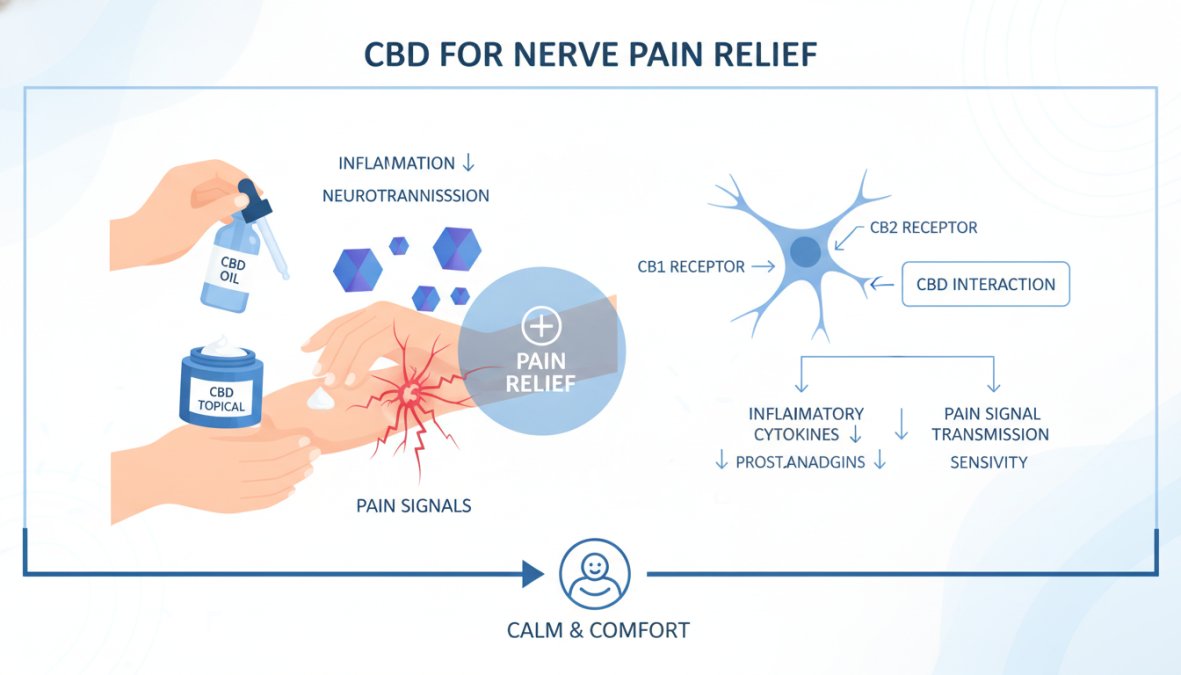
The endocannabinoid system is a network of receptors, enzymes, and signaling molecules regulating pain, mood, sleep, and immune response.
(/how-cbd-works-for-pain/) Nerve Pain Relief]
The Endocannabinoid System and Neuropathic Pain
Neuropathic pain arises from nervous system damage or dysfunction, distinct from tissue injury pain. Conditions like diabetic neuropathy, sciatica, post-herpetic neuralgia, and chemotherapy-induced peripheral neuropathy notoriously resist standard analgesics.
The endocannabinoid system contains two primary receptor types: CB1 receptors in the brain and spinal cord, and CB2 receptors in immune tissues. CBD does not bind directly to these receptors like THC does. Instead, it works indirectly: inhibiting FAAH (which breaks down natural endocannabinoids), activating TRPV1 channels involved in pain sensation, and modulating serotonin receptors that influence pain processing.
This multi-target pharmacology distinguishes CBD from single-mechanism drugs. Rather than targeting one pathway, it nudges several systems simultaneously, which may explain why some patients report broader relief than expected.
CBD’s Role in Reducing Inflammation and Pain Signals
Chronic inflammation can sensitize nerve endings and amplify pain signals through central sensitization. CBD demonstrates anti-inflammatory properties by reducing pro-inflammatory cytokines and modulating microglial activity in the central nervous system.
For people with nerve pain tied to autoimmune disease or post-injury nerve damage, this dual action on inflammation and pain signaling is clinically relevant. It does not replace anti-inflammatory medications but may complement them, reducing total medication burden.
CBD works through multiple pathways: modulating endocannabinoid activity, activating pain-sensing channels, and reducing inflammatory signaling. This multi-target approach distinguishes it from single-mechanism drugs like gabapentin or NSAIDs.
CBD Dosage for Nerve Pain: Finding Your Optimal Amount
There is no universal CBD dosage for nerve pain. Effective doses vary based on body weight, metabolism, condition severity, delivery method, and product quality. A common approach is starting at the lowest reasonable dose and titrating upward gradually while tracking response.
Starting Low and Titrating Gradually
The standard starting point is 10-25mg daily, taken as a single dose or split across two administrations. Hold at a given dose for five to seven days before increasing, as cannabidiol’s effects on pain can take time to accumulate.
A practical titration schedule:
- Begin at 15-20mg daily for one week
- Assess pain scores and sleep quality
- If insufficient relief, increase by 10-15mg for the next week
- Continue in weekly increments until meaningful relief or side effects appear
- Maintain stable effective dose for at least four weeks before reassessing
Most people find their effective range between 25mg and 100mg daily, though some require more. Keeping a simple pain journal during titration provides real data rather than impressions.
Factors That Influence Your Dosage Needs
Several variables shift where your effective dose lands:
- Body mass: Larger body mass generally requires higher doses
- Delivery method: Sublingual oils absorb faster than capsules or gummies; topicals deliver localized effect without systemic absorption
- Bioavailability: Water-soluble CBD formulations offer significantly better absorption than oil-based products
- Concurrent medications: Some drugs affect CBD metabolism
- Product quality: A 50mg dose from a poorly tested product may deliver far less actual cannabidiol than claimed
Track your pain on a 0-10 scale each morning and evening during titration. This provides real data and helps identify your effective dose window.
Topical CBD for Nerve Pain: Localized Relief Options
Peripheral neuropathy in the feet, localized sciatica, or post-surgical nerve sensitivity often respond well to targeted application rather than systemic dosing. Topical CBD for nerve pain is a distinct delivery category with its own mechanism and best-use profile.
How Topical Applications Differ from Oils and Capsules
Topical CBD products do not enter the bloodstream in meaningful concentrations. Instead, they penetrate skin and interact with cannabinoid receptors and TRPV1 channels in local tissues. This makes topical CBD effective for surface-level or peripheral nerve conditions but unlikely to address central or deep neuropathic pain.
If your nerve pain is systemic or widespread, topicals complement oral CBD rather than replace it. If pain is localized, burning in feet or aching along a specific nerve path, a topical applied directly may provide faster relief than waiting for oral absorption.
Best Practices for Using CBD Topicals
- Apply to clean, dry skin for maximum absorption
- Use a generous amount and massage in thoroughly
- Allow 15-30 minutes before assessing effect
- Reapply every 4-6 hours as needed
- Avoid broken skin or open wounds
- Patch test on a small area first if you have sensitive skin
CBD vs Gabapentin for Nerve Pain: What You Need to Know
Gabapentin (Neurontin) is commonly prescribed for neuropathic pain. Many exploring CBD are either already on gabapentin or trying to reduce reliance on it.
How These Treatments Compare in Mechanism and Efficacy
Gabapentin binds to voltage-gated calcium channels, reducing excitatory neurotransmitter release and dampening nerve signal overactivity. It is a single-mechanism drug with well-documented efficacy for diabetic neuropathy and post-herpetic neuralgia. According to the National Institute of Neurological Disorders and Stroke’s overview of neuropathic pain treatments, gabapentin remains a first-line pharmacological option.
CBD works through multi-pathway mechanisms described earlier. Direct head-to-head clinical trials comparing CBD and gabapentin are limited. Existing evidence suggests CBD may offer meaningful relief for some patients, particularly those who do not tolerate gabapentin well or seek to reduce pharmaceutical load.
Gabapentin has more clinical trial data for nerve pain specifically. CBD has a more favorable side effect profile and no addiction potential. They are not mutually exclusive, and many use both under medical supervision.
Side Effects and Safety Considerations
| Factor | Gabapentin | CBD |
|---|---|---|
| Addiction potential | Moderate (especially at high doses) | None documented |
| Cognitive effects | Sedation, brain fog common | Mild sedation at high doses |
| Withdrawal risk | Yes, requires tapering | Not established |
| Drug interactions | Moderate | Yes, via CYP450 enzymes |
| Long-term safety data | Extensive | Limited but emerging |
| Psychoactive effects | None | None (if THC-free) |
Do not abruptly discontinue gabapentin to switch to CBD. Gabapentin requires gradual tapering under medical supervision. Stopping suddenly can cause withdrawal symptoms including seizures.
Drug Interactions and Medication Safety with CBD
CBD is metabolized by liver cytochrome P450 enzymes, specifically CYP3A4 and CYP2C19. These same enzymes process many common medications. When CBD occupies these enzymes, it can slow metabolism of other drugs, causing accumulation to higher-than-expected levels.
Common Medications That May Interact with CBD
Medications commonly affected include:
- Blood thinners (warfarin): CBD can increase warfarin levels, raising bleeding risk. This interaction requires INR monitoring if both are used together
- Anti-epileptic drugs: Interactions with other seizure medications are possible
- Certain antidepressants (SSRIs, TCAs): Metabolism may be slowed, potentially increasing side effects
- Opioid pain medications: CBD may enhance sedative effects; dose adjustments may be needed
- Benzodiazepines: Combined sedation risk increases
As documented in the FDA’s consumer update on CBD drug interactions, the agency has flagged liver enzyme elevation and drug interaction concerns as areas requiring further study and medical oversight.
How to Talk to Your Doctor About CBD for Nerve Pain
Frame it as a symptom management question: "I’m looking for additional options for my nerve pain. I’ve read about cannabidiol and want to understand if it’s safe given my current medications."
- Bring a list of current medications for interaction assessment
- Ask specifically about CYP450 interactions if you take warfarin, anti-epileptics, or immunosuppressants
- Request a liver function baseline if planning long-term CBD use
- Ask whether your pain clinic has a CBD documentation policy
The American Legion’s survey findings on veteran CBD use and VA policy highlights the disconnect between veteran interest in cannabidiol and available VA guidance, underscoring why these conversations need to happen proactively.
Quality, Testing, and What to Look for in CBD Products
The CBD market is not uniformly regulated, and the gap between label claims and actual product content can be significant. Underdosing means no therapeutic effect. Contamination means potential harm.

Third-Party Lab Testing and Certificate of Analysis (COA)
A Certificate of Analysis is a document from an independent laboratory confirming actual cannabinoid content and contaminant status of a specific product batch. Every reputable CBD product should have a current, batch-specific, accessible COA.
What a COA should confirm:
- Cannabinoid potency: Actual CBD content matches label claim within reasonable margin
- THC content: Below 0.3% for legal hemp-derived products
- Heavy metals: Below established safety thresholds
- Pesticides: No residues from non-organic practices
- Microbials: No harmful bacteria or mold
- Residual solvents: Absent or below safe limits
CBD Health Collection publishes independently verified COA lab results for all products, using organically grown, USA-sourced hemp extracted via clean CO2 process in a GMP- and FDA-registered facility.
Before purchasing any CBD product, search for the COA using the batch number on the label. If a company cannot provide a current, batch-specific COA from an independent lab, move on.
Hemp vs Cannabis: Understanding the Legal Distinction
Hemp and marijuana are both cannabis sativa varieties but legally and chemically distinct. Hemp is federally defined as cannabis containing less than 0.3% THC by dry weight. CBD products from hemp are federally legal under the 2018 Farm Bill, though state laws vary.
For practical purposes: if subject to VA drug testing or employment screening, choose broad-spectrum or CBD isolate products with verified non-detectable THC, not full-spectrum. Even trace THC can accumulate with daily use and trigger a positive test. According to the U.S. Department of Veterans Affairs’ official policy on CBD and veteran health, VA clinicians may discuss CBD with patients but cannot recommend or prescribe it due to federal scheduling constraints.
CBD for Nerve Pain Relief: What Clinical Evidence Shows
The evidence base for CBD for nerve pain relief is real but still maturing. Overstating evidence undermines credibility; understating it disserves patients who might benefit.
Self-Reported Pain Improvements and Patient Satisfaction
Cross-sectional surveys of CBD users consistently show high rates of self-reported pain improvement, particularly for neuropathic and chronic pain. Many report CBD allowed them to reduce opioid or pharmaceutical use.
Self-reported data limitations are well-known: placebo effects, recall bias, and selection bias influence results. Randomized controlled studies are the gold standard. Several are currently underway examining cannabidiol for specific neuropathic conditions, and results will sharpen understanding of therapeutic efficacy, optimal dosing, and which populations benefit most.
Current evidence clearly supports: CBD has a favorable safety profile at therapeutic doses, meaningful drug interaction risks requiring medical oversight, and a biologically plausible mechanism for neuropathic pain relief.
Limitations and Gaps in Current Research
Honest gaps in the literature include:
- Most clinical trials are short-term (weeks, not months or years), so long-term pain care data is limited
- Optimal dosing protocols have not been established through rigorous trials
- Head-to-head comparisons with standard neuropathic pain medications are sparse
- Veteran-specific research remains limited despite high veteran interest
The field is advancing. Academic medical centers have active CBD research programs. The next two to three years should produce considerably more clarity on where CBD fits in treatment guidelines for neuropathic pain.
Nerve pain is genuinely difficult to treat, and the gap between available pharmaceutical options and adequate symptom management leaves many searching for something that works. CBD Health Collection was built for this need: products from organically grown, USA-sourced hemp, CO2-extracted for purity, independently lab-tested for potency and safety, and formulated for optimal bioavailability through water-based delivery. If you’re ready to explore a science-backed approach to nerve pain management, get started with CBD Health Collection and experience the difference that pharmaceutical-grade quality and product transparency make.
Frequently Asked Questions
Is CBD effective for nerve pain?
CBD shows promise for nerve pain relief through its interaction with the endocannabinoid system and its anti-inflammatory properties. Many users report reduced neuropathic pain and improved symptom management. However, clinical trials are still ongoing. Individual results vary, and CBD works best when combined with other pain management strategies. Consult your healthcare provider before starting CBD for nerve pain to ensure it's appropriate for your specific condition.
What is the best CBD dosage for nerve pain?
There's no universal dosage for CBD and nerve pain, it depends on body weight, pain severity, and individual tolerance. Most people start with 5-10 mg daily and gradually increase by 5 mg every few days until they achieve relief. Some find effective doses between 15-50 mg daily. Keep a pain journal to track symptom changes. Always start low and go slow, and discuss your dosage plan with a healthcare provider, especially if you're taking other medications.
How does topical CBD for nerve pain differ from oils or capsules?
Topical CBD products like freeze gels and pain patches deliver cannabidiol directly to the affected area, providing localized relief without entering the bloodstream. This makes them ideal for targeted nerve pain in specific locations. Oils and capsules offer systemic relief throughout the body. Topicals typically work faster (15-30 minutes) but may have a shorter duration. Many users combine both methods, topicals for acute flare-ups and oils for long-term management.
Does CBD interact with gabapentin or other nerve pain medications?
CBD may interact with gabapentin and other medications metabolized by the liver (CYP3A4 enzyme). These interactions can affect medication effectiveness or increase side effects. Always inform your doctor if you're considering CBD while taking gabapentin, opioids, or other pain medications. Your healthcare provider can monitor you for interactions and adjust dosages if needed. Never stop prescribed medications without medical guidance.
This article was written using GrandRanker