If you’re curious about the wellness benefits of CBD but feel a little lost, you’ve come to the right place. The world of hemp is buzzing with terms like ‘cannabidiol,’ ‘full-spectrum,’ and ‘THC,’ and it’s easy to feel overwhelmed. You might be wondering if it’s safe, if it’s legal, or if it will make you feel ‘high.’ These are all valid questions, and finding clear, trustworthy answers is the first step on any wellness journey.
Our goal is to gently guide you through the noise. In this complete beginner’s guide, we demystify cannabidiol, explaining what it is and how this natural plant compound works with your body. We’ll explore the potential, science-backed benefits for finding calm and comfort, and give you the confidence to navigate the market. You’ll learn how to choose a pure, effective, and independently tested product that aligns with your personal health goals. Consider this your calm, simple roadmap to making an informed choice for your well-being.
Key Takeaways
- Learn how CBD, a natural compound from the hemp plant, supports your body’s wellness goals without any intoxicating effects.
- Understand how your body’s own internal system works to maintain balance and support your overall sense of well-being.
- Discover the key differences between Full Spectrum, Broad Spectrum, and Isolate to confidently choose the right option for you.
- Find the ideal product form for your lifestyle, from simple oils to soothing topicals, to help you meet your wellness targets.
What is CBD? Demystifying the Basics for Beginners
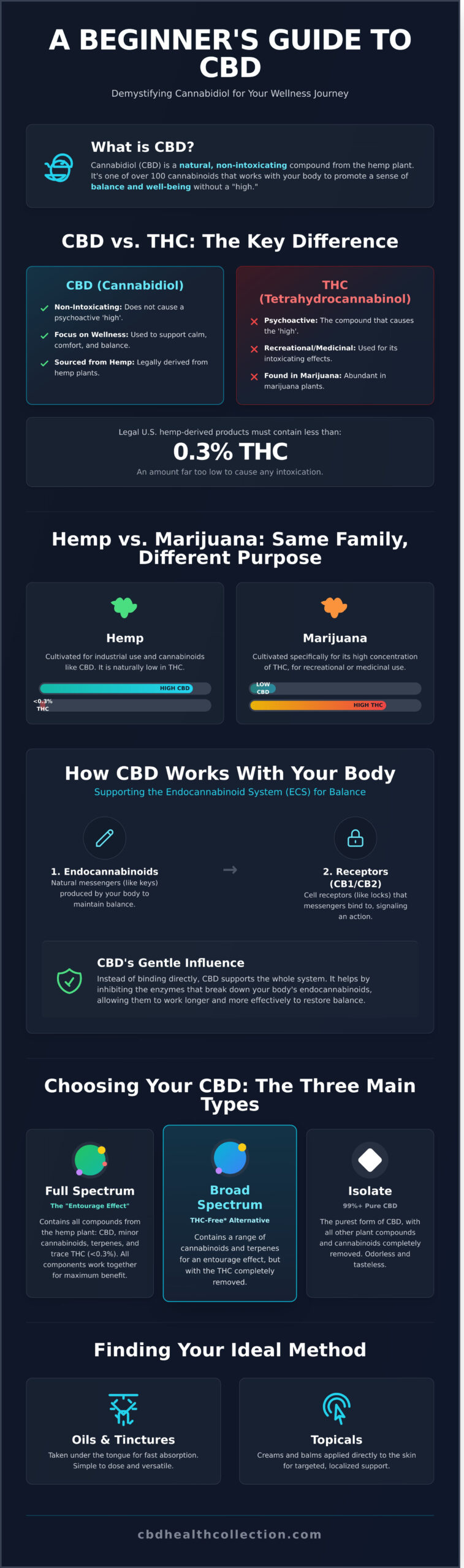
If you’re new to the world of wellness, you may be wondering: what exactly is CBD? Simply put, Cannabidiol-or CBD for short-is one of over 100 natural compounds, known as cannabinoids, found in the hemp plant. While you can find a comprehensive overview of cannabidiol and its history online, the most important thing to understand is its purpose. Unlike other compounds from the cannabis family, CBD is completely non-intoxicating. Its focus is not on recreation, but on promoting a sense of balance and well-being within your body.
To help visualize how it works, this short video from a medical professional explains the science in a clear, accessible way:
CBD vs. THC: The Most Important Distinction
The primary difference lies with another famous cannabinoid: THC (Tetrahydrocannabinol), the compound responsible for the psychoactive ‘high’ associated with marijuana. CBD does not have this effect. Think of it like the difference between decaffeinated and regular coffee-one is chosen for its calming properties without the jitters, the other for its stimulating effects. Legally, all hemp-derived products in the U.S. must contain less than 0.3% THC, an amount far too low to cause any intoxication.
Hemp vs. Marijuana: It’s All in the Family
While often confused, hemp and marijuana are not the same. Both belong to the Cannabis Sativa plant family, but they are cultivated for very different purposes, much like a sweet cherry and a sour cherry are different varieties of the same fruit.
- Hemp: Cultivated to be rich in CBD and contain only trace amounts of THC (<0.3%).
- Marijuana: Cultivated to have high concentrations of THC for recreational or medicinal use.
You can feel confident knowing that all of our products are sourced exclusively from pure, legally compliant, American-grown hemp, ensuring you receive only the natural wellness benefits.
How Does CBD Work? A Simple Guide to the Endocannabinoid System (ECS)
Have you ever wondered how your body stays so remarkably balanced? From regulating your sleep schedule to managing your mood and stress levels, there’s a master control system working behind the scenes. This incredible network is called the Endocannabinoid System (ECS), and understanding it is the key to understanding how CBD can support your overall wellness.
The ECS is your body’s ‘master regulator,’ constantly working to maintain a state of internal balance known as homeostasis. When something is out of sync-whether it’s stress, pain, or a sleepless night-the ECS steps in to help restore order. By supporting this vital system, you can naturally encourage a greater sense of well-being.
What is the Endocannabinoid System (ECS)?
Think of the ECS as a complex communication network within your body. It’s made up of three core components that work together to keep you feeling your best:
- Endocannabinoids: These are cannabinoids produced naturally by your own body. They act as messengers, delivering signals where they are needed.
- Receptors (CB1 and CB2): Found on cells throughout your body, these are like ‘locks.’ Endocannabinoids are the ‘keys’ that bind to them to unlock a specific response.
- Enzymes: These are responsible for breaking down endocannabinoids once they’ve completed their job, ensuring they only act when needed.
CBD’s Interaction with Your Body
So, where does cannabidiol fit in? Unlike THC (the compound that causes a ‘high’), CBD interacts with your ECS in a more indirect and gentle way. According to the authoritative definition of CBD from the National Cancer Institute, it is a non-intoxicating substance. Instead of binding directly to the receptors, it acts as a supportive influence on the entire system.
One of its primary roles is to prevent the enzymes from breaking down your body’s own endocannabinoids too quickly. This allows your natural messengers to have a longer, more profound effect, helping your body return to a state of balance more efficiently. This is how it helps promote calm and comfort without causing impairment, making it a natural way to support your body’s quest for equilibrium.
The Different Types of CBD: Full Spectrum, Broad Spectrum, and Isolate
As you begin exploring the world of CBD, you’ll quickly notice that not all products are created equal. The way cannabidiol is extracted from the hemp plant results in three distinct types, each offering a unique profile of compounds. Understanding these differences is the key to choosing a product that aligns perfectly with your wellness goals.
Think of it like buying orange juice. Some people prefer juice with all the natural pulp for the full-bodied flavor and texture. Others want a completely pulp-free, smooth juice. The choice depends on your personal preference, and the same is true for CBD.
Full Spectrum CBD: The ‘Entourage Effect’
Full spectrum products contain all the beneficial compounds naturally found in the hemp plant, including a wide range of cannabinoids, terpenes, and flavonoids. This also includes a trace amount of THC, which is always kept below the federal legal limit of 0.3%. These components are believed to work together in synergy, creating what scientists call the “entourage effect.” This synergy is thought to enhance the overall therapeutic effects, contributing to the growing evidence for CBD’s health benefits.
- Who it’s for: Individuals who want to experience the full, holistic benefits of the entire hemp plant.
Broad Spectrum CBD: The Best of Both Worlds
Broad spectrum CBD offers a middle ground. It contains a rich array of cannabinoids and terpenes for a partial entourage effect, but it has undergone an additional refinement process to remove all detectable traces of THC. This makes it an excellent choice for those who want the collaborative benefits of multiple plant compounds without consuming any THC.
- Who it’s for: Those seeking the benefits of the hemp plant but prefer or need to avoid THC entirely.
CBD Isolate: The Purest Form
As the name suggests, CBD isolate is the purest form available, consisting of 99%+ pure cannabidiol. During extraction, all other plant compounds-including other cannabinoids, terpenes, and THC-are completely removed. The result is a fine, crystalline powder that is tasteless and odorless, making it a versatile and predictable option.
- Who it’s for: Anyone who wants to take only pure CBD, is sensitive to other cannabinoids, or requires a product guaranteed to be 100% THC-free. Our THC-Free Gummies use pure, effective CBD to deliver consistent and reliable calm.
Common Forms of CBD Products: Finding Your Ideal Method
Once you decide to explore the benefits of CBD, the next step is choosing how to take it. The world of hemp-derived wellness offers a wide variety of product types, and there is no single “best” option for everyone. The ideal method depends entirely on your personal preferences, lifestyle, and wellness goals-whether you’re looking for fast-acting relief, all-day support, or targeted comfort.
Understanding the key differences in how these products work, particularly their onset time and bioavailability (the amount that enters your bloodstream), can help you make an informed and confident choice for your daily routine.
CBD Oils and Tinctures
Oils and tinctures are a classic and highly effective way to take CBD. Administered sublingually (under the tongue), the compound is absorbed directly into the bloodstream through capillaries, bypassing the digestive system for a faster onset of effects, typically within 15-30 minutes. This method offers excellent bioavailability and allows for precise, flexible dosing with a marked dropper, making it easy to find the exact amount that works for you.
CBD Gummies and Capsules
For those seeking simplicity and consistency, gummies and capsules are an excellent choice. Each serving contains a pre-measured, precise amount of CBD, taking all the guesswork out of your daily regimen. They are discreet, easy to take on the go, and a great option if you dislike the natural, earthy taste of hemp oil. Because they pass through the digestive system, effects may take longer to appear (60-90 minutes) but tend to last longer.
CBD Topicals: Creams, Salves, and Gels
When you need to address discomfort in a specific area, topicals offer targeted relief. These products are applied directly to the skin, where they interact with local cannabinoid receptors in your skin, muscles, and joints without entering the bloodstream. They are perfect for soothing tired muscles after a workout or easing stiffness in your joints. For powerful, cooling relief, you can find targeted comfort with our CBD Freeze Gel.
Is CBD Safe and Legal? What Every Consumer Should Know
If you’re considering adding CBD to your wellness routine, questions about its safety and legality are completely normal. We believe that an informed consumer is an empowered one, so let’s clear up these two important topics to help you move forward with confidence on your wellness journey.
This journey toward well-being is unique for everyone. While many find balance through natural supplements like CBD, others explore different avenues, from sourcing high-quality foods through services like Helexo to exploring cosmetic self-care. For those interested in the latter, for instance, it’s equally important to research your options; you can explore Dermal Fillers from specialized online suppliers to learn more about those treatments.
Understanding the 2018 Farm Bill
The legal landscape for hemp changed dramatically with the passage of the 2018 Farm Bill. This federal law officially removed hemp from the list of controlled substances, distinguishing it legally from marijuana. The key requirement is that for a product to be legal, it must be derived from hemp and contain less than 0.3% THC. This bill made hemp-derived wellness products widely accessible across the United States, though it’s always wise to be aware of your specific state’s regulations.
Potential Side Effects and Drug Interactions
Your well-being is the top priority. According to the World Health Organization, CBD is generally well-tolerated with a good safety profile. When side effects do occur, they are typically mild. They may include:
- Fatigue or drowsiness
- Changes in appetite or weight
- Diarrhea
Because it can interact with certain medications, it is crucial to speak with your doctor before starting any new supplement. This conversation ensures it’s a safe and beneficial choice for your specific health needs.
How to Choose a High-Quality, Safe Product
The market is not yet consistently regulated, which means product quality can vary significantly. To ensure you’re getting a pure and effective product, always look for brands that provide up-to-date, third-party lab test results, also known as a Certificate of Analysis (COA).
Navigating this landscape is easier when you turn to established health and wellness providers. For instance, an online pharmacy like Farmacia Snella often curates a range of carefully selected supplements, prioritizing safety and quality for their customers.
A COA is an unbiased report from an independent lab that verifies:
- Potency: The exact amount of CBD and other cannabinoids in the product.
- Purity: That it is free from harmful contaminants like pesticides, heavy metals, and molds.
- Compliance: That the THC level is below the legal 0.3% limit.
This level of transparency is non-negotiable for your safety. At CBD Health Collection, we make our independently verified COAs readily available because we believe our products are naturally better for you when you have complete peace of mind.
Your Journey to Wellness Starts Now
You’ve now learned that cannabidiol is a natural, non-intoxicating compound from the hemp plant that supports your body’s own endocannabinoid system to encourage balance. Understanding the different types and forms of CBD is the first, most important step toward making an informed decision for your health and finding the relief you seek.
Choosing a high-quality product is just as crucial. At CBD Health Collection, we are committed to transparency and purity. That’s why our products are Organically Grown & Processed in the USA, with THC-Free Options available for your peace of mind. Every batch is backed by Independently Verified COA Lab-Testing, so you always know exactly what you’re getting.
We are here to support you on your path. When you’re ready to take the next step, we invite you to explore our collection of lab-tested CBD products to start your journey. Your wellness is worth it, and a more balanced life could be just ahead.
Frequently Asked Questions About CBD
How does taking CBD make you feel?
Unlike THC, CBD is non-intoxicating, so it will not produce a “high.” Instead, users often report a subtle feeling of calm, relaxation, and balance. The experience is less about adding a new sensation and more about easing feelings of stress or physical discomfort. The goal is to support your body’s natural equilibrium, helping you feel more like yourself on your best days. It’s a gentle, supportive experience designed to enhance your overall wellness.
How long does it take for CBD to start working?
The onset time depends entirely on the method of use. Tinctures taken under the tongue (sublingually) are absorbed quickly, typically taking effect within 15 to 45 minutes. Edibles and capsules must be digested first, so they usually take longer, around 60 to 90 minutes. Topicals applied directly to the skin work on a localized area, with effects often felt within 20 to 40 minutes as the product absorbs into the tissue.
Will CBD show up on a drug test?
Standard drug tests screen for THC, the intoxicating compound, not for CBD. However, full-spectrum products contain trace amounts of THC (legally under 0.3%) which could potentially accumulate in the body over time. For absolute peace of mind, we recommend choosing broad-spectrum or CBD isolate products, which are specifically formulated to be THC-free. Always check a product’s third-party lab reports, or Certificate of Analysis (COA), to verify its contents.
What’s the difference between hemp seed oil and CBD oil?
Though they both come from the same plant, they are entirely different products. Hemp seed oil is made by pressing the plant’s seeds and is a nutritional product, rich in healthy fats, similar to flax or olive oil. It contains no cannabinoids. CBD oil is extracted from the hemp plant’s flowers, leaves, and stalks, which contain a high concentration of cannabinoids. It is used to support wellness goals like relaxation and relief by interacting with the body’s endocannabinoid system.
How much CBD should I take as a beginner?
When starting your wellness journey, we always recommend the “start low and go slow” approach. A typical starting dose for a beginner is between 5 and 10 milligrams (mg) per day. Stay with this amount for at least a week to observe how your body responds before making any adjustments. Finding the right amount is a personal process, and listening to your body is the best way to determine the ideal dose for your unique needs.
Is it possible to take too much CBD?
CBD is generally recognized as safe and well-tolerated, even in large amounts. It is non-toxic, and there are no known instances of a fatal overdose. Taking a significantly higher dose than needed may result in mild side effects, such as drowsiness, dry mouth, or an upset stomach. This is why starting with a small dose and gradually finding what works for you is the most effective and comfortable way to begin.