Table of Contents
- Why CBD for Pet Hyperactivity Is Getting So Much Attention
- How to Calm a Hyperactive Dog Naturally: Where CBD Fits In
- CBD Dosage for Dogs: How to Find the Right Therapeutic Dose
- Choosing the Right CBD Product for Hyperactive Pets
- How to Read a Certificate of Analysis (COA) Before You Buy
- Side Effects of CBD in Pets: What Owners Need to Know
- Common Myths About CBD for Pet Hyperactivity, Debunked
- Conclusion
Last Updated: June 14, 2026
CBD for pet hyperactivity is one of the fastest-growing topics in pet wellness: more dog owners than ever are searching for natural, non-pharmaceutical ways to help their animals calm down. This guide from CBD Health Collection covers how cannabidiol interacts with your dog’s biology, how to read a lab report before you buy, how to choose the right product, dose it correctly, and integrate it with behavioral training. But first, here’s what most guides get wrong: CBD is not a sedative, and treating it like one leads to disappointment.
Why CBD for Pet Hyperactivity Is Getting So Much Attention
Pet owners are increasingly turning to hemp-derived CBD before reaching for prescription medications. Cannabidiol is non-psychoactive, widely available, and carries a relatively low risk profile compared to pharmaceutical sedatives. Veterinary interest has grown alongside consumer demand, though formal FDA regulatory guidance for pet applications remains limited.
The throughline of this guide: CBD works best as a complement, not a cure. Used alone without addressing root causes of restlessness, it delivers modest results. Paired with the right environment, behavioral modification, and a properly dosed, third-party tested product, the picture changes considerably.
What Causes Hyperactivity in Dogs?
Hyperactivity in dogs is not a single condition. Misidentifying the cause is the most common reason CBD and other interventions fail.
Common causes include:
- Separation anxiety: Dogs left alone for long periods develop destructive behavior and restlessness as a stress response
- Environmental triggers: Loud noises, new people, or routine changes can spike canine anxiety
- Breed-specific energy levels: High-drive breeds like Border Collies, Jack Russell Terriers, and Belgian Malinois have baseline energy needs that dwarf other dogs
- Insufficient physical exercise and mental stimulation: Under-stimulated dogs redirect energy into hyperactive, often destructive behavior
- Underlying health issues: Osteoarthritis can cause restlessness due to pain; canine cognitive dysfunction can produce agitation in older dogs
Knowing which category your dog falls into shapes everything: the product you choose, the dose you start with, and whether CBD is even the right tool.
How the Endocannabinoid System Plays a Role
The endocannabinoid system is a biological signaling network found in all mammals that regulates mood, pain perception, immune response, and sleep. Cannabinoid receptors (CB1 and CB2) are distributed throughout the brain, nervous system, and peripheral tissues. CBD interacts with these receptors indirectly, modulating signaling without binding directly the way THC does, which is why it’s non-psychoactive. According to American Kennel Club’s guidance on CBD for dogs, preliminary research suggests CBD may support calm behavior in dogs, though large-scale clinical trials in canines remain limited.
How to Calm a Hyperactive Dog Naturally: Where CBD Fits In
Most owners reach for a supplement first and ask questions later. That’s backwards.
 placed on a rustic wooden surface, with warm afternoon sunlight streaming through a nearby window](https://cdn.grandranker.com/articles/cbd-for-pet-hyperactivity-a-practical-2026-guide-content-1-1781400710.jpg)
How to calm a hyperactive dog naturally starts with identifying and addressing environmental and behavioral root causes before adding any supplement. Dogs that receive adequate physical exercise, structured routines, and behavioral training respond significantly better to CBD than those who receive it in an otherwise chaotic environment.
Behavioral Modification and Mental Stimulation First
Before opening a tincture bottle, audit your dog’s daily routine. A dog getting 20 minutes of leash walking per day and spending 10 hours alone needs more exercise, interactive puzzle feeders, and structured training, not CBD first. Mental stimulation through sniff walks, nose work games, and obedience training burns more energy per minute than most physical activities. Once you’ve addressed those fundamentals, CBD becomes a meaningful addition rather than a band-aid on a structural problem.
Using CBD Alongside Training: An Integration Framework
The most effective approach pairs supplementation with behavioral training in a deliberate sequence:
- Administer CBD 30-45 minutes before a known trigger (thunderstorm, visitor arrival, car ride)
- Run a short training session during the calmer window the CBD creates
- Reward calm behavior specifically, not just obedience
- Track responses in a simple log: date, dose, trigger, behavior rating 1-5
- Adjust dose or timing based on two weeks of data before making conclusions
This framework treats CBD as a behavioral bridge. The calm state it supports creates a window where behavioral modification actually sticks, and many dogs require lower doses over time as trained responses become habitual.
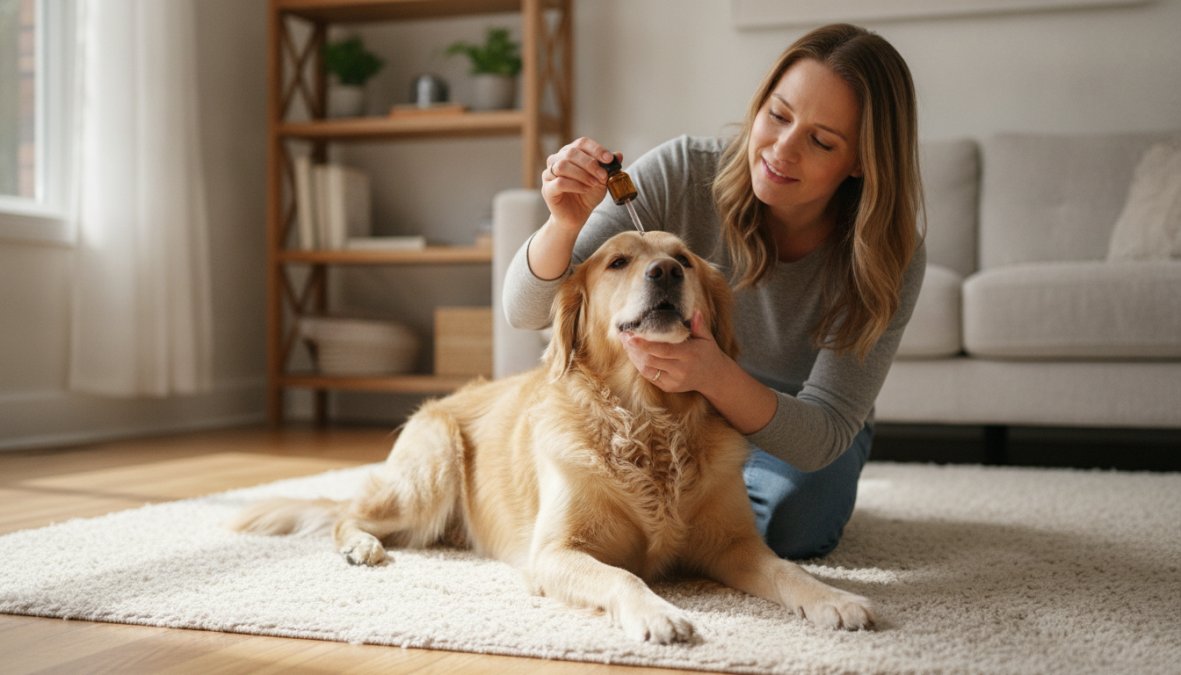
Administer CBD oil drops directly onto your dog’s gums or under the tongue rather than mixing into food. Bioavailability is higher with direct mucosal absorption, and onset is faster than food-mixed delivery.
CBD Dosage for Dogs: How to Find the Right Therapeutic Dose
CBD dosage for dogs is where most owners make their biggest mistakes, almost always starting too high and expecting immediate results. The therapeutic dose depends on body weight, severity of the behavioral issue, product bioavailability, and individual metabolism.
Dosage Titration: Start Low, Adjust Slowly
Dosage titration means starting at the lowest effective dose and increasing gradually until the desired effect is achieved:
- Starting dose: 0.1-0.2 mg of CBD per kilogram of body weight, once daily
- Assessment period: Observe for 5-7 days before changing anything
- Increment: Increase by 0.1 mg/kg if no effect is observed
- Maximum general guideline: Most practitioners suggest staying below 2 mg/kg per day until more clinical data is available
| Dog Weight | Starting Dose | Mid-Range Dose | Upper Guideline |
|---|---|---|---|
| 5-10 kg (11-22 lbs) | 0.5-1 mg CBD | 2-4 mg CBD | 10-20 mg CBD |
| 10-20 kg (22-44 lbs) | 1-2 mg CBD | 4-8 mg CBD | 20-40 mg CBD |
| 20-35 kg (44-77 lbs) | 2-3.5 mg CBD | 8-14 mg CBD | 40-70 mg CBD |
| 35+ kg (77+ lbs) | 3.5-5 mg CBD | 14-20 mg CBD | 70-100 mg CBD |
These are general starting guidelines, not prescriptions. Always confirm with your veterinarian, especially if your dog takes other medications.
Breed-Specific Hyperactivity Protocols
High-drive working breeds (Border Collies, Australian Shepherds, Belgian Malinois) often require higher doses and more frequent administration than companion breeds because their baseline anxiety and arousal thresholds are fundamentally different. Toy breeds present the opposite challenge: small size means even modest doses can tip into lethargy, so titration should be especially gradual. Brachycephalic breeds (French Bulldogs, Pugs) often respond well to CBD for anxiety-related restlessness, but owners should monitor closely for any changes in breathing patterns.
Never extrapolate dosing from human CBD products to pets. Human tinctures often contain concentrations disproportionately high for small animals, and some human formulations include additives like xylitol that are toxic to dogs.
Choosing the Right CBD Product for Hyperactive Pets
The product format matters almost as much as the dose. Different delivery methods have different onset times, bioavailability levels, and practical usability depending on your dog’s temperament.
Tinctures vs. Calming Chews vs. Soft Gels: A Comparison
| Format | Onset Time | Bioavailability | Best For | Drawback |
|---|---|---|---|---|
| Tinctures (oils) | 15-45 min | High (sublingual) | Precise dosing, fast onset | Some dogs resist dropper |
| Calming chews | 30-60 min | Moderate | Easy administration, picky dogs | Harder to adjust dose precisely |
| Soft gels | 45-90 min | Moderate-high | Consistent daily dosing | Slowest onset, harder to split |
Tinctures are the best starting format for dogs new to CBD because they allow precise titration in small increments. Calming chews work well once you’ve established the right dose and need convenience over precision.
Full-Spectrum vs. Broad-Spectrum vs. THC-Free: What Matters for Pets
Full-spectrum CBD contains all cannabinoids including trace THC (legally below 0.3%). Dogs have a higher density of cannabinoid receptors in the cerebellum and brainstem than humans, making them more sensitive to THC’s effects, even trace amounts can cause lethargy, ataxia, and distress in some dogs.
Broad-spectrum CBD retains the full range of non-THC cannabinoids, terpenes, and flavonoids, delivering the "entourage effect" without the THC risk. This is the preferred choice for most pet applications.
THC-free isolate products contain only pure cannabidiol, the safest option for dogs with known sensitivity, but lacking the synergistic compounds that make broad-spectrum formulations more effective.
For most pet owners, broad-spectrum, hemp-derived CBD from a USA-sourced, organically grown supply chain is optimal. CBD Health Collection’s pet wellness products are broad-spectrum, CO2-extracted, and produced in a GMP- and FDA-registered facility, meaning THC-free status is verified rather than assumed.
How to Read a Certificate of Analysis (COA) Before You Buy
A Certificate of Analysis (COA) is a third-party laboratory report that verifies a product’s actual cannabinoid content, confirms THC levels, and screens for contaminants including pesticides, heavy metals, and residual solvents. Any reputable CBD company makes COAs publicly available for every product batch.
Here’s what to check, in order:
- Lab identity: Is the testing lab a third-party facility? Look for ISO 17025 accreditation.
- Cannabinoid panel: Does the CBD content match the label? A 500 mg bottle should test at or near 500 mg.
- THC level: For pet products, confirm THC is at or below 0.3%, and ideally non-detectable (ND) for broad-spectrum claims.
- Contaminant panel: Pesticides, heavy metals (lead, arsenic, cadmium, mercury), and microbials should all show "pass" or "ND."
- Batch number: The COA batch number must match the batch number on your product packaging.
According to U.S. Pharmacopeia guidance on dietary supplement testing, third-party verification is the gold standard for supplement quality assurance. A brand that doesn’t publish COAs is a brand you should skip.
The COA batch number on your product’s label must match the batch number on the COA document. Mismatches mean the test results don’t apply to what you actually purchased.
Side Effects of CBD in Pets: What Owners Need to Know
Side effects of CBD in pets are real, and pretending otherwise does owners a disservice.
The most commonly reported side effects are dose-dependent and typically resolve when the dose is reduced.
Common side effects:
- Lethargy or sedative effects: Almost always a sign the dose is too high. Reduce by 25-50% and reassess.
- Dry mouth: Dogs may drink more water. Not harmful, but worth noting.
- Lowered blood pressure: At high doses, a temporary drop can cause brief unsteadiness after dosing.
- Gastrointestinal upset: Loose stools or reduced appetite, particularly when CBD is introduced too quickly.
What to watch for and when to stop:
Ataxia, vomiting, or extreme lethargy warrant immediate dose cessation and a call to your veterinarian. As noted in Cornell University College of Veterinary Medicine research on CBD in dogs, CBD appears well-tolerated at appropriate doses, though drug interactions with medications metabolized by the liver’s cytochrome P450 enzyme system deserve attention. If your dog takes phenobarbital, cyclosporine, or NSAIDs, discuss CBD use with your vet before starting.
Common Myths About CBD for Pet Hyperactivity, Debunked
Myth 1: "CBD will make my dog high."
False. Broad-spectrum and THC-free CBD products contain no psychoactive THC. The confusion comes from conflating CBD with cannabis products designed for human recreational use.
Myth 2: "More CBD means faster results."
Wrong, and potentially harmful. Higher doses past the therapeutic threshold produce sedative effects, not better calming. The goal is the minimum effective dose, not the maximum tolerated dose.
Myth 3: "CBD works immediately."
Onset depends on delivery format and the individual dog. Tinctures can show effects in 15-45 minutes, but meaningful behavioral changes from consistent use often take 2-4 weeks. Owners who give up after one dose are making a premature judgment.
Myth 4: "All CBD products are the same."
The difference between a COA-verified, organically grown, CO2-extracted broad-spectrum oil and an unverified product from an unknown source is the difference between a known dose of a clean compound and an unknown quantity of an untested one.
Myth 5: "CBD replaces veterinary care."
CBD is a pet wellness supplement, it does not diagnose, treat, or cure any condition. Dogs showing signs of aggression, severe anxiety, or unexplained behavioral changes deserve a full veterinary workup before any supplement is introduced. According to American Veterinary Medical Association position on veterinary CBD, veterinarians are encouraged to discuss cannabis-derived products with clients as part of a complete care conversation.
Conclusion
Finding the right approach to cbd for pet hyperactivity takes patience, observation, and a willingness to treat the whole picture rather than just the symptom. The biggest barrier most owners face is not finding a product, it’s knowing how to evaluate quality, dose correctly, and integrate supplementation with the behavioral work that creates lasting change.
CBD Health Collection offers pet wellness products derived from organically grown, USA-sourced hemp, independently verified through third-party COA testing, and produced in a GMP- and FDA-registered facility. With broad-spectrum formulations designed for optimal bioavailability and a 30-day satisfaction guarantee, it’s a trustworthy starting point for pet owners who want transparency, not guesswork. Get started with CBD Health Collection and give your dog the calm, consistent support they deserve.
Frequently Asked Questions
Does CBD actually help with hyperactive pets?
CBD may help reduce restlessness and canine anxiety by interacting with cannabinoid receptors in the endocannabinoid system, which helps regulate mood and stress responses. While research is still emerging, many pet owners report noticeable calming effects when using hemp-derived CBD alongside consistent behavioral modification. It works best as part of a broader approach that includes physical exercise and mental stimulation rather than as a standalone solution.
How long does it take for CBD to calm a hyperactive dog?
Most pet owners notice initial calming effects within 30 to 60 minutes of administering CBD oil or calming chews, depending on the product's bioavailability and the dog's individual metabolism. Tinctures tend to act faster than soft gels or chews. For ongoing hyperactivity linked to separation anxiety or environmental triggers, consistent daily use over one to two weeks often produces the most noticeable behavioral improvement.
How do I determine the right CBD dosage for my pet's hyperactivity?
A common starting point for CBD dosage for dogs is 1-2 mg of CBD per 10 pounds of body weight, given once or twice daily. Always begin at the lower end and practice dosage titration, gradually increasing every five to seven days while monitoring your dog's response. Factors like breed, age, and severity of hyperactivity affect the ideal dose. Always consult a veterinarian before starting, especially if your dog takes other medications.
What are the side effects of CBD in pets?
The most commonly reported side effects of CBD in pets include mild lethargy, dry mouth, and temporary digestive upset. Sedative effects are rare at therapeutic doses but can occur if too much is given too quickly. CBD derived from organically grown, THC-free hemp and independently verified via a Certificate of Analysis is generally considered safe. Always start with a low dose and monitor your pet closely, and discontinue use if adverse reactions persist.
Is CBD safe for long-term use in pets?
Current evidence suggests hemp-derived CBD is well-tolerated in dogs over extended periods when given at appropriate therapeutic doses. There is no strong evidence of toxicity with long-term use of THC-free, broad-spectrum or full-spectrum products from clean CO2 extraction. However, periodic veterinary consultation is advisable to reassess dosage as your pet ages or if conditions change. Always choose products with third-party lab testing to ensure consistent purity and potency.
Are there natural alternatives to CBD for pet hyperactivity?
Yes. Consistent physical exercise, structured behavioral modification routines, and mental stimulation through puzzle feeders or training sessions are foundational tools for managing a hyperactive dog. Other natural options include calming supplements containing L-theanine or valerian root. CBD for pet hyperactivity works best when layered on top of these strategies rather than used as a replacement. Addressing environmental triggers such as loud noises or schedule changes also plays a significant role.
This article was written using GrandRanker