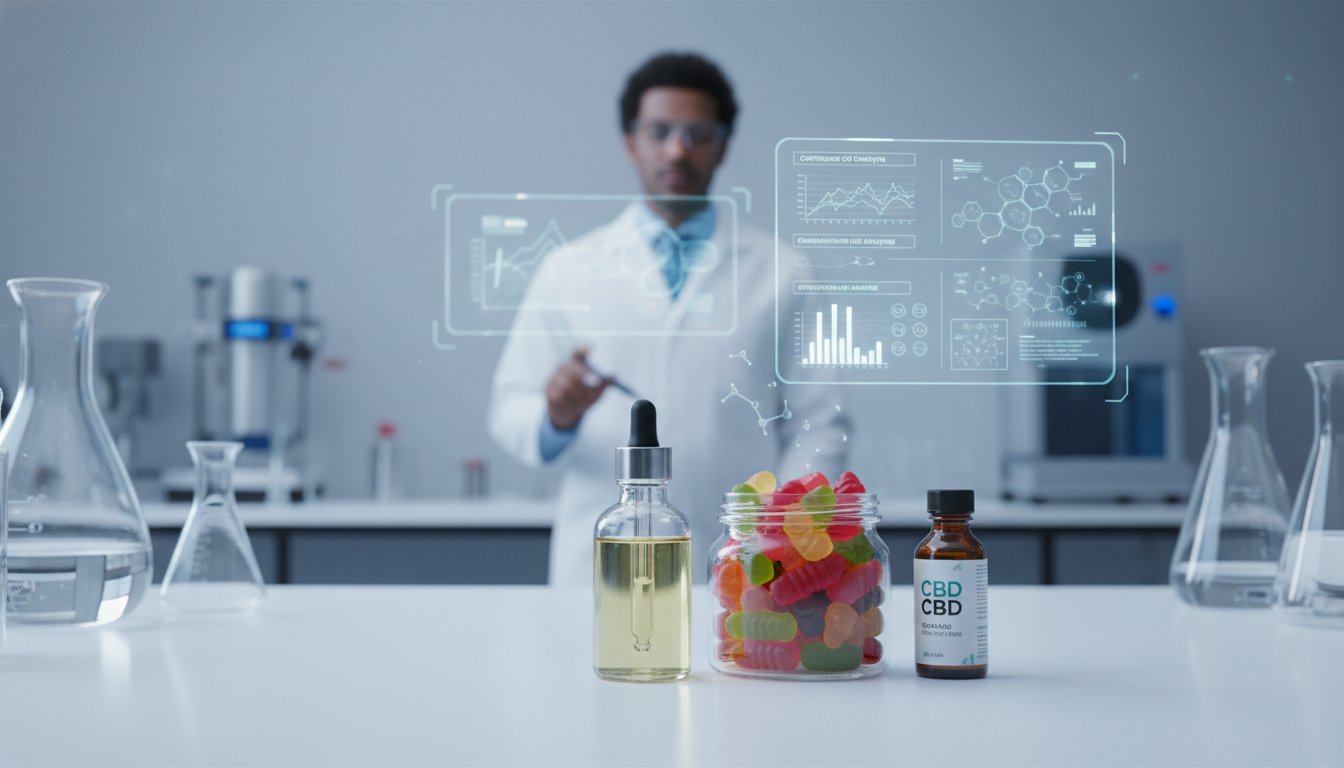
On November 12, 2026, the federal definition of legal hemp changes forever, and many products you currently trust will suddenly become illegal under the new 0.4 milligram total THC limit. This shift, introduced by H.R. 5371, means that finding safe and compliant third-party lab tested cbd products isn’t just about quality anymore; it’s about your peace of mind and legal safety. It’s completely understandable if you feel overwhelmed by these new regulations or worried about hidden heavy metals and pesticides in your supplements. You’re looking for relief, not a science project or a legal headache.
We believe that transparency is the only way to build real trust in the wellness space. This guide will teach you how to master the art of reading lab reports and verify brand claims with total confidence. You’ll learn exactly what to look for in a Certificate of Analysis (COA) so you can distinguish between empty marketing and scientific proof. We’ll provide a clear framework for identifying pure CBD Gummies, capsules, and pet oils that meet the strictest 2026 safety standards. By the end of this article, you’ll have the tools to ensure every product you choose is as pure as nature intended.
Key Takeaways
- Discover why independent validation is the only way to ensure your wellness products are free from harmful contaminants like heavy metals and pesticides.
- Master the simple steps to verify a Certificate of Analysis by matching batch numbers and confirming actual cannabinoid concentrations.
- Learn why choosing third-party lab tested cbd products protects you from the bias and potential inaccuracies of in-house testing methods.
- Get a practical checklist for your next purchase, including how to use QR codes to verify that a lab report is current and valid.
- Understand the importance of a transparent production lifecycle, from organic domestic hemp seeds to the finished goods in your wellness routine.
Why Third-Party Lab Testing is Non-Negotiable in 2026
Trust is the most important ingredient in any wellness routine. When we talk about third-party testing, we’re describing an independent, unbiased evaluation of a product by a lab that has no financial stake in the brand. This process ensures that what you see on the label is exactly what’s inside the bottle. Because the FDA doesn’t currently pre-approve CBD supplements before they reach the shelves, the responsibility for safety verification falls directly on you.
The risks of skipping this step are real. Research indicates that up to 70% of untested CBD products are mislabeled regarding their potency. Without following established Cannabis product testing standards, you may end up with a product that’s far weaker than promised or contains hidden contaminants. While many brands perform “in-house” testing for basic quality control, true transparency only comes from third-party lab tested cbd products. It’s the difference between a student grading their own homework and an official exam.
To better understand how these scientific reports protect you, watch this helpful video:
The Risks of Untested CBD Products
Using untested products can lead to several wellness setbacks. Hemp is a bioaccumulator, meaning the plant naturally absorbs everything from the soil it grows in. If the soil contains heavy metals or pesticides, those toxins can end up in your CBD oil. Beyond environmental toxins, low-quality markets sometimes hide synthetic cannabinoids like “K2” or “Spice” in their formulas to mimic the effects of hemp. There’s also the danger of accidental intoxication. If a product hasn’t been verified, it might contain high THC levels that cause unwanted mind-altering effects, which is exactly what most wellness seekers want to avoid.
The Role of the 2018 Farm Bill in 2026
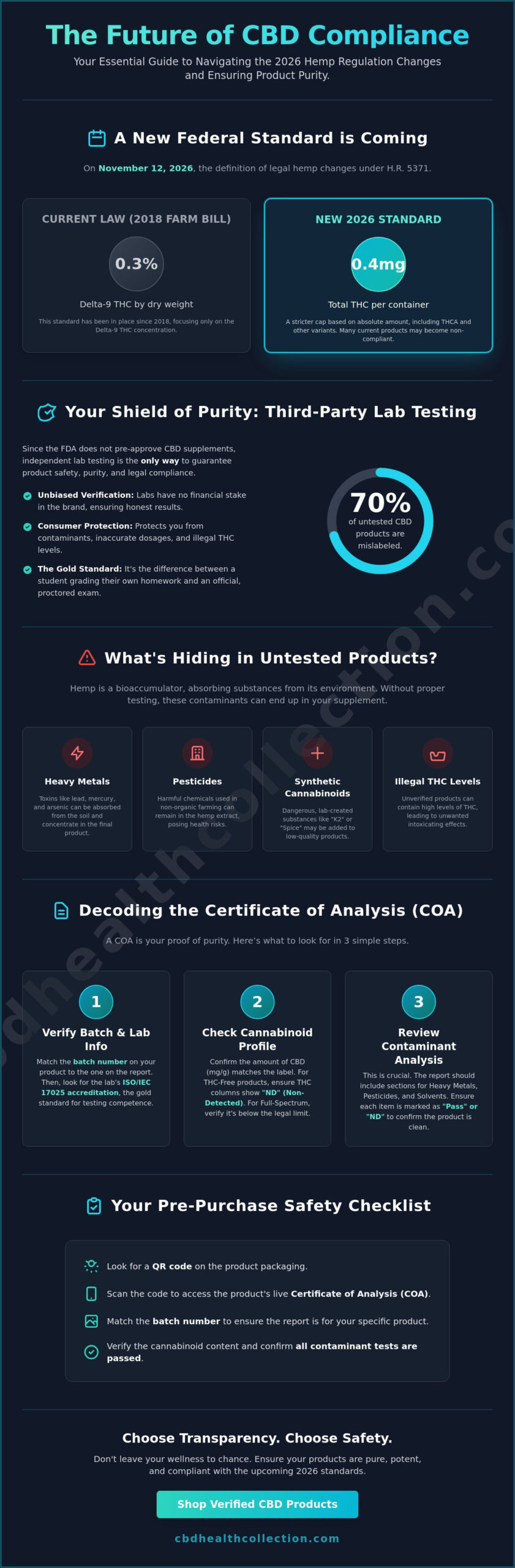
The legal landscape is shifting rapidly. While the 2018 Farm Bill originally set a limit of 0.3% delta-9 THC, new federal regulations under H.R. 5371 change the game on November 12, 2026. The standard is moving to a “total THC” calculation, which includes THCA and other variants. Most importantly, a new cap of 0.4 milligrams of total THC per container will be enforced. This means that many full-spectrum products that were legal yesterday might not be legal tomorrow. Independent labs are the only way to ensure your favorite CBD Gummies or capsules stay within these strict federal and state boundaries. Using third-party lab tested cbd products is now essential for staying compliant with the law while protecting your health.
How to Read a Certificate of Analysis (COA)
A Certificate of Analysis might look like a complex chemistry report, but it’s actually your best tool for peace of mind. To start, always verify the batch number. This unique code on your product’s packaging must match the number at the top of the lab report. If these numbers don’t align, the report doesn’t apply to the specific bottle in your hand. This simple check ensures you are looking at the authentic results for the third-party lab tested cbd products you’ve purchased.
Beyond the batch number, look for the lab’s credentials. A trustworthy report comes from a facility with ISO/IEC 17025 accreditation. This certification proves the lab meets high international standards for technical competence and consistent results. While the FDA’s role in cannabis research continues to evolve, they don’t yet certify individual supplements. This makes ISO accreditation the gold standard for independent verification in the current market.
Decoding the Cannabinoid Profile
The cannabinoid profile shows you exactly what’s providing your relief. You’ll usually see values listed as “Weight %” or “mg/g.” To find the total CBD in your container, multiply the mg/g value by the total grams of product in the bottle. Look for minor cannabinoids like CBG or CBN, which work together to create the “entourage effect.” Full Spectrum products will show a legal trace of THC, while THC-Free products must show “ND” (Non-Detected) in the THC column. Understanding these numbers helps you choose the right CBD products for your specific wellness goals.
The Safety Screen: What You Don’t Want to Find
The safety screen is where the lab checks for “uninvited guests.” In 2026, standards for purity are stricter than ever. You want to see “Pass” or “ND” across four critical categories:
- Heavy Metals: Labs test for lead, arsenic, cadmium, and mercury, which hemp can absorb from the soil.
- Pesticides: This data confirms that “organic” claims are backed by scientific proof rather than just marketing.
- Residual Solvents: This screen ensures no harsh chemicals like butane or ethanol remain from the extraction process.
- Microbial Contaminants: This checks for mold, yeast, and bacteria like E. coli that could develop during storage or production.
By mastering these steps, you can confidently select third-party lab tested cbd products that are truly pure. You deserve to know exactly what you’re putting into your body, and a clean COA is the only way to be certain.
Third-Party vs. In-House Testing: Why the Source Matters
Choosing a wellness product is a personal decision that requires complete honesty from the brand. When you search for third-party lab tested cbd products, you’re looking for an outside perspective. In-house testing is a common practice where a company uses its own equipment to check a batch. While this is helpful for internal quality control, it creates a clear conflict of interest. A brand shouldn’t grade its own homework when your health is on the line. Independent labs provide the unbiased proof you need to feel confident in your choice.
Specialized third-party labs invest in high-precision technology that most manufacturing facilities don’t have. They use validated scientific methods to ensure every drop of CBD oil or every gummy has a consistent concentration. This level of calibration is essential for accuracy. Beyond precision, these independent reports offer legal accountability. They provide verifiable evidence for regulatory bodies that the product meets safety standards. Most accredited labs use two primary methods for testing:
- HPLC (High-Performance Liquid Chromatography): This is used to measure cannabinoid potency with extreme accuracy.
- GC-MS (Gas Chromatography-Mass Spectrometry): This is essential for detecting tiny amounts of pesticides or residual solvents.
The In-House Testing Myth
Some brands claim their products are “lab-tested” but only provide internal spec sheets. These documents are often just marketing summaries rather than actual scientific data. In-house testing is great for maintaining production consistency, but it’s poor for building consumer trust. The truth is that comprehensive third-party testing is expensive. As we explored earlier, a full panel can cost hundreds of dollars per sample. Some companies skip this step to cut corners and lower their costs. You deserve better than a “spec sheet” that hasn’t been verified by an outside expert.
Identifying ISO-Certified Laboratories
The most reliable third-party lab tested cbd products come from labs with ISO/IEC 17025 accreditation. This specific certification means the lab has been audited for technical competence. It ensures their results are reliable and repeatable. You can usually find a lab’s credentials on their official website or by looking for an accreditation seal on the Certificate of Analysis. If a report comes from a lab without this certification, it’s essentially just a marketing flyer. Taking a few minutes to check the lab’s background helps you separate professional science from empty promises.
Practical Checklist: Verifying Your CBD Before You Buy
Buying CBD shouldn’t feel like a leap of faith. You deserve to know exactly what’s in the bottle before you spend your hard-earned money. Most reliable third-party lab tested cbd products now feature a QR code on the packaging. When you scan this with your phone, it should take you directly to a digital Certificate of Analysis (COA). If the code is missing or leads to a generic homepage, that’s your first sign to look elsewhere. You aren’t just looking for any report; you’re looking for the specific one that matches the batch number printed on your product.
Once you have the report open, check the “Report Date” immediately. The CBD industry moves fast, and hemp quality can change between harvests. A report older than 12 months is considered outdated for current inventory. You also want to verify that the “Sample Name” on the lab report matches the name of the product in your hand. Finally, take a quick moment to cross-reference the lab’s contact information. A quick search of the lab’s name and address can confirm it’s a real, accredited facility rather than a fabricated entity.
Red Flags to Watch Out For
Authenticity is everything. Some unscrupulous brands might use “template” reports that look official but lack a specific batch number. This is a major warning sign. You should also look closely at the PDF file itself. Are the fonts inconsistent? Is the lab’s logo blurry while the rest of the text is sharp? These are often signs of an altered document. Another common trick is providing “Potency Only” reports. A report that only shows CBD levels but skips the safety screen for heavy metals and pesticides is incomplete and doesn’t meet the standards for third-party lab tested cbd products.
Shopping for Specific Needs
Your specific wellness goals require different levels of scrutiny. If you’re seeking relief from physical discomfort, ensure your CBD cream for pain relief is tested for skin irritants and residual solvents used during extraction. For those focused on pet wellness, CBD oil for dogs requires even stricter microbial testing, as animals can be more sensitive to mold or bacteria than humans. If you’re managing stress or anxiety, verify the “THC-Free” status on the COA. This is especially important given the new federal 0.4 milligram total THC limit taking effect on November 12, 2026, which makes precise testing even more critical for your peace of mind.
Ready to experience the difference that total transparency makes? Explore our fully verified collection of gummies, capsules, and pet oils today.
The CBD Health Collection Standard: Purity You Can Trace
You’ve learned the technical side of safety and how to spot red flags in a lab report. Now, it’s about finding a wellness partner who puts those rules into practice every single day. At CBD Health Collection, we don’t just follow the industry standard; we aim to set it. Our commitment begins with 100% organic, USA-grown hemp. By managing the process from seed to shelf, we ensure that the soil is clean and the plants are nurtured without synthetic additives. This domestic focus is the foundation of our third-party lab tested cbd products, ensuring that what you put in your body is as pure as nature intended.
We use a rigorous “Triple Check” process to guarantee transparency at every stage of production. This isn’t just a single test at the end of the line. We verify the hemp at the farm, test the raw extract after processing, and then conduct a final independent analysis on the finished good. This multi-stage approach allows us to provide transparent lab results for every single batch of CBD products we offer. Whether you’re reaching for a bottle of capsules or a pet tincture, you can trace its journey back to the very field where it grew.
Our mission is simple: we want to provide natural, reliable solutions for those struggling with pain, stress, and sleep. We know that if a product contains hidden toxins or incorrect cannabinoid levels, it can’t do its job effectively. By prioritizing these rigorous safety protocols, we honor the health of our service-oriented community members who rely on us for consistent, non-intoxicating support in their demanding lives.
From Our Farm to Your Home
Domestic production standards are the secret to cleaner Certificates of Analysis. Because we utilize organic farming practices right here in the United States, our reports consistently show an absence of the harsh pesticides often found in imported hemp. We believe that the best wellness products start with healthy soil and ethical farming. This dedication to purity ensures that our CBD Freeze Gel and oils meet the strict 2026 federal requirements long before they ever reach your doorstep.
Your Journey to Relief Starts with Trust
We make it easy to access the data you need to feel secure. You can find the specific COAs for our CBD gummies and other favorites directly on our website or by scanning the QR code on your package. If you ever feel confused by the terminology or the numbers on a report, our caring customer support team is ready to help you interpret the findings. We’re here to be your knowledgeable guide in the wellness space, ensuring you never have to guess about your safety. Shop our third-party tested CBD collection with confidence today and experience the peace of mind that comes with true purity.
Step Into Your Wellness Future with Confidence
The path to natural relief should be paved with transparency and scientific proof. By learning how to decode a Certificate of Analysis and recognizing the vital role of independent verification, you’ve taken the most important step toward a safer wellness routine. The upcoming federal shifts on November 12, 2026, make it more critical than ever to verify the “total THC” and purity of every batch you buy. When you prioritize third-party lab tested cbd products, you’re choosing biological safety over marketing hype.
You deserve wellness solutions that work as hard as you do. Our standard is built on a foundation of ISO-certified lab testing and USA-grown organic hemp. We provide THC-free options for total peace of mind, ensuring you can find the support you need without any unwanted surprises. Whether you’re looking for comfort for yourself or your loyal companions, we’re here to be your trusted guide in the wellness space.
View our latest lab-tested CBD products for people and pets and start your journey toward pure, verified relief today. You’ve done the research; now it’s time to feel the difference that true quality makes.
Frequently Asked Questions
What does “ND” mean on a CBD lab report?
“ND” stands for “Non-Detected,” which means the lab’s equipment couldn’t find measurable levels of a specific substance. In third-party lab tested cbd products, this is usually what you want to see for pesticides, heavy metals, and THC if you’re using a broad-spectrum formula. It indicates the product is pure and meets strict safety standards for your wellness routine.
How often should a CBD company test their products?
A responsible CBD company should test every single batch they produce. Testing isn’t a one-time event; it’s a continuous commitment to quality. Each harvest and production run can vary, so a unique Certificate of Analysis for every batch ensures that the specific bottle you hold is safe and matches the label’s claims exactly.
Can I trust a CBD brand that only does in-house testing?
It is best to avoid brands that rely solely on in-house testing. While internal checks are helpful for production consistency, they lack the unbiased oversight of an independent facility. Without a third-party report, there’s no way to verify that a brand isn’t overlooking potency issues or hidden contaminants to save on costs.
What is the most important thing to look for on a CBD COA?
The most important thing to look for is a matching batch number and a “Pass” status on the safety screen. You should confirm the batch number on your product’s label matches the one on the report. Then, ensure the product passed tests for heavy metals, pesticides, and mold to guarantee it’s safe for your body.
Is it possible for a CBD product to have 0% THC?
Yes, CBD products can be completely THC-free. CBD isolates and broad-spectrum products undergo additional refinement to remove THC while keeping other beneficial compounds. This is a reliable option for those who want the wellness benefits of hemp without any psychoactive concerns or the risk of accidental THC consumption.
Why do some CBD lab reports show different amounts of CBD than the label?
Minor differences are common because hemp is a natural plant and extraction processes can have slight variances. Most industry standards allow for a 10% to 20% margin of error between the label and the lab result. If the difference is much larger than that, it could be a sign of poor quality control or inaccurate labeling.
How do I know if a CBD lab report is fake?
You can spot a fake report by checking for inconsistent fonts, blurry logos, or missing QR codes. Legitimate third-party lab tested cbd products will have a clear, high-resolution COA from an ISO-certified lab. You can also contact the lab directly to verify that the report number in their system matches the document you’re viewing.
Does third-party testing make CBD more expensive?
Third-party testing is an added production cost, but it’s a necessary investment for your safety. While it might contribute to the final price, the value of knowing your product is free from lead, mercury, and pesticides is immeasurable. Most reputable brands view these costs as an essential part of their commitment to transparency and consumer health.