
Table of Contents
- How Does CBD Work for Stress Inside the Body
- What the Science Says: Clinical Research on CBD and Stress
- CBD Dosage for Stress: How to Find Your Starting Point
- Best CBD Products for Anxiety and Stress: Full-Spectrum vs. Broad-Spectrum vs. Isolate
- How CBD Helps Stress Management Safely: Side Effects and Drug Interactions
- How to Choose a High-Quality CBD Product: Third-Party Testing and Sourcing Transparency
- Legal Status, Common Myths, and What to Ignore
- Conclusion
Last Updated: June 9, 2026
Stress is one of the most pervasive health challenges adults face today, and understanding how cbd helps stress management has become a priority for millions seeking natural alternatives to pharmaceuticals. This guide breaks down the science, practical application, and product choices that matter most. But first, here’s what most guides get wrong: CBD is not a sedative, and it doesn’t eliminate stress. It works by supporting the systems your body already uses to regulate it. That distinction changes everything about how you approach dosage, product selection, and expectations.
How Does CBD Work for Stress Inside the Body
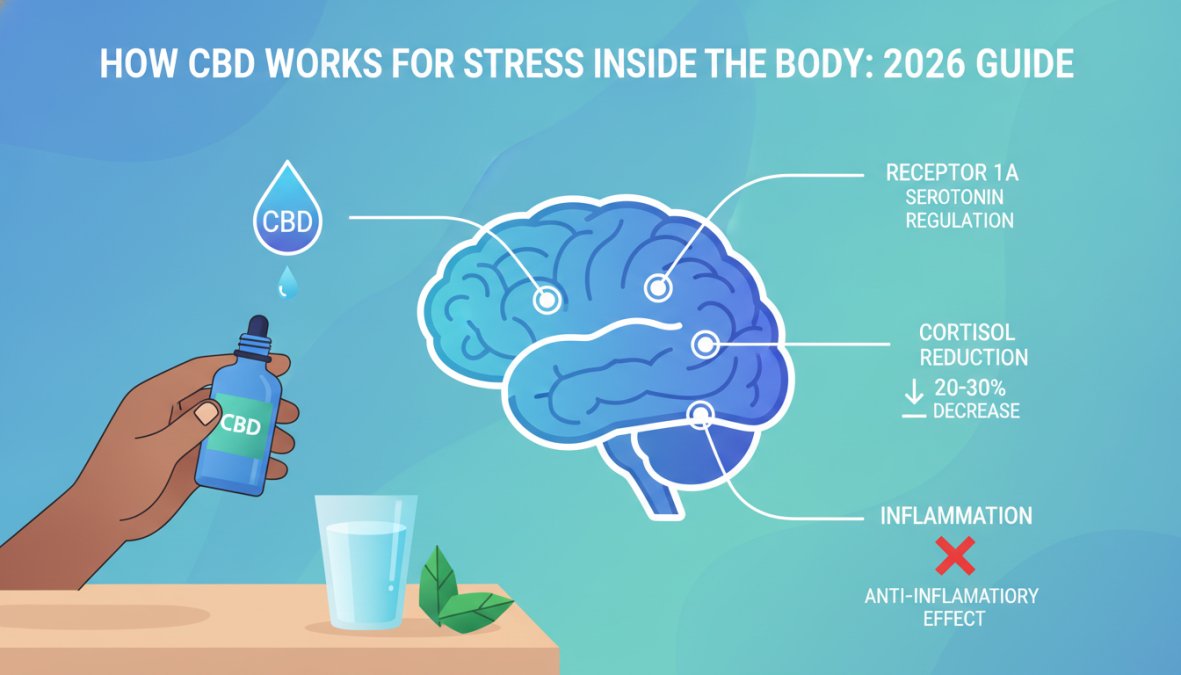
CBD works for stress by interacting with the body’s endocannabinoid system, a regulatory network that governs mood, sleep, pain perception, and the stress response. Understanding this mechanism is the foundation for using cannabidiol effectively.
The Endocannabinoid System and Homeostasis
The endocannabinoid system (ECS) is the body’s master regulatory network, maintaining homeostasis across virtually every major physiological process. When stress disrupts equilibrium, the ECS works to restore balance. Chronic stress can deplete endocannabinoid tone, leaving the system less able to buffer ongoing pressure, this is where hemp-derived cannabidiol enters the picture.
The endocannabinoid system is your body’s built-in stress buffer. CBD supports this system rather than overriding it, which is why effects tend to be modulatory rather than sedating.
CB1 and CB2 Receptors, Serotonin, and the Cortisol Response
CB1 receptors are concentrated in the brain and central nervous system, influencing mood, memory, and stress perception. CB2 receptors are more prevalent in immune tissue, regulating inflammation and somatic symptoms of chronic stress. CBD doesn’t bind directly to either receptor the way THC does; instead, it modulates receptor activity indirectly while also interacting with serotonin receptors (specifically 5-HT1A), which play a central role in anxiety and emotional regulation.
The cortisol response is another key mechanism. Elevated cortisol over time contributes to anxiety, poor sleep, and immune suppression. According to research published in the National Library of Medicine on cannabidiol pharmacology, CBD appears to influence the hypothalamic-pituitary-adrenal (HPA) axis that controls cortisol release, though precise mechanisms are still being studied. CBD acts across multiple receptor systems simultaneously, which explains both its broad potential and the variability in individual responses.
What the Science Says: Clinical Research on CBD and Stress
Clinical research on CBD and stress is genuinely promising, but the honest picture is more qualified than many wellness brands suggest.
Placebo-Controlled Trials and Anxiolytic Effects
Placebo-controlled trials have examined CBD’s anxiolytic effects across contexts ranging from generalized stress to performance anxiety, with many participants reporting meaningful reductions in subjective stress measures versus placebo. What the research consistently shows is that CBD’s effects appear dose-dependent and context-sensitive: lower doses tend to produce alerting effects, while moderate doses are more commonly associated with calming outcomes. As documented in Harvard Health Publishing’s overview of CBD evidence, CBD has shown the most consistent evidence for anxiety-related conditions, though large-scale trials are still needed to establish standardized dosing protocols.
CBD for Specific Stress Triggers: Sleep, Social Anxiety, and Somatic Symptoms
Social anxiety is one of the most studied applications, with multiple trials showing CBD reduced anxiety in simulated public speaking scenarios. Sleep disruption is another active area, with preliminary findings suggesting CBD may reduce sleep-onset time and improve quality in stress-affected individuals.
Somatic symptoms, muscle tension, headaches, gastrointestinal discomfort, represent a less-discussed but clinically relevant category. CBD’s interaction with both the endocannabinoid system and peripheral pain pathways means it addresses the physical dimension of stress, not just the psychological one. This is where a topical product like CBD Health Collection’s freeze gel becomes relevant beyond simple pain relief: addressing somatic and psychological components simultaneously is a more complete approach than targeting mood alone.
CBD Dosage for Stress: How to Find Your Starting Point
CBD dosage for stress is the question most people get wrong. There is no universal dose, effective amounts vary based on body weight, metabolism, stress severity, and delivery method. Starting too low produces no effect; starting too high wastes product and makes it harder to identify what works.
Titration: The Low-and-Slow Method
Titration means starting at a low dose and incrementally increasing until you find the minimum effective amount. A common starting point is 10-15mg daily. A practical protocol:
- Start with 10mg daily, taken at the same time each day
- Hold for 5-7 days and note changes in stress levels, sleep, or mood
- If no effect, increase by 5-10mg and repeat the observation period
- Continue until you identify a dose that produces a noticeable but not sedating response
- Maintain that dose for 30 days before reassessing
Skipping titration and starting at high doses is the most common CBD mistake. It wastes product, makes it harder to identify your effective dose, and can produce unwanted side effects including drowsiness or mild digestive discomfort.
Bioavailability by Administration Method
Bioavailability is the percentage of a dose that reaches systemic circulation. Sublingual administration (tincture held under the tongue for 60-90 seconds) produces higher bioavailability than oral ingestion because it bypasses first-pass liver metabolism. Soft gels and gummies absorb through the digestive tract, reducing bioavailability but extending duration. Topical products act locally with minimal systemic absorption.
CBD Health Collection’s water-based formulation is specifically designed to optimize bioavailability, addressing a core limitation of standard oil-based products. Fat-soluble cannabinoids have inherently lower absorption in the aqueous digestive environment; water-based delivery changes that equation.
Best CBD Products for Anxiety and Stress: Full-Spectrum vs. Broad-Spectrum vs. Isolate
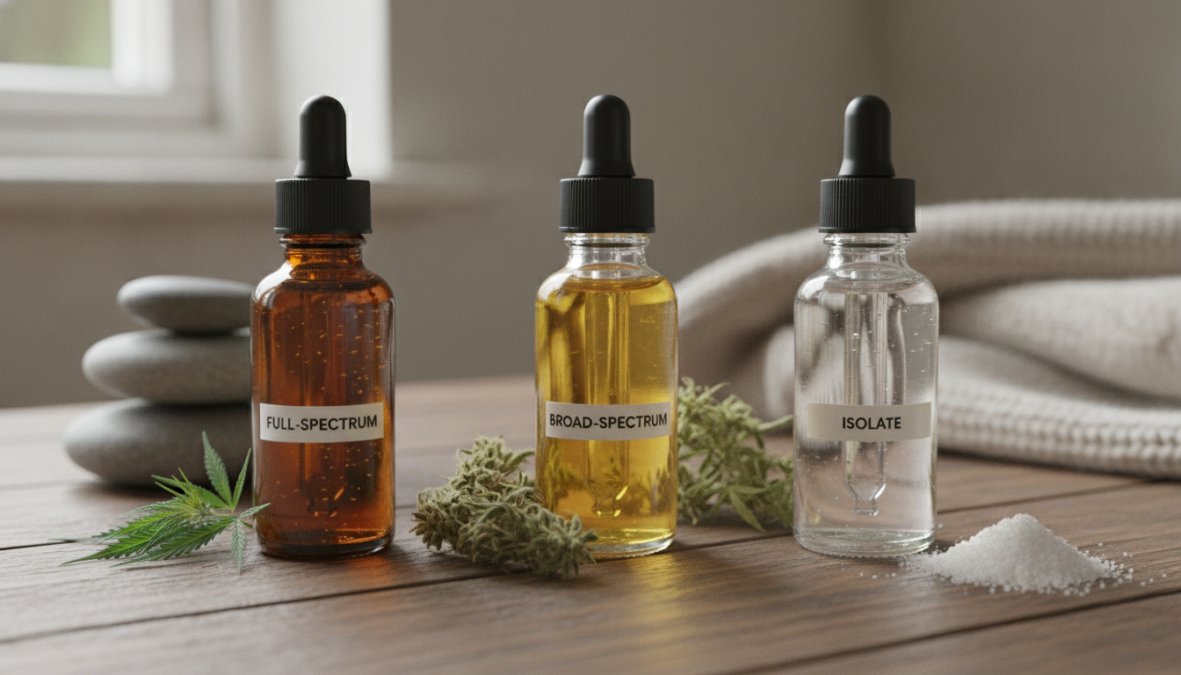
Full-spectrum CBD contains all naturally occurring cannabinoids, terpenes, and flavonoids from hemp, including trace THC (below 0.3%). The combined action of these compounds, the "entourage effect", may produce stronger therapeutic outcomes than isolated cannabidiol alone.
Broad-spectrum CBD retains the full range of hemp compounds except THC, making it the preferred option for people subject to drug testing who still want the entourage effect.
CBD isolate is pure cannabidiol with all other compounds removed, the most predictable for dosing and genuinely THC-free, but lacking synergistic compounds that may enhance efficacy.
Comparison Table: Tinctures, Gummies, Soft Gels, and Topicals
| Product Type | Onset Time | Duration | Bioavailability | Best For |
|---|---|---|---|---|
| Sublingual Tincture | 15-30 min | 4-6 hours | Moderate-high | Daily stress, flexible dosing |
| Broad-Spectrum Gummies | 45-90 min | 6-8 hours | Moderate | Consistent daily use, convenience |
| Soft Gels | 45-90 min | 6-8 hours | Moderate | Precise dosing, travel |
| Topical Freeze Gel | 10-20 min (local) | 2-4 hours | Minimal systemic | Somatic stress symptoms, muscle tension |
| Pain Patches | 30-60 min | 8-12 hours | Low-moderate | Extended relief, overnight use |
(/best-cbd-for-sleep-and-anxiety/) Products for Anxiety and Stress: Full-Spectrum vs. Broad-Spectrum vs. Isolate]
CBD Health Collection offers the full range of these formats, all derived from organically grown, USA-sourced hemp and produced in a GMP- and FDA-registered facility, with independently verified third-party lab results on every product.
How CBD Helps Stress Management Safely: Side Effects and Drug Interactions
CBD has a favorable safety profile compared to many pharmaceutical anxiolytics, but it is not without considerations.
Known Adverse Effects and Who Should Use Caution
The most commonly reported adverse effects include dry mouth, drowsiness at higher doses, mild digestive disturbance, and appetite changes, generally dose-dependent and often resolving as the body adjusts. Certain populations should consult a physician before starting CBD:
- Pregnant or breastfeeding individuals
- People with liver conditions (CBD is metabolized hepatically)
- Individuals with low blood pressure
- Those taking medications with a narrow therapeutic index
Drug-Drug Interactions: What to Check Before You Start
CBD is metabolized by the cytochrome P450 (CYP450) enzyme system, the same pathway responsible for processing a large proportion of common medications. When CBD inhibits CYP450 activity, it can raise or lower plasma concentrations of co-administered drugs to potentially unsafe levels. Medications warranting particular attention include blood thinners (especially warfarin), certain antiepileptics, immunosuppressants, and some antidepressants. The FDA’s consumer information page on CBD specifically flags drug interactions as a key concern and recommends consulting a healthcare provider before combining CBD with prescription medications. This is not a reason to avoid CBD, it’s a reason to have a five-minute conversation with your prescribing physician first.
How to Choose a High-Quality CBD Product: Third-Party Testing and Sourcing Transparency
The CBD market remains largely unregulated at the federal level, meaning product quality varies enormously between brands. Third-party testing is the single most important quality signal, and it’s non-negotiable.
Reading a Certificate of Analysis (COA)
A certificate of analysis (COA) is issued by an independent laboratory and verifies cannabinoid content, contaminant levels, and purity. Every reputable brand should make COAs publicly accessible for every product batch. When reviewing a COA, check for:
- Cannabinoid panel confirming CBD potency matches label claims
- THC content at or below 0.3% (or non-detectable for THC-free products)
- Heavy metals testing (lead, mercury, arsenic, cadmium)
- Pesticide residue screening
- Microbial contamination results
- Residual solvents panel
- Batch number matching the product you purchased
A COA that only tests cannabinoid content is incomplete. Full-panel testing is the standard serious brands meet.
Cross-reference the batch number on your product packaging with the COA on the brand’s website. If the numbers don’t match, the COA doesn’t apply to your product. This is a common quality-control gap that most buyers never check.
Sustainability, Hemp Sourcing, and CO2 Extraction
Hemp is a bioaccumulator, it absorbs compounds from the soil it grows in, including heavy metals and pesticides. Organically grown, USA-sourced hemp is a meaningful quality differentiator, not just a marketing claim. CO2 extraction is the cleanest available method for isolating cannabinoids, using pressurized carbon dioxide that leaves no chemical residue and preserves the full cannabinoid and terpene profile. CBD Health Collection uses CO2 extraction exclusively and sources hemp from domestic organic farms, with every batch independently tested.
Legal Status, Common Myths, and What to Ignore
Hemp-derived CBD with less than 0.3% THC is federally legal in the United States under the 2018 Farm Bill. It is not the same as marijuana, it is not psychoactive, and it will not produce a "high." The most persistent myths worth addressing directly:
Myth: CBD is the same as marijuana. Hemp-derived CBD contains negligible THC and produces no intoxicating effects. The pharmacology is fundamentally different.
Myth: More CBD is always better. The dose-response curve for CBD is bell-shaped in some applications, higher doses are not linearly more effective and can sometimes reduce efficacy.
Myth: CBD works immediately. Sublingual tinctures act within 15-30 minutes; oral formats take 45-90 minutes. Systemic effects for stress management often become more apparent after consistent use over several weeks.
Myth: All CBD products are equivalent. Extraction method, hemp source, and formulation all affect outcomes significantly. A poorly made isolate and a well-formulated broad-spectrum product are not comparable.
According to the Brightfield Group’s CBD consumer research, stress and anxiety relief consistently rank among the top reasons consumers use CBD products, reflecting both the scale of the need and the gap left by conventional options.
Managing stress effectively requires addressing both the neurological and physiological dimensions of the stress response, and that’s exactly where a science-based CBD approach has genuine utility. CBD Health Collection was founded by a pharmaceutical industry veteran to bring that rigor to consumer CBD products: organically grown, CO2-extracted, independently lab-tested, and formulated for optimal bioavailability. Every product ships free nationwide and comes with a 30-day satisfaction guarantee. Get started with CBD Health Collection and experience a stress management approach grounded in pharmacology, not just wellness marketing.
Frequently Asked Questions
Does CBD actually help with stress and anxiety?
CBD shows meaningful promise for stress-associated anxiety based on early clinical trials and placebo-controlled studies. It appears to interact with serotonin receptors and the endocannabinoid system to support a calmer cortisol response. While research is ongoing and CBD is not a cure for any mental health disorder, many users report noticeable relaxation and reduced somatic symptoms. Results vary by individual body chemistry, product quality, and consistent use.
What is the best way to take CBD for stress management?
Sublingual tinctures are widely considered one of the most effective administration methods for stress because the CBD absorbs directly into the bloodstream, offering higher bioavailability and faster onset, typically 15 to 45 minutes. Soft gels and gummies offer convenience and consistent dosing but take longer to work. For CBD dosage for stress, starting low (10-15 mg) and titrating slowly upward every few days helps you find your personal effective dose without overshooting.
How long does it take for CBD to work for stress?
Onset time depends on the administration method. Sublingual tinctures typically produce effects within 15 to 45 minutes. Gummies and soft gels can take 45 minutes to 2 hours because they pass through the digestive system first. Consistent daily use over 2 to 4 weeks may be needed to notice cumulative benefits, as cannabidiol builds up in the body's endocannabinoid system over time. Patience and consistent titration are key to finding what works for you.
Are there side effects or drug interactions I should know about?
CBD is generally well tolerated, but potential adverse effects include dry mouth, drowsiness, changes in appetite, and mild digestive upset. More importantly, CBD is metabolized by the liver's cytochrome P450 enzyme system, meaning it can interact with medications like blood thinners, antidepressants, and certain anticonvulsants. Always consult a healthcare provider before starting CBD, especially if you take prescription medications, and check a drug-drug interaction resource to assess your specific risk profile.
Is CBD legal and safe for daily stress management?
Hemp-derived CBD containing less than 0.3% THC is federally legal in the United States under the 2018 Farm Bill, though state laws vary. THC-free broad-spectrum and isolate products are non-psychoactive and widely available. For daily use, safety depends heavily on product quality, always choose brands that provide third-party testing and a certificate of analysis (COA) confirming purity and potency. CBD Health Collection products are independently lab-tested and produced in a GMP- and FDA-registered facility for added assurance.
What is the difference between full-spectrum, broad-spectrum, and CBD isolate for stress?
Full-spectrum CBD contains all hemp cannabinoids including trace THC (up to 0.3%), potentially amplifying therapeutic potential through the entourage effect. Broad-spectrum retains multiple cannabinoids but removes THC entirely, a strong choice for those who want cannabinoid synergy while remaining THC-free. CBD isolate is pure cannabidiol with no other compounds, offering precise dosing but without entourage benefits. For stress management, broad-spectrum is often recommended as a balanced middle ground with good anxiolytic effects and no psychoactive risk.
This article was written using GrandRanker